
The Kia EV5 is a medium SUV ideal for families ready to embrace electric vehicles, offering an impressive array of features, superb build quality and a feel of luxury seldom found at this price point.
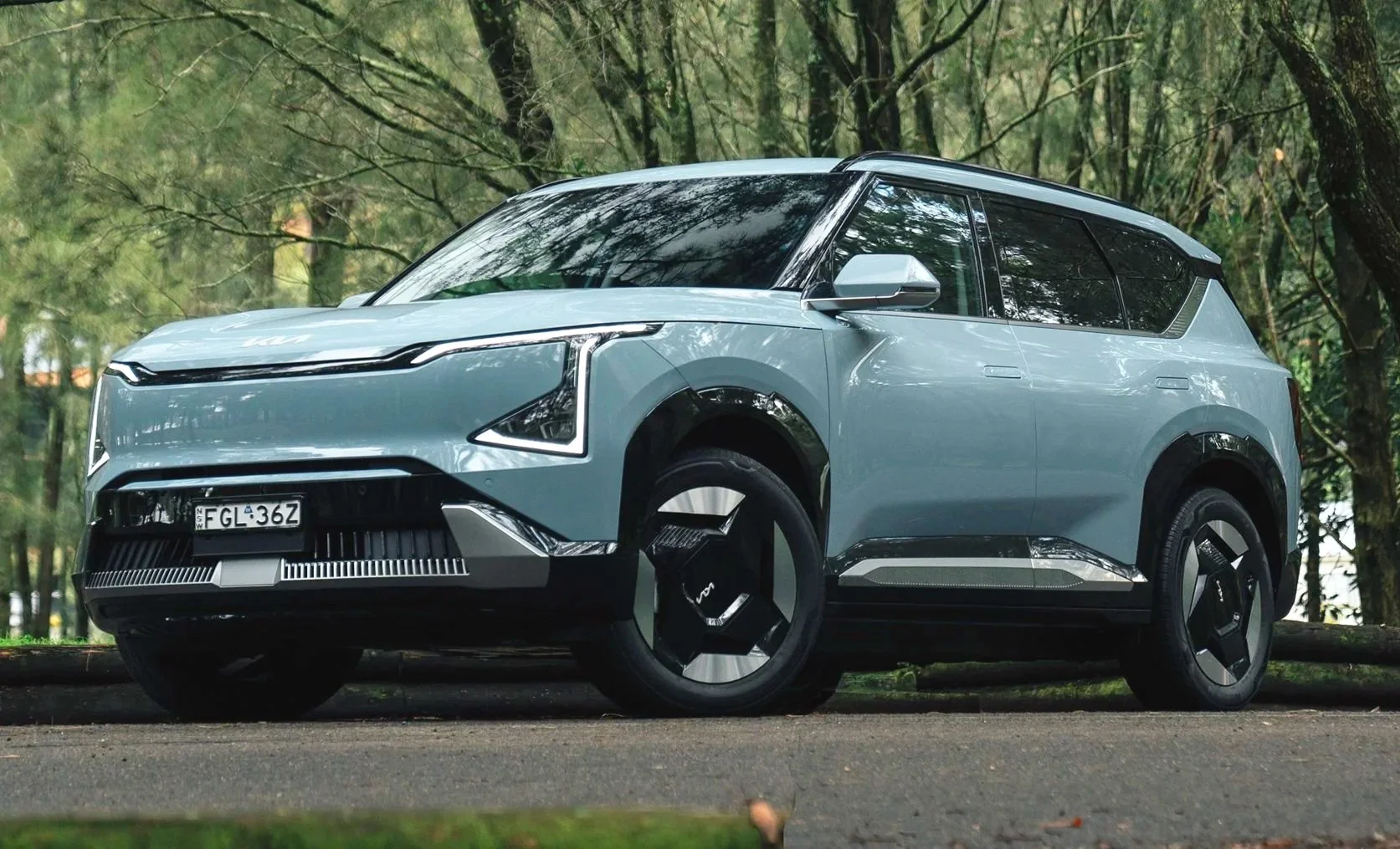
The Kia EV5 is more than just a fully electric Sportage, especially if you want that level of sophistication you historically only got from notionally premium German brands, but for a considerable saving.
The EV5 is supremely quiet, remarkably well tuned for Australian roads and offers a spacious cabin ideal for busy families who need a do-everything suburban SUV and daily city commuter.
To give you some perspective on how popular the EV5 is in the context of buying a luxury electric 5-seat midsize SUV, it’s currently outselling the Audi Q5, the Mercedes GLC, the Lexus NX, Mazda’s CX-60, the Hyundai Ioniq 5, Toyota bZ4x and the Skoda Enyaq. The only models of importance that are outselling the EV5 are the Zeekr 7X and the BMW X3.
Not only does the EV5 sell well against other Euro, Japanese and Korean brands in the over-$60K medium SUV segment, it also competes very well against the influx of Chinese EVs which have become famous for their high value offerings, particularly where it relates to EV pricing.
The reason Kia is holding its own against the Chinese rivals is that the EV5 plays both games very well. It’s still in the realm of affordability starting at $50,000, but it’s also feels like it should be a six-figure vehicle in terms of refinement. This is a dark art Kia and Hyundai have mastered over the last 10 years and they’ve clearly shown that going too cheap can cheapen the brand’s appeal, which is why you can also have an EV5 with thick layers of prestige for about $76,000.
This Korean-led onslaught of affordable luxury began with the Kia Stinger GT back in 2017 which felt like a premium German Autobahn-honed missile, and since then Kia hasn’t stopped making it’s ordinary family SUVs feel like you’re in a first-class lounge. Something like Sorento, Carnival and the Tasman all feel like they defy the market segment they’re relegated to and the EV5 continues this theme.
There’s nothing ugly to look at, nothing feels overtly tacky or cheap to touch or manipulate with your fingers, and the sound attenuation feels anechoic in nature. And then we get to the driving experience which is not only typical of the smoothness of EVs, but it’s engineered to be good at handling and dynamics on our particularly rough roads here in Australia.
Let’s look at exactly what you get so you can see which spec-level will suit your budget and requirements.
Download the official Kia EV5 spec sheet here >
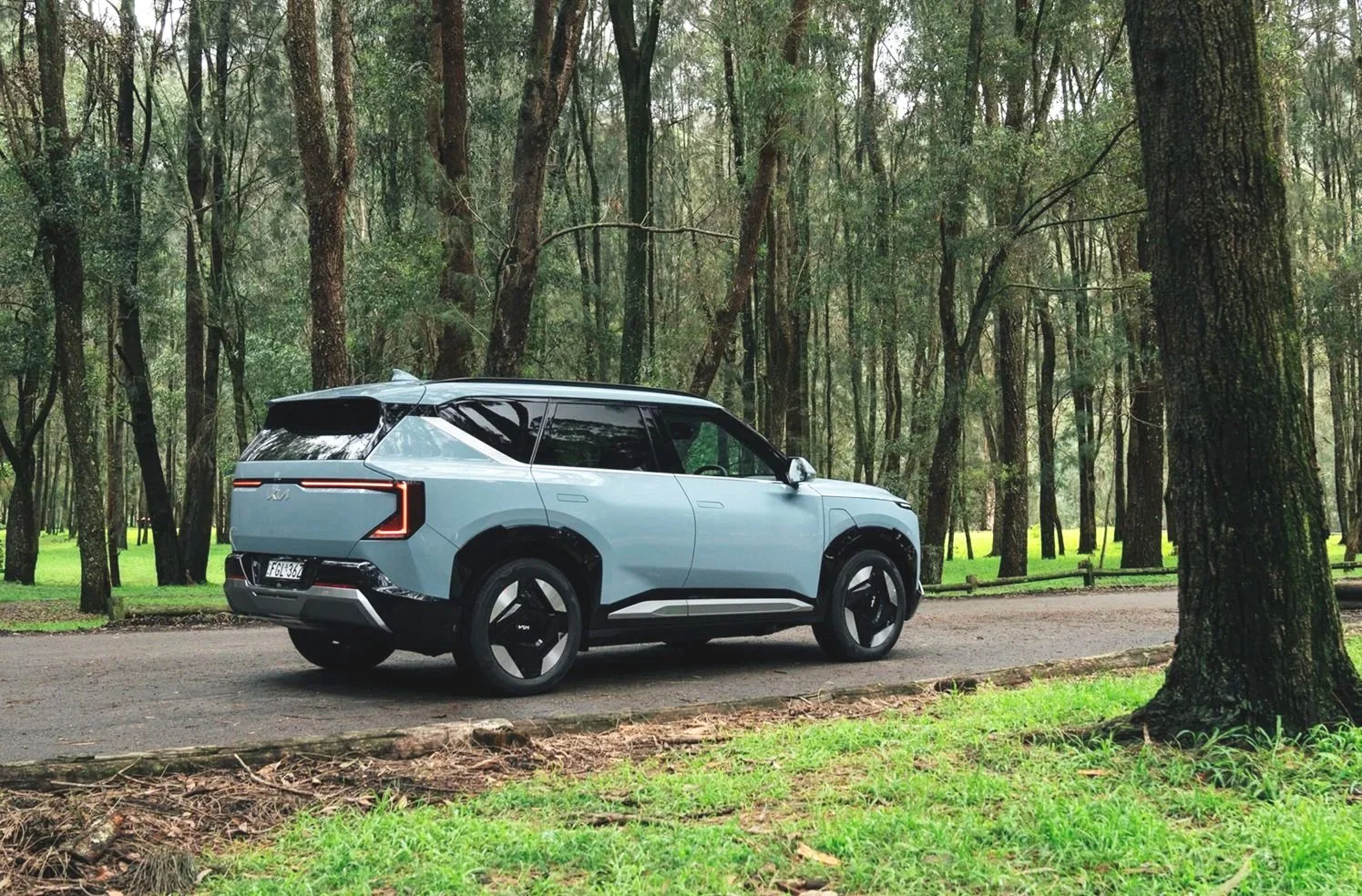
FEATURES & PRICING
EV5 AIR (standard range) | $50,000
64 kWh LFP batt., 400 km range (claimed), single-motor, FWD, 160kW
includes:
18-inch alloy wheels (no spare; tyre repair kit)
Cloth + faux leather seat trim
8-way electric driver's seat, 4-way electric lumbar adjustment, 3-stage seat massage
4-Way manually adjusted front passenger seat
Heated front seats
Dual-zone climate control
12.3-inch driver’s digital display, 5-inch climate display + 12.3-inch infotainment touchscreen
Apple CarPlay and Android Auto (wired and wireless), satnav
Six-speaker stereo system
Front and rear parking sensors, reversing camera
Adaptive cruise control with stop-and-go
Highway Drive Assist 2 with lane-change assist
Blind-spot monitoring and rear cross-traffic collision avoidance
LED headlights (auto dusk sensing) and tail lights, auto high beam, timed escort function
Electric, heated, auto-folding door mirrors
Power windows, automatic headlights and rain-sensing wipers
Vehicle-to-load (V2L) interior socket
Reclining 2nd row seats (60:40 split folding), centre armrest
EV5 AIR (long range) | $60,000
88 kWh LFP batt., 555 km range (claimed), FWD, 160kW
adds no features. Changes include:
Ground clearance: down from 175mm to 161mm
Tare weight increases: 1901kg to 2054kg
GVM increases from 2340kg to 2490kg
EV5 EARTH | $65,000
64 kWh LFP batt., 500 km range (claimed), dual-motor, AWD, 230kW
adds:
19-inch alloy wheels (no spare; tyre repair kit)
Gloss-black roof rails and side-skirts
Privacy glass for rear windows and tailgate
Electric tailgate (height-adjustable, smart)
Faux leather seat trim
Bronze-finish interior trim | Nougat Beige interior option
Electric child-proof rear door locks
External V2L adaptor, in addition to the interior V2L socket
Changes include:
11 kW three-phase AC charging
Max. braked towing capacity increases: 300 kg to 1250kg
Maximum towball download increases: 50kg to 100kg
EV5 GT-LINE | $76,000
64 kWh LFP batt., 500 km range (claimed), dual-motor, AWD, 230kW
adds:
20-inch alloy wheels
Parking collision avoidance (reverse, side, forward)
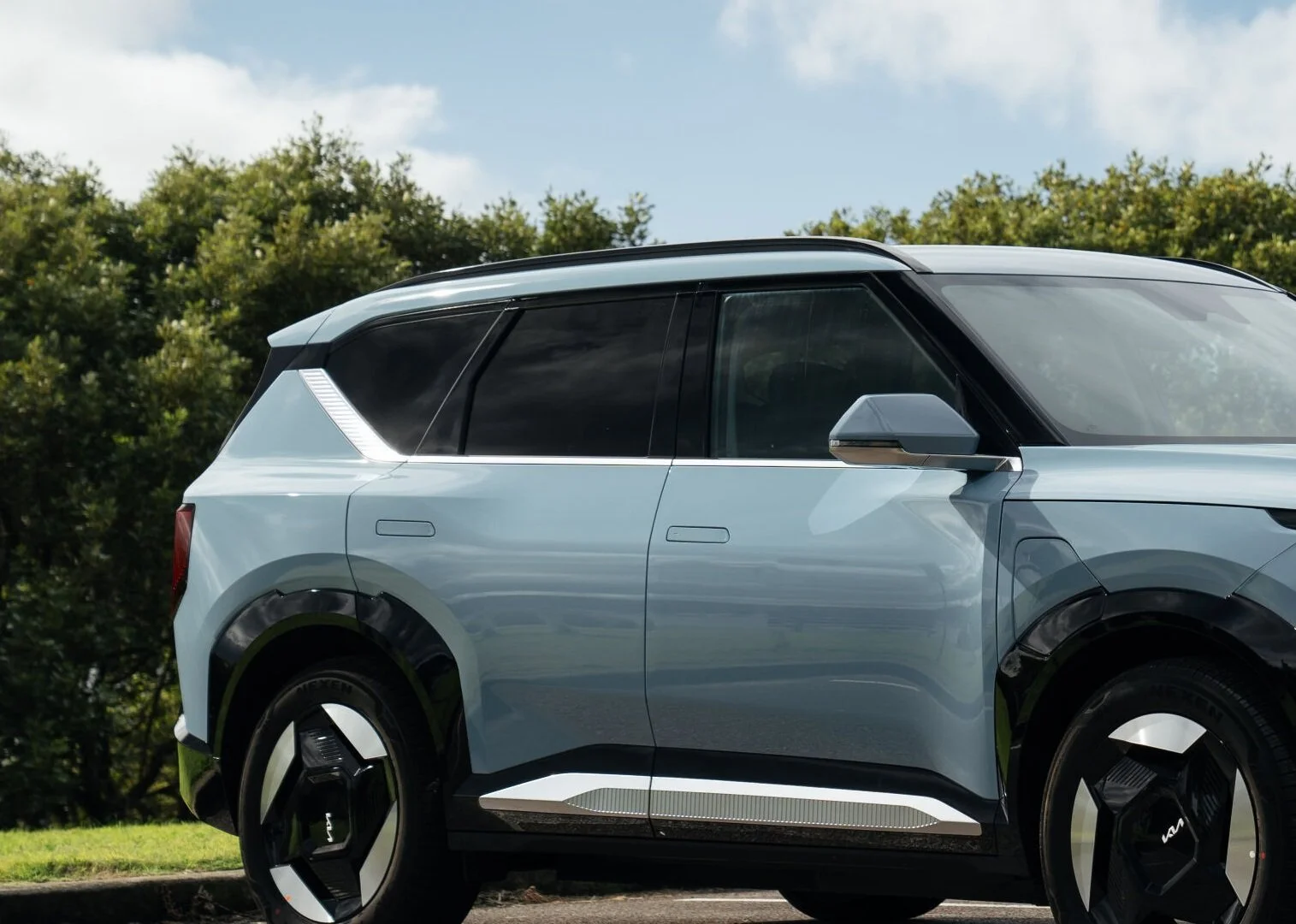
Automatic flush-fitting door handles
Panoramic sunroof
GT-Line artificial leather upholstery with two-tone styling
Four-way power-adjustable front passenger seat with four-way power lumbar adjustment
‘Premium relaxation’ driver's seat incl. powered leg rests
Driver's seat memory for two positions
Driver's seat massage (six-stage)
Front passenger massage (three-stage)
Heated outer rear seats
Ventilated (cooled) front seats
Heated steering wheel
Three-spoke sports steering wheel
Ambient mood lighting
Wireless phone charging
Heated and cooled rear sliding storage tray
Pop-up luggage board
Rear seat-back table behind the front passenger seat
Alloy sports pedals
Head-up display
Harman/Kardon 8-speaker premium audio system
Surround View Monitor with 3D view
Blind Spot View Monitor
Parking Collision Avoidance Assist for reversing, side and forward manoeuvres
Remote smart parking assist 2
Fingerprint authentication
Active sound design
Dynamic LED turn indicators
Laminated driver's window glass
Two-tone exterior paint options
GT-Line-specific exterior styling
Gloss-black door mirrors and window trims
INTERIOR
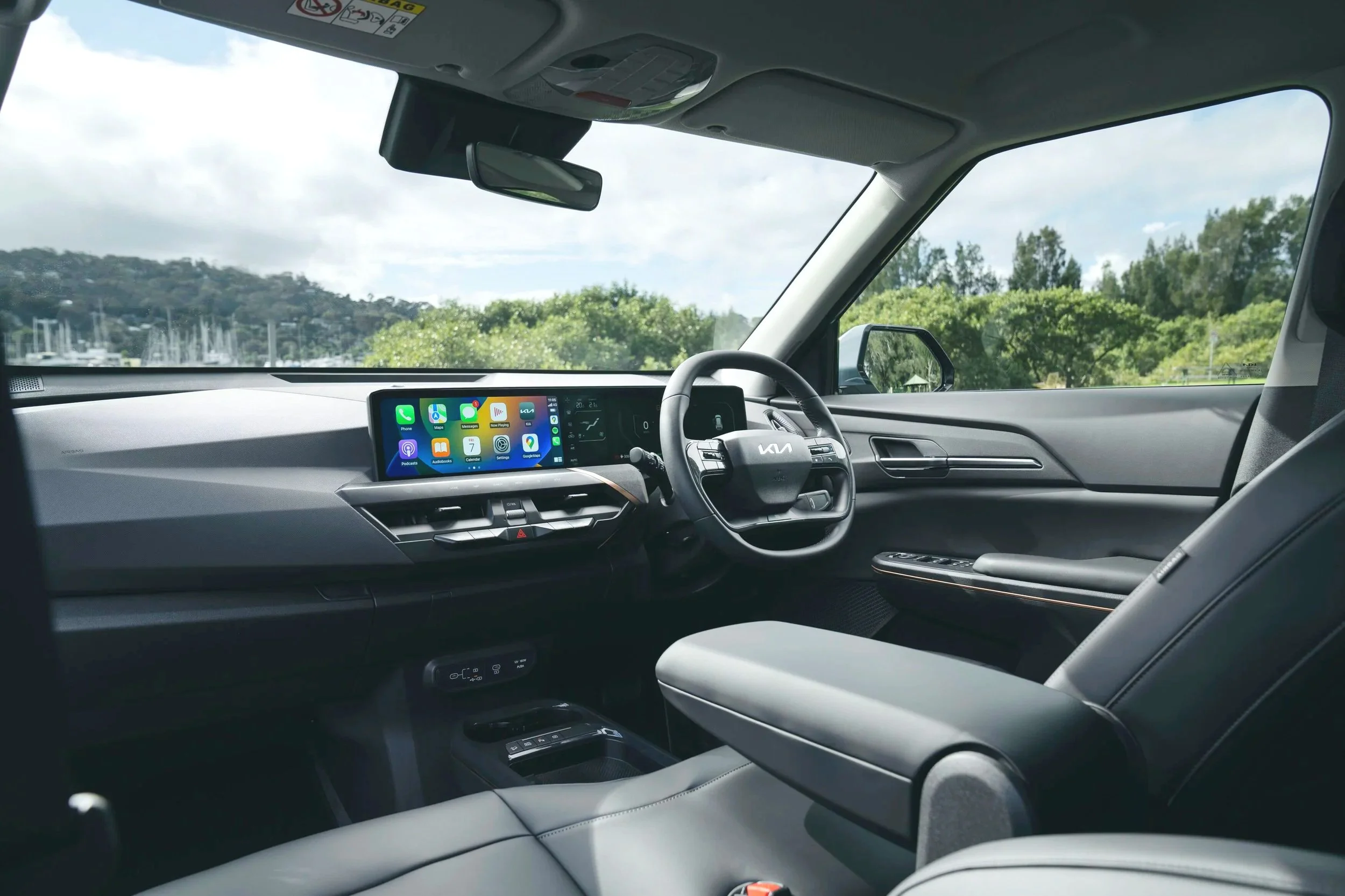
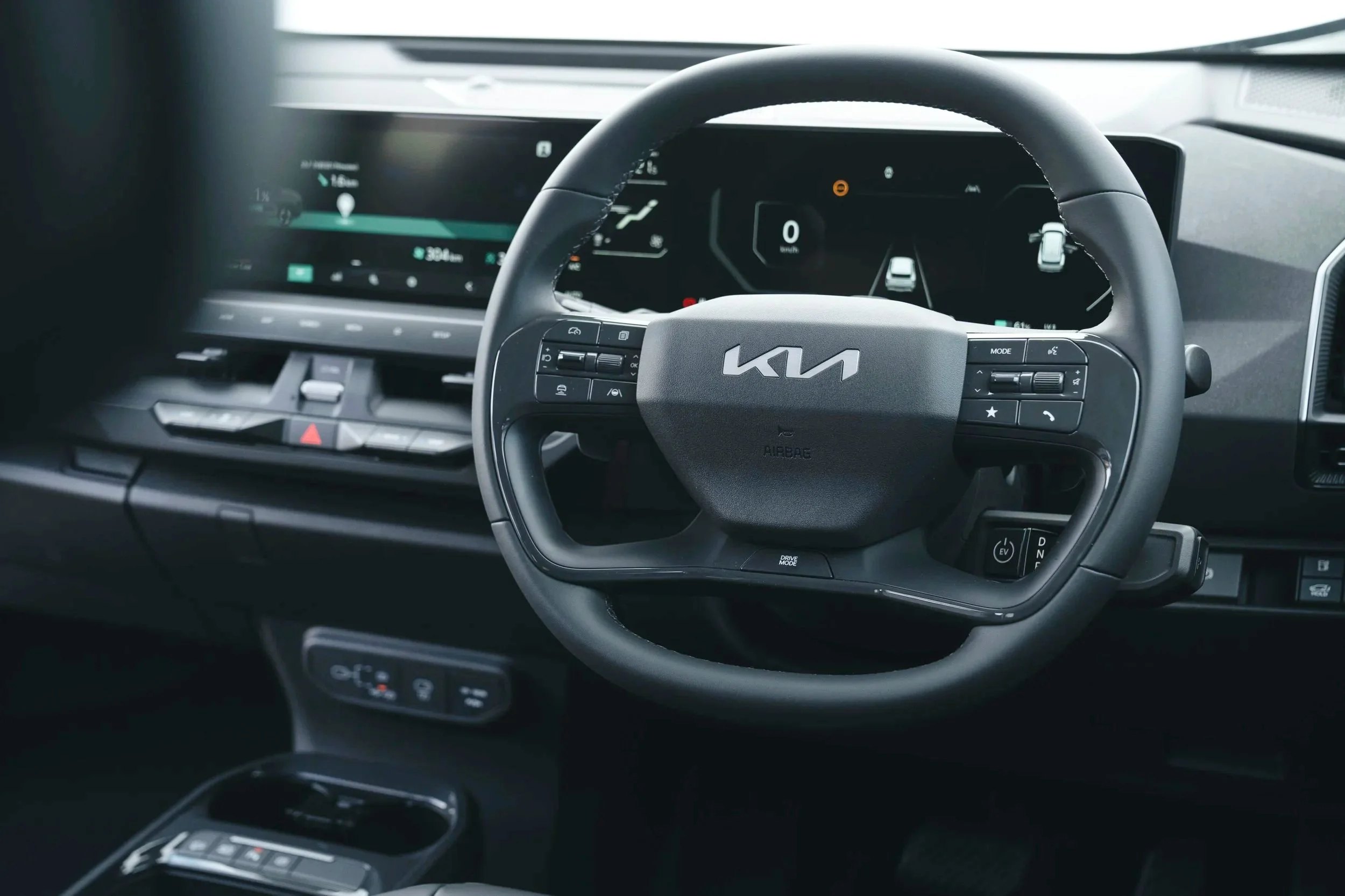
The interior of a Kia EV5 offers plenty of familiarity in terms of design from other Kia products, such as the steering wheel design and layout, the ultra-wide panoramic infotainment screen and driver’s display with the characteristic central climate/AC mini display in the middle, and of course there’s the central console and cupholders.
But they haven’t just duplicated the interior of a Sportage or the smaller EV3 and called it a day. There are still tactile buttons which mean less diving into the touchscreen for those respective settings, and they’ve actually given the steering wheel a unique look that reduces the visual affect of 9 buttons, 2 scroll wheels, 2 up/down tabs and 4 spokes might have on the user.
They go further, however, to make it differentiate from other Kias by the addition of a pivot hinge centre armrest in the front which looks remarkably like a pinball machine flipper. You also get a distinctive central lower seatbase extension which is very close to becoming a front bench seat.
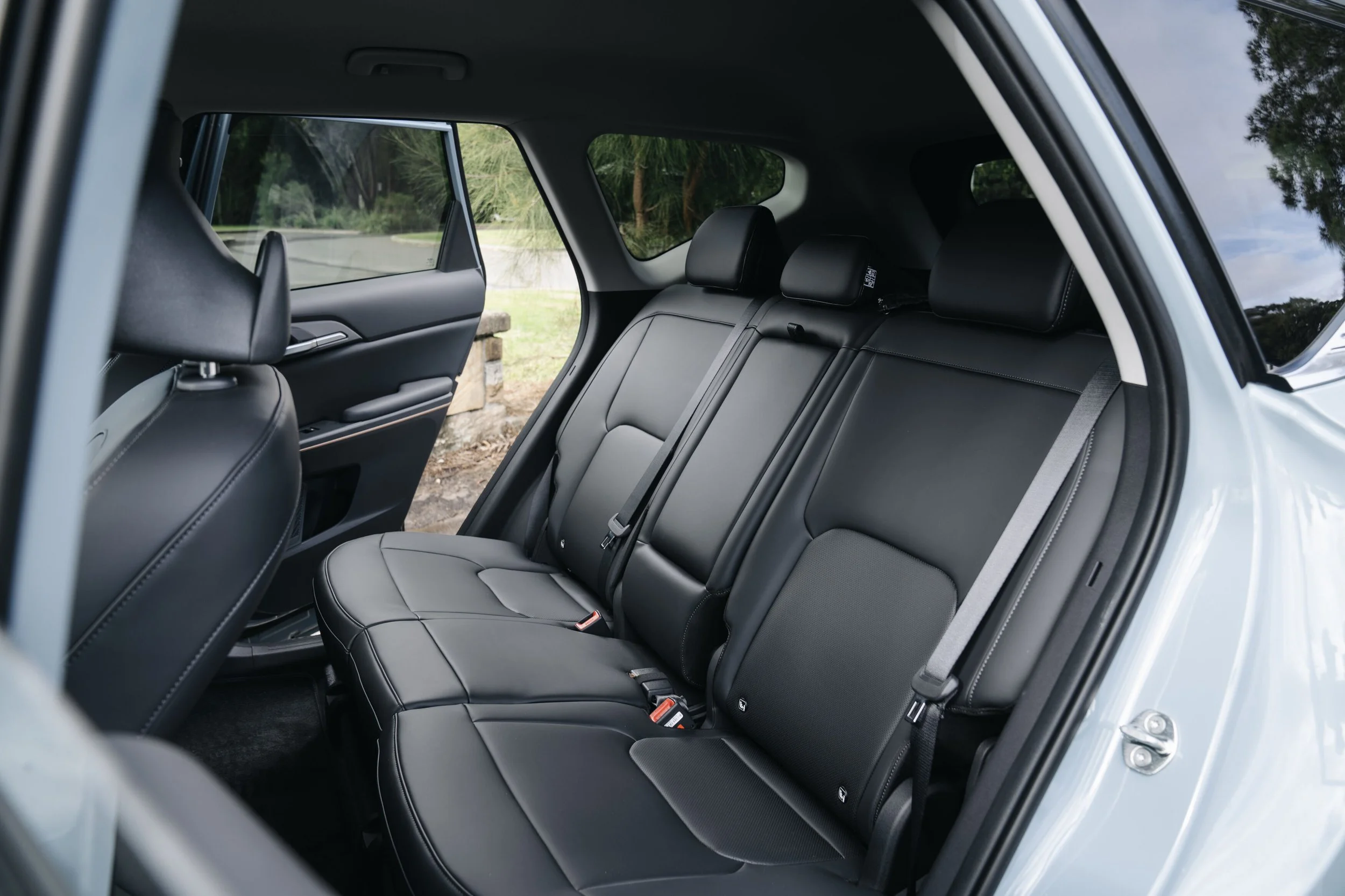
The rear seats recline and offer easily accessed ISOFix anchor points and plenty of legroom thanks to the 2.75m wheelbase and a flat floor.
Getting into and out of both the front and rear seats is quite easy thanks to wide door apertures that allow access for adults as well as kids. The roofline offers good headroom for those same adults as well as rear AC vents for the kids.
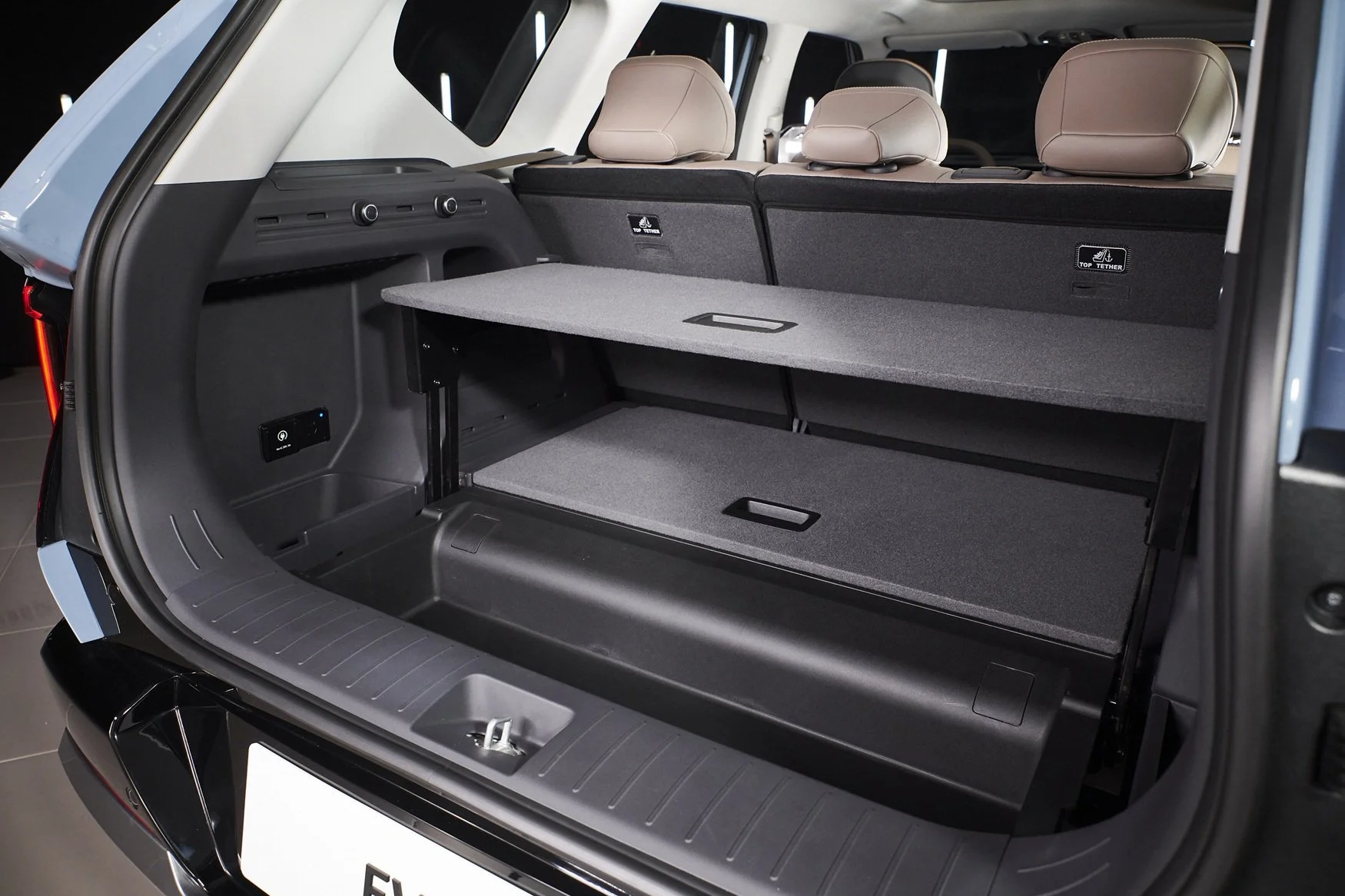
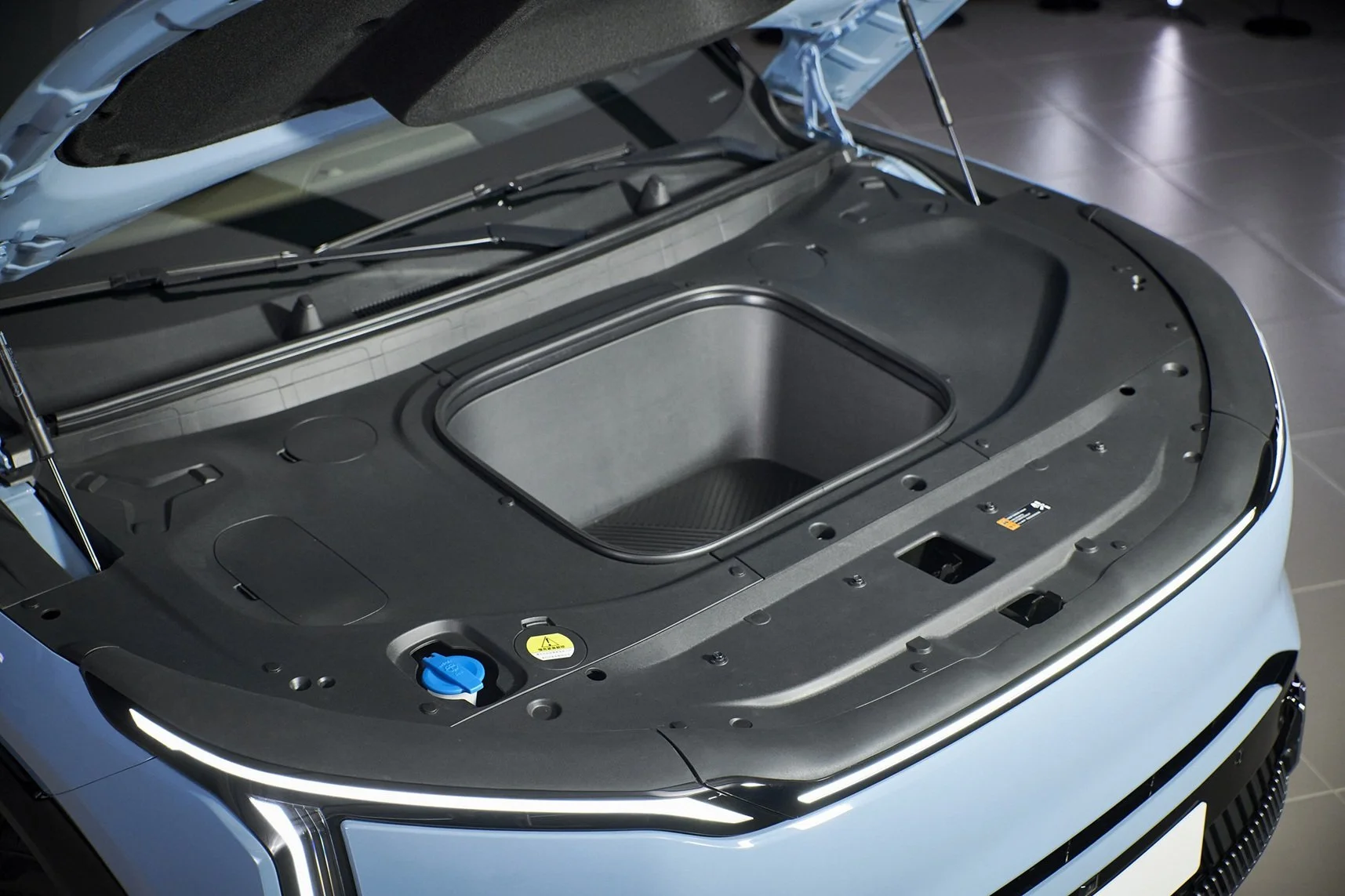
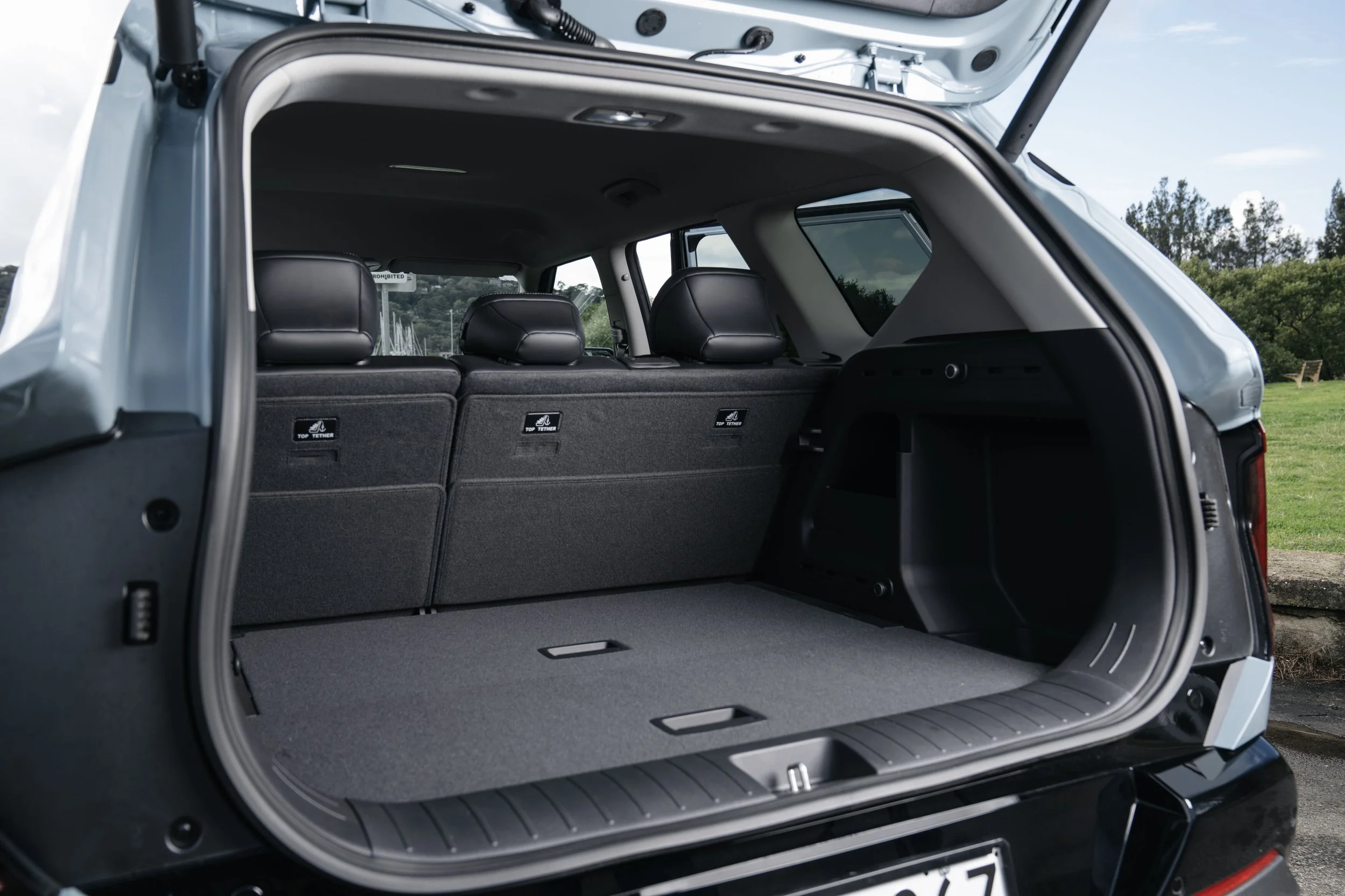
Cargo space is decent in the EV5 both front and rear with a 67-litre (25kg) storage ‘frunk’ under the bonnet, but obviously the 512-litre boot with sub-floor storage space for hiding handbags or devices - not that you can see much through the heavily tinted rear privacy or side-glass.
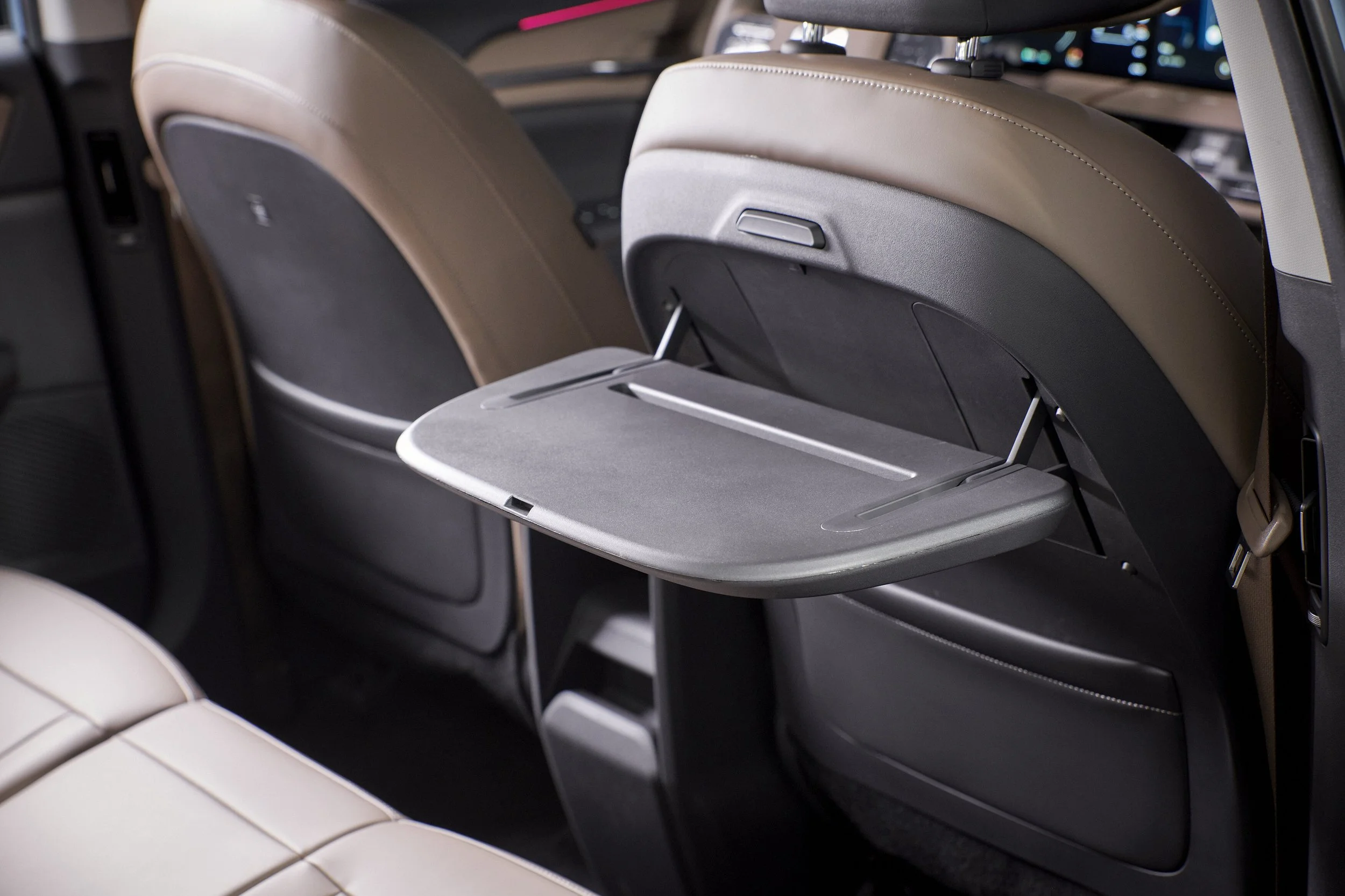
The sliding bag hood system in the boot is a clever design for stowing shopping that might otherwise roll around in-transit, and in the second row you get some practical storage options like the sliding cubby bin in the rear of the centre console for tucking away phones or tablets from prying eyes. Meanwhile, kids eating food or teenagers doing their homework (year, right) or adults working on laptops can use the folding down tray table on the driver’s seatback.
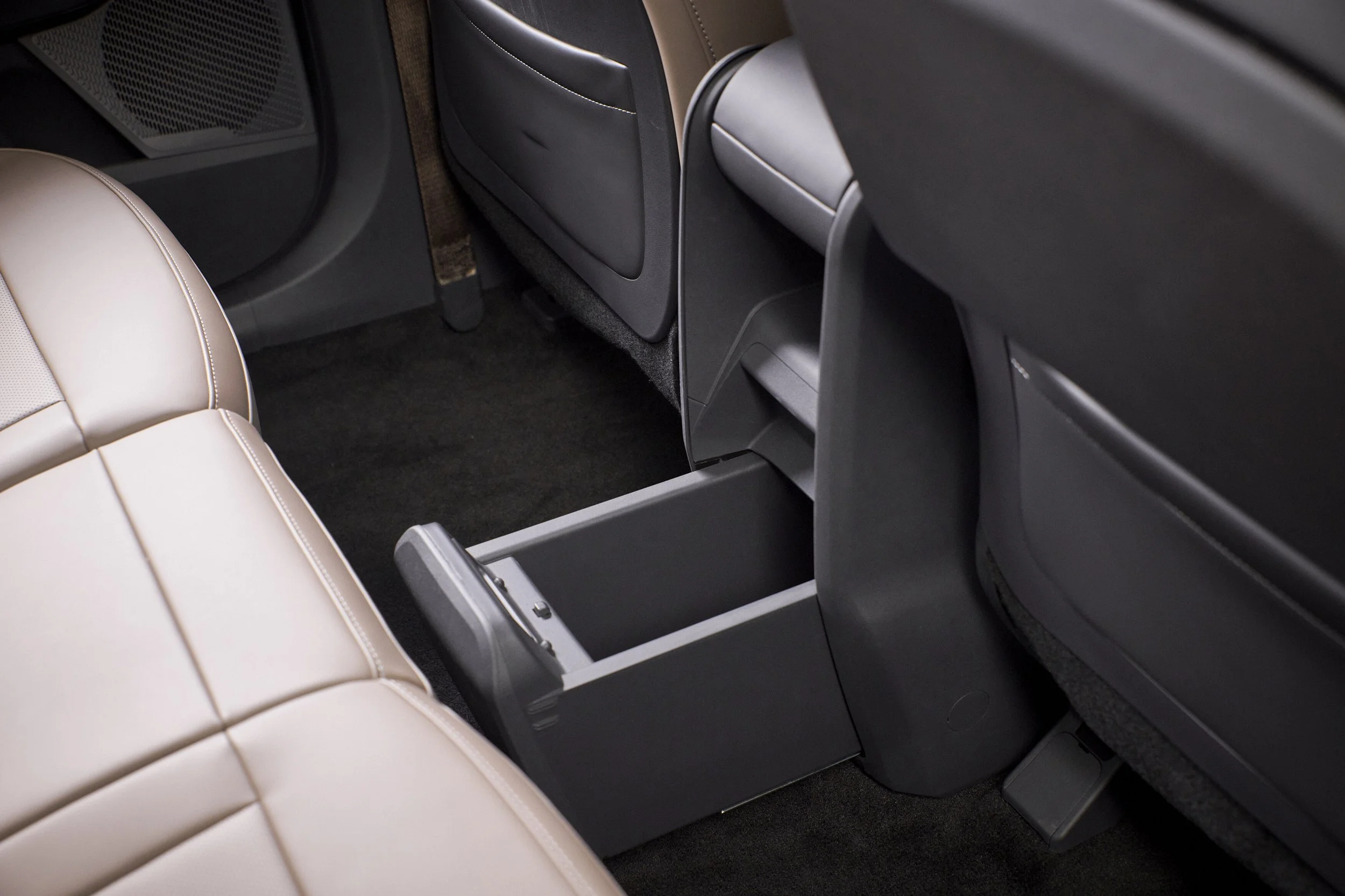
Sharp eyes will have noticed that the inclusion of the flip-up armrest and the rear slid-out centre console bin (which is chilled) does not have any rear air vents for the air-con. That’s because they’re built into the B-pillar instead. This is a far better design than the conventional layout fitting them into the rear of the centre console.
SAFETY
Kia EV5 scored a 5-star ANCAP safety rating in 2024 testing which found very good scores in all four pillars measured under the now superseded protocols. you can download ANCAP’s EV5 report here >
EV5 scored 88 per cent for Adult Occupant Protection, 86 per cent for Child Occupant Protection 74 per cent in Vulnerable Road User Protection and 82 per cent for Safety Assist (such as auto emergency braking, lane keeping, driver monitoring and collision avoidance).
What’s also important to note about the EV5’s safety credentials is something you won’t see in any crash testing assessment and it’s specifically about the EV5’s inherent design.
The nature of a medium SUV that uses a big, heavy traction battery and electric motor-generator as the powertrain means it comes with fundamental safety advantages over combustion counterparts. The nature of the EV5 being heavier than most of its rivals means it will fair better in a crash than smaller lighter vehicles - both in single-vehicle collisions (between the EV5 and an object), and vehicle-to-vehicle crashes.
This is evident in the mobile sled crash teats where a 1400kg deformable barrier on the mobile sled impact the EV5 in frontal offset and side impact tests. You can observe how the 1.9-2.2-tonne EV5 holds up quite well against the car-based sled. If you, hypothetically, crashed a 2-tonne EV5 into a 1.7-tonne Kia Sportage, the EV5 will hold up better owing to its weight advantage. This is basic Laws of Physics stuff.
An important distinction crash testing doesn’t highlight is just how incredible it is to walk away from crashes at speeds as ordinary as 60km/h; a speed we all drive every day. The vehicle’s safety systems are not trying to stop you getting hurt or feeling sore - they’re trying to keep you alive at (what seem like) relatively benign speeds. That’s the goal here.
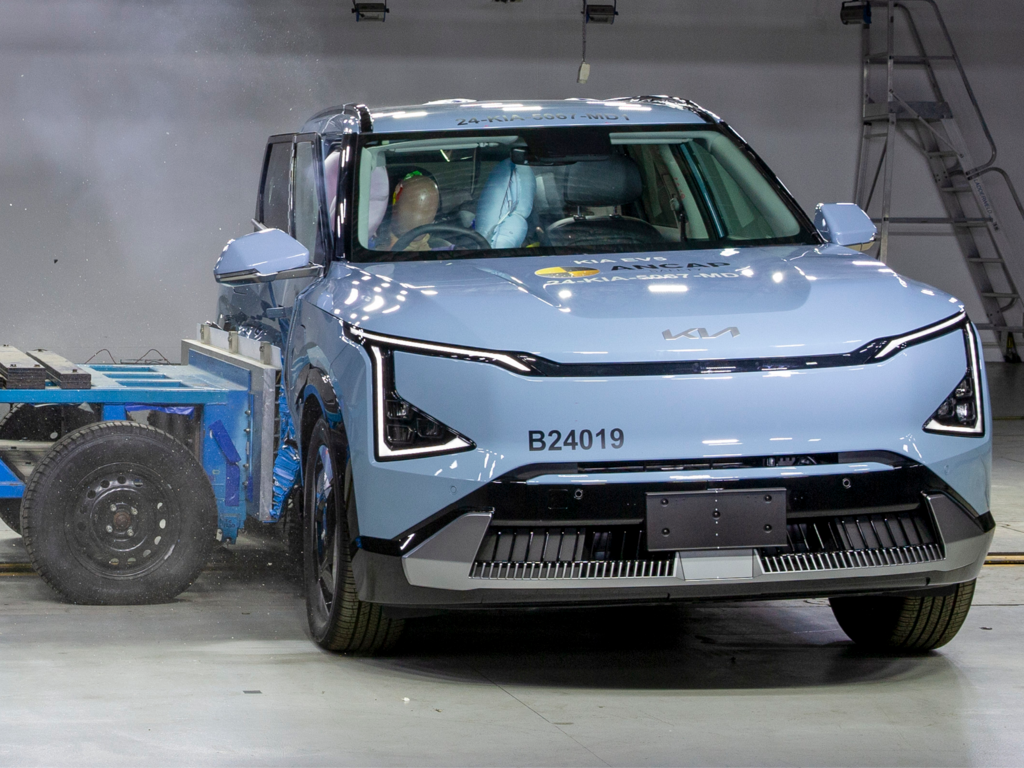
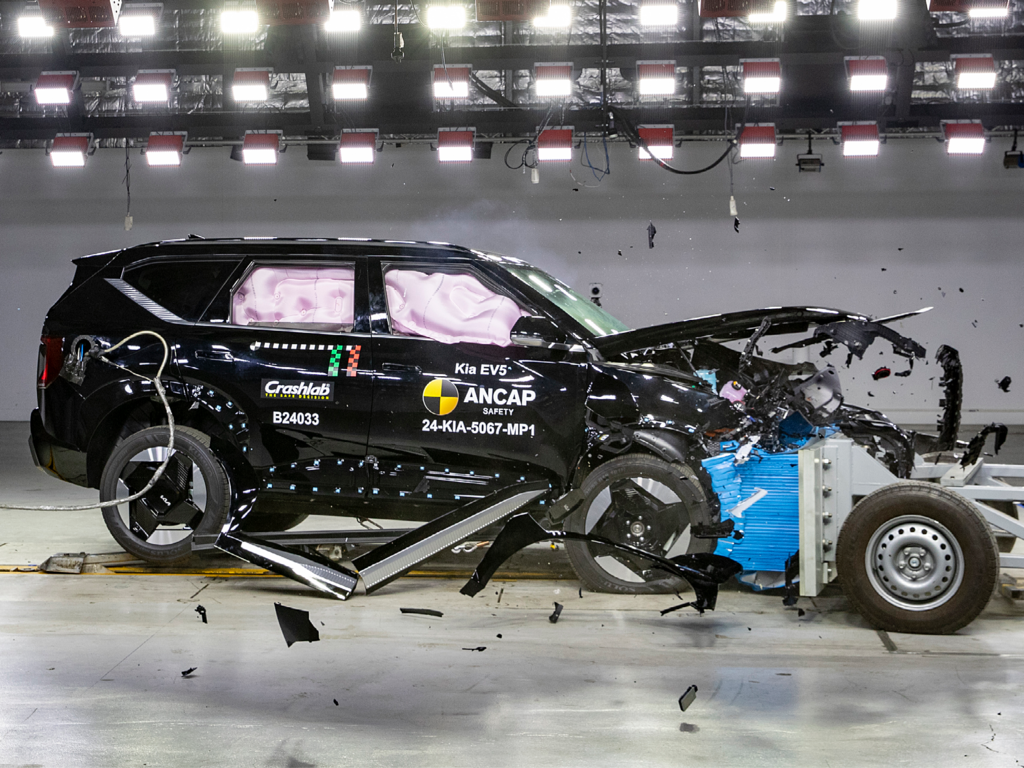
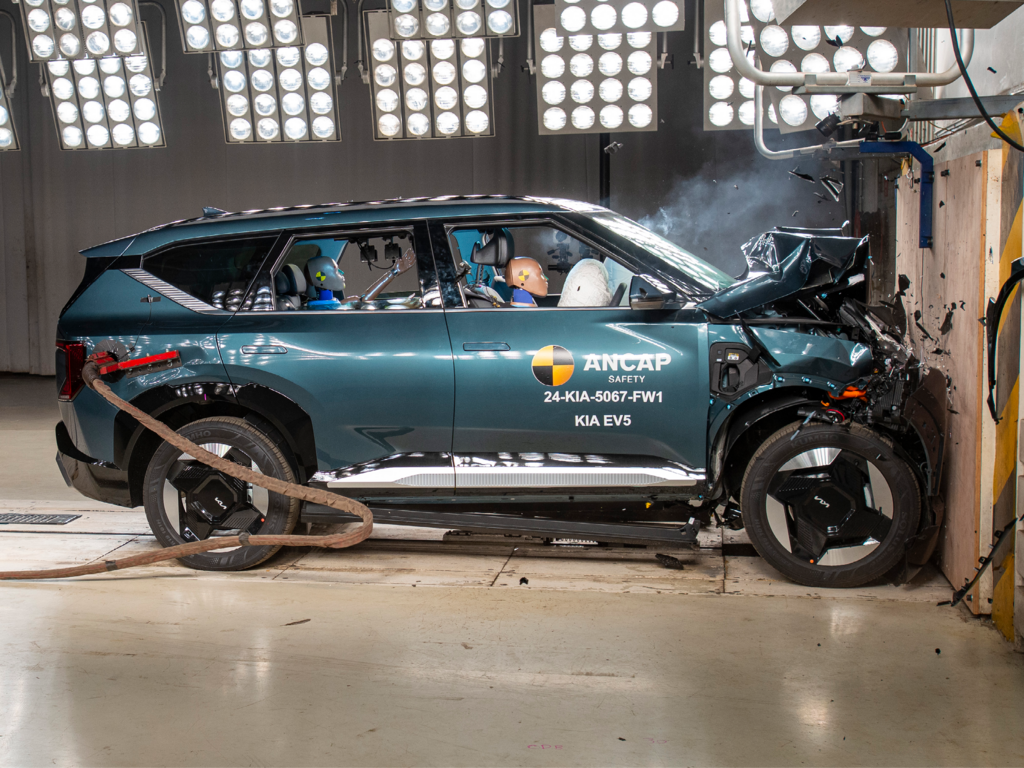
In the four pillars of assessment, the EV5 scored 88 per cent (35 out of 40) in Adult Occupant Protection, 86 per cent (42 out of 49) for Child Occupant Protection, it scored 74 per cent (46 out of 6) for Vulnerable Road User Protection and 14 out of 18 (that’s 82 per cent) for ‘Safety Assist’.
While not perfect in some very specific instances that aren’t especially concerning (in terms of relevancy), the EV5 gets a pretty decent score and includes important features that perform quite well like auto emergency braking that includes in reverse (although it’s not standard and therefore wasn’t tested by ANCAP on their available testing mule). EV5 also includes AEB for cyclists and motorcycles and pedestrians (forwards) where it performs very well in a range of scenarios including junctions and oncoming traffic, and it performs well at night.
I'll help you save thousands on a Kia EV5
Just fill in this form.
No more car dealership rip-offs.
Greater transparency.
Less stress.
ENGINE
Kia EV5 uses the most durable battery chemistry type of Lithium Iron Phosphate (LFP) and uses two different sizes of battery, either a 64kWh unit in the ‘standard range’ (which we’ll call ‘SR’) or an 88kWh unit for the ‘long range’ (‘LR’) 2WD ‘Air’ variant, the ‘Earth’ and the ‘GT-Line’.
It takes the now ubiquitous Type 2 CCS charging plug type which has its charging port located on the driver’s side just above the right front wheelarch for convenient access, meaning you don’t have to park nose-in or arse-in to charging stations in order to plug in.
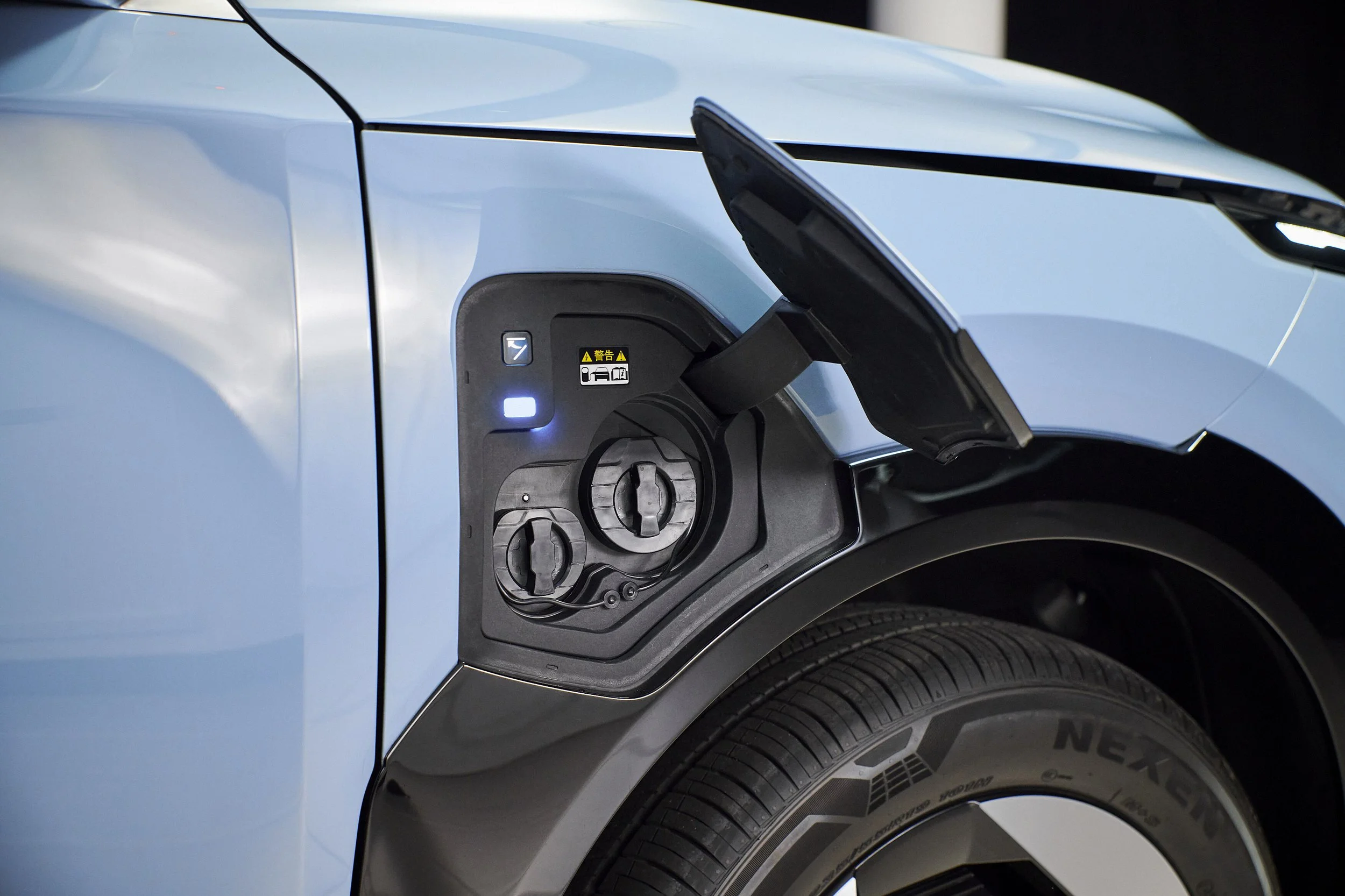
The 2WD standard range is capable of up to 6.6kW of single-phase charging which takes approximately 9 hours - quite doable on a typical charging unit installed at home, by a licensed electrician, in order to fully recharge overnight from 10% to 100%.
The LR versions (Air LR, Earth and GT-Line) will take 3-phase up to 11kW of capacity in roughly 8 hours from the same 10 to 100% state of charge. So for the sake of cost effectiveness, it’s hardly going to be worth it fitting 3-phase, unless of course you already have it installed in your site premises such as a workplace.
Fast charging via DC public charging with a 50kW charger takes about an hour to go from 10 to 80%, and as little as, notionally, 35-40 minutes using a 350kW charging station of which there are just 40 here in Australia currently. Having said that, those stations are often in short supply, are sparsely populated (typically along major interstate highways) and are known to suffer maintenance issues due to their sparsity.
Kia’s claimed maximum possible range with an EV5, in the Air LR variant with the 88kWh battery, is 555km. This drops to 500 in the Earth (LR), and again down to 470km in the GT-Line (LR). It then drops again to 400km in the Air SR variant with the smaller 64kWh battery.
FUNCTIONALITY
In 5-seat mode with the row 2 seats deployed, you’re going to get at best 513 litres of cargo space in the boot which beats the BMW X3 plug-in hybrid, BYD Sealion 7, the Hyundai Elexio and the Toyota bZ4x. But it’s a couple of shopping bags down on things like the Zeekr 7X and Volkswagen ID. (~5%), the XPeng G6 (11%) and the MG S6 (13%).
But in reality, you’re unlikely to actually go filling the entire boot and requiring every inch of space, are you? It’s surprisingly rare, even on school holidays, in which case you utilise the footwells, you’ll throw things in the frunk, and worst-case you need to get some roof racks and a cargo pod, that’s going to be cents on the dollar compared with the asking price of $50-76K.
If you’re shopping in this price range, you can afford the aftermarket accessories to expand the practical envelope of your big, luxurious, electric medium SUV. You will, of course, have to go aftermarket because according to Kia Australia’s website there are no genuine roof racks available. Branded folding picnic table and chair and air mattress, sure. Even a diecast EV5 model, yes. But genuine roof racks, no.
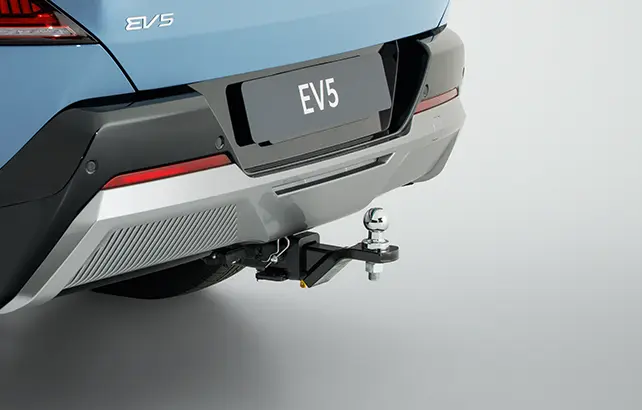
Towing is not exactly what the EV5 is designed for, but just in case you’re wondering, you get a 300kg braked capacity on the Air SR (with 50kg towball download), and 1250kg with the Air LR, Earth and GT-Line (with 100kg of towball download) which actually isn’t that bad. In fact it’s quite decent for an EV. But you should anticipate the projected range will drop off a cliff, so to speak, the heavier the trailer.
The EV5 has a GVM (maximum legal potential weight limit) ranging from 2340kg in the short-range Air, to 2490 in the long-range Air, to 2630kg in the Earth and 2650kg for the GT-Line. So if you take away the 2229kg tare weight from a GT-Line’s 2650kg you’re left with a payload capacity of 421kg. In the Earth it’s 432kg of payload, 436kg for the Air long-range and 430kg for the short-range Air.
What all this subtraction means is you get the most amount of payload in the long-range Air, followed by the Earth, then the Air short-range and the least amount of payload in the GT-Line owing to all its extra features adding weight and therefore eating into the GVM.
So if you plan to do longer-distance trips with the family and all their gear, you’re best getting the long-range Air not just for the increased battery capacity and therefore greater range on a single charge, but also because you might also want the best payload capacity.
DRIVING
It needs to be said that Kia and Hyundai’s EVs are probably the best driving electric vehicles you can buy in Australia, for multiple reasons.
Firstly, the EV5 is tuned for Australian driving conditions by a team of local engineers at Kia Australia in Sydney. But if you’re not particularly interested in the technicalities of how the EV5 rides and handles so nicely, you may never fully appreciate the nuance here.
One of the main handling drawbacks of the majority of EVs out there is that they don’t feel positive in the way they steer and they often lack subtlety to their suspension setup. In Australia, we typically prefer a compliant (soft) ride, but not too soft - in fact our market tends to like slightly sportier suspension (slightly on the firm side) with direct steering that’s evenly weighted.
Suspension that is too stiff is jarring, but too soft and it feels floppy and rolls in the corners which feels unsettling and lack confidence when you turn corners. EVs often get this balance wrong because the weight hasn’t been calibrated precisely enough to be stiff enough when you hit a bump. The EV5 feels Goldilocks.
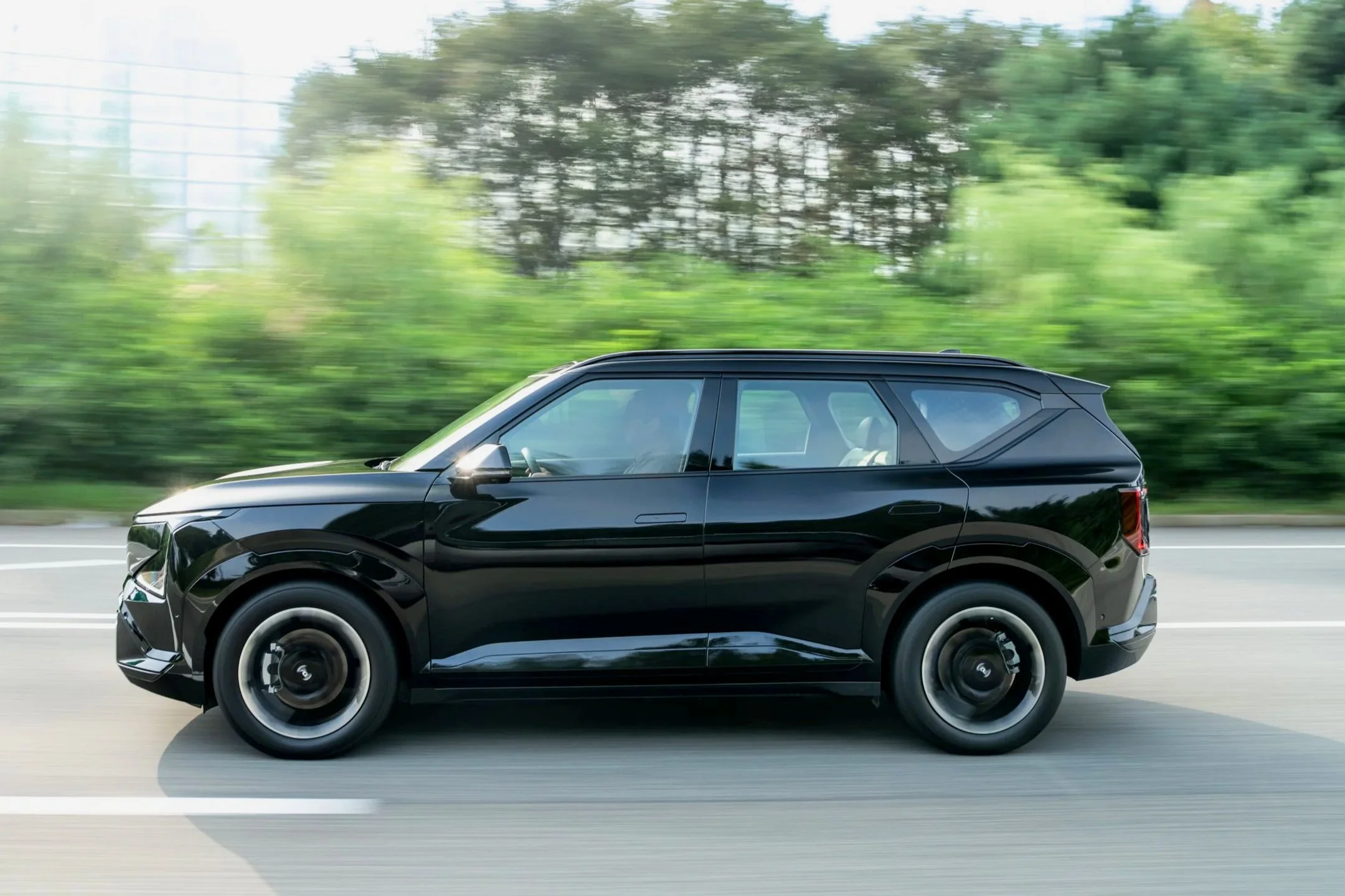
When you hit a bump, you do feel it, but it’s not too harsh and not too soft. It doesn’t take a long time to recover and equally it’s not so firm that it thumps into your back. Kia invests a lot of money into getting this right for our market because it teaches the rest of the company excellent ride and handling dynamics thanks to our uniquely poor roads (compared with South Korea and Europe) and high driver expectations.
All this means to say to you that in a wide variety of scenarios the EV5 feels compliant and subtle in the way it handles its bulk.
DRAWBACKS
No vehicle is perfect and certainly the EV5 has some drawbacks, but it really is in the nitpicking category as opposed to these being egregious flaws. Because to be honest, there’s not a lot to fault here.
The biggest drawback is the price of the top-spec GT-Line at $76,000. This is asking a lot in a market being swamped by more affordable (nay cheaper) alternatives from Chinese brands. But Kia makes up for this by offering superior driving characteristics and a robust commercial footprint with a huge parts and technical support apparatus behind the brand. You’re also getting what you pay for because the EV5 feels solid in every way.
When it comes to those nit-picking observations which you may or may not find problematic, let’s start with the cabin.
The one issue with mounting the tray-table to the back of the driver’s seat is that all those little arm movements and typing fingers and stroppy kids are going to be bumping and jolting the driver’s seat, which is distracting.
If you hate lane-keeping features in modern cars you can deactivate it on Kia products by holding the lane-keeping button on the steering wheel for 3 seconds to disable it.
The last and probably the biggest gripe with the EV5 is a fact that pertains the pretty much every single EV and the majority of plug-in hybrids (and also conventional hybrids) and it’s the spare wheel situation.
You don’t get one in the EV5, nor any other EV for that matter. So if you get a puncture in the sidewall, or a gash in the treadface (the flat bit that rolls on the ground and has groves in it) you will need a tow truck, because the so-called tyre repair kit cannot repair such damage to a tyre. If you just get a nail or screw, then the tyre repair kit should work (keyword: should), but it’s no guarantee.
This can be very problematic if you get a flat in a multi-storey carpark where a tow truck typically cannot reach.
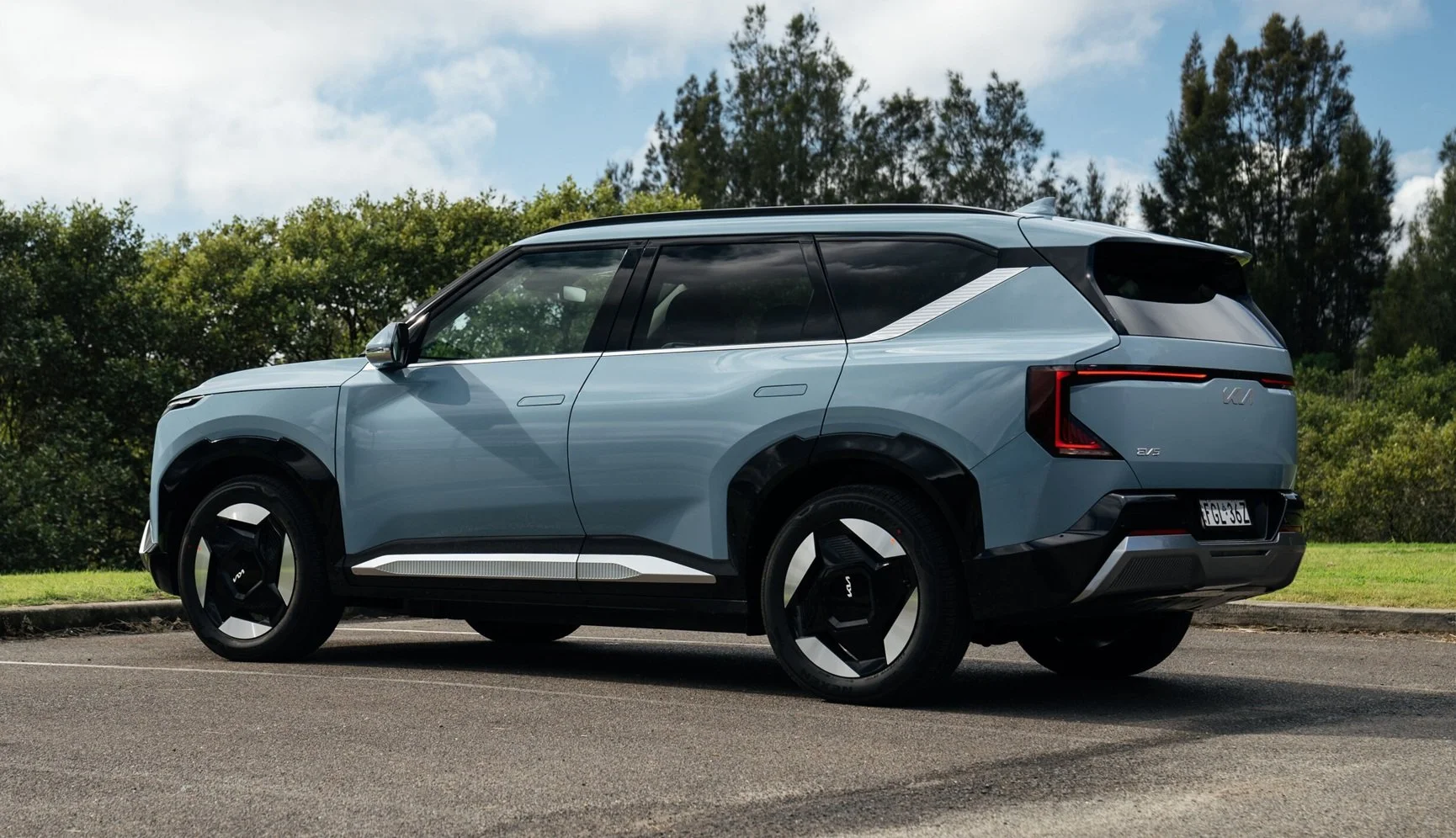
Imagine if they’d given the EV5 the first full-size spare wheel in an Australian-market electric SUV…
MAIN COMPETITORS
HYUNDAI IONIQ 5 | 63 kWh RWD, 125 kW motor (left) | 84 kWh Long Range RWD, 168 kW motor (right)
Kerb wt: 1985 kg
Power-to-weight: 84.6 kW/t
Drive type: Rear-wheel drive (RWD)
Luggage capacity: 520 litres; 1,580 litres with rear seats folded
Spare wheel: tyre repair kit only
Approx. Victorian driveaway: $70,000–$75,000
Kerb wt: 1985 kg
Power-to-weight: 63.0 kW/t
Drive type: Rear-wheel drive
Luggage capacity: 520 litres (VDA), 1,580 litres seats folded
Spare wheel: tyre repair kit
Approx. driveaway: $66,000–$70,000

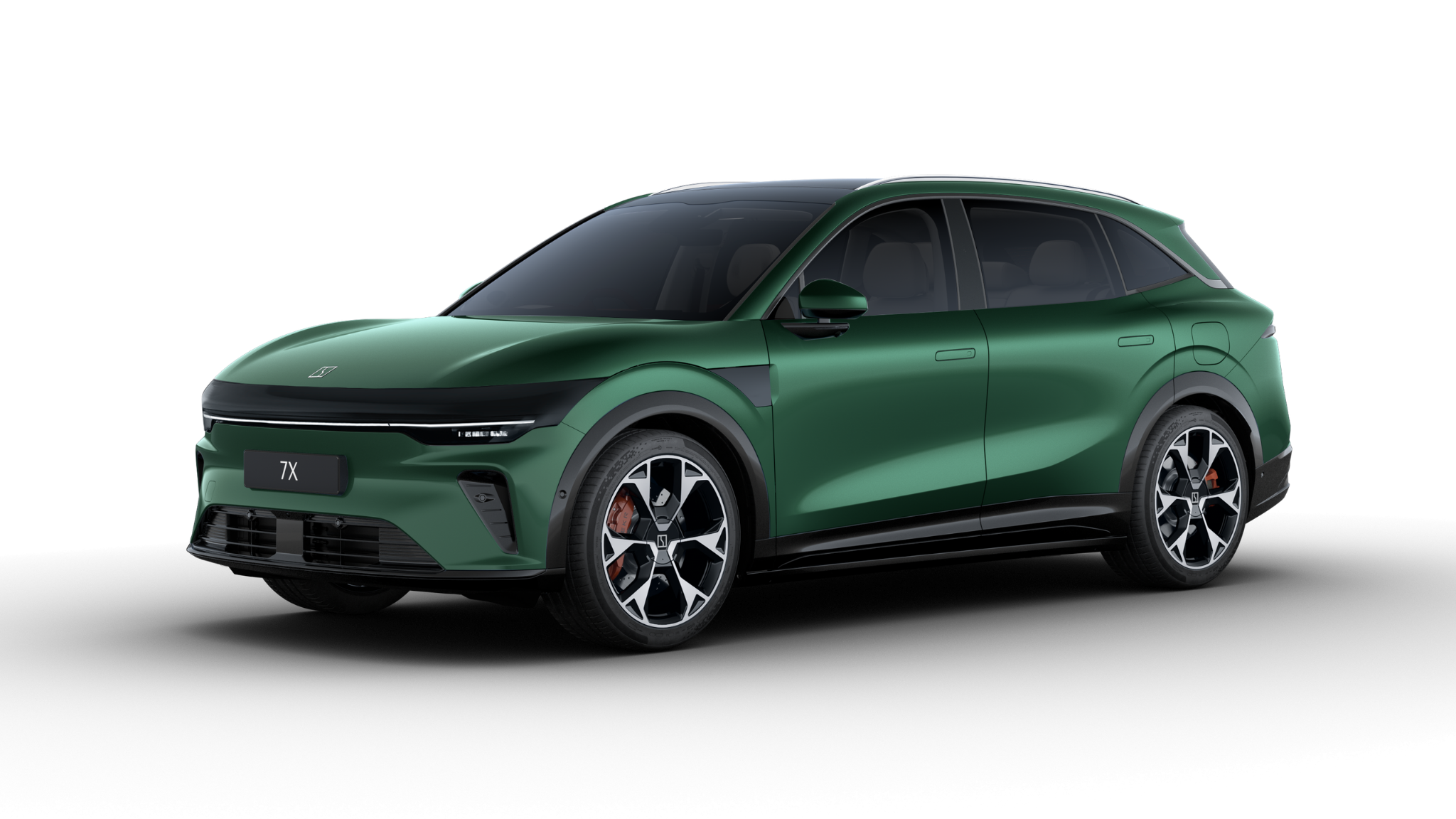
ZEEKR 7X | RWD, Long Range and Performance (335–500 kW)
Kerb wt: Approximately 2320–2385 kg (previous MY26 specifications; confirm updated weights)
Power-to-weight: Approximately 144–210 kW/t using those weights
Drive type: RWD or AWD
Luggage capacity: 539 litres, 1978 litres seats folded
Spare wheel: tyre repair kit only
Approx. driveaway: $63,000–$80,000
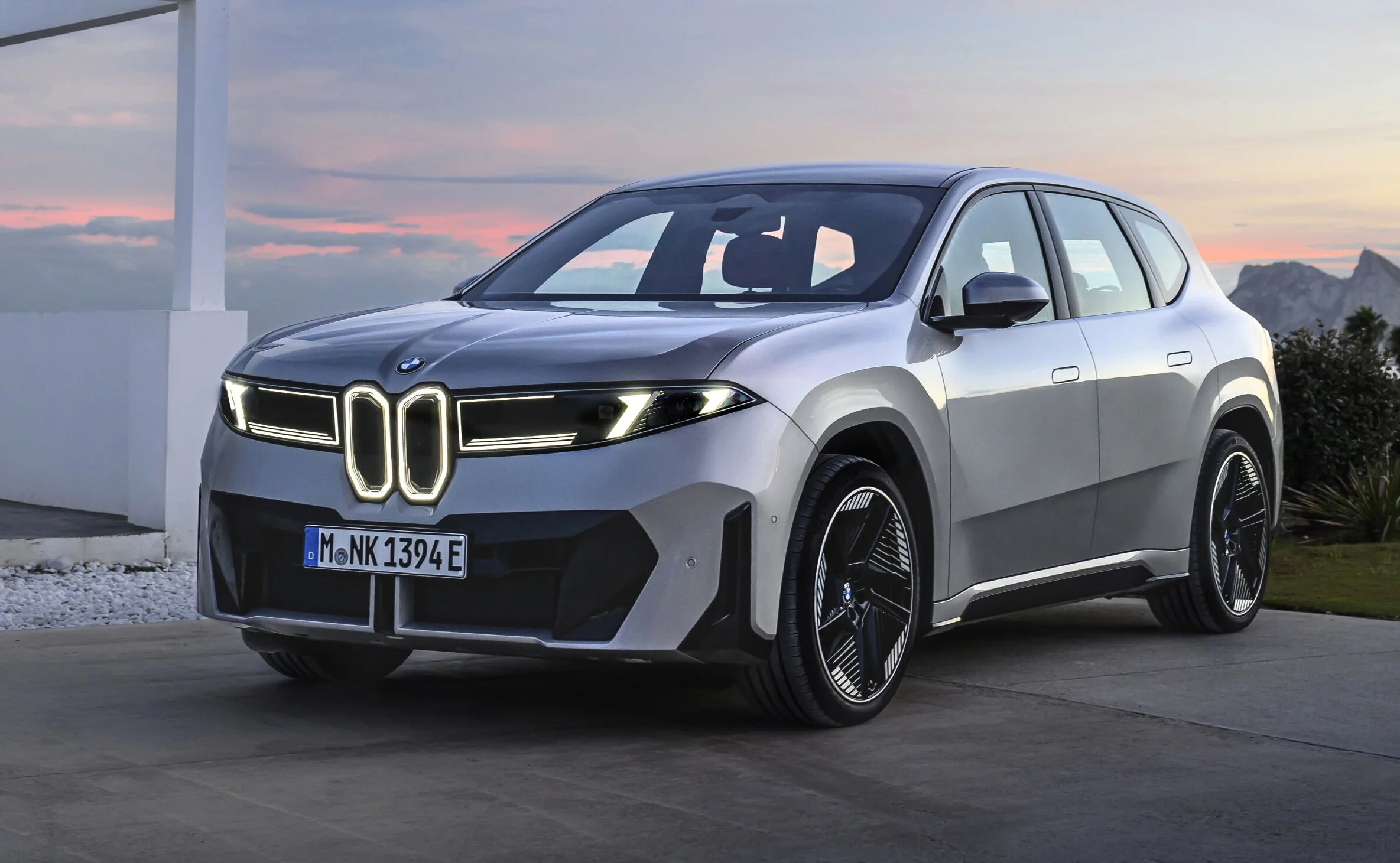
BWM iX3 (235–345 kW)
Kerb wt: 2160–2360kg
Power-to-weight: 108.8–146.2kW/t
Drive type: RWD (40) or AWD (50 xDrive)
Luggage capacity: 520 litres, 1,750 litres seats folded
Spare wheel: tyre repair kit only
Approx. driveaway: $100,000–$135,000
TOYOTA BZ4X | 2WD / AWD / Touring | 165–252kW
Kerb wt: 1960–2055 kg (2WD/AWD; Touring differs)
Power-to-weight: 84.2–122.6kW/t
Drive type: FWD or AWD
Luggage capacity: 421 litres (2WD), 410 litres (AWD)
Spare wheel: tyre repair kit only
Approx. driveaway: $59,000–$74,000
CONCLUSION
Price isn’t everything when it comes to buying and electric vehicle, however important it is in making an informed choice. Value is not just finding the lowest price, but seeing that you buy the best product with the budget available.
The Kia EV5 offers solid value not because it has the lowest price - because it doesn’t - its value is in the sum of its parts. As a whole, it’s an excellent vehicle in terms of equipment and build quality, but also because it’s from a trusted, dependable brand that has a strong reputation for customer support, local Australian tuning investment and a substantial onshore parts availability.
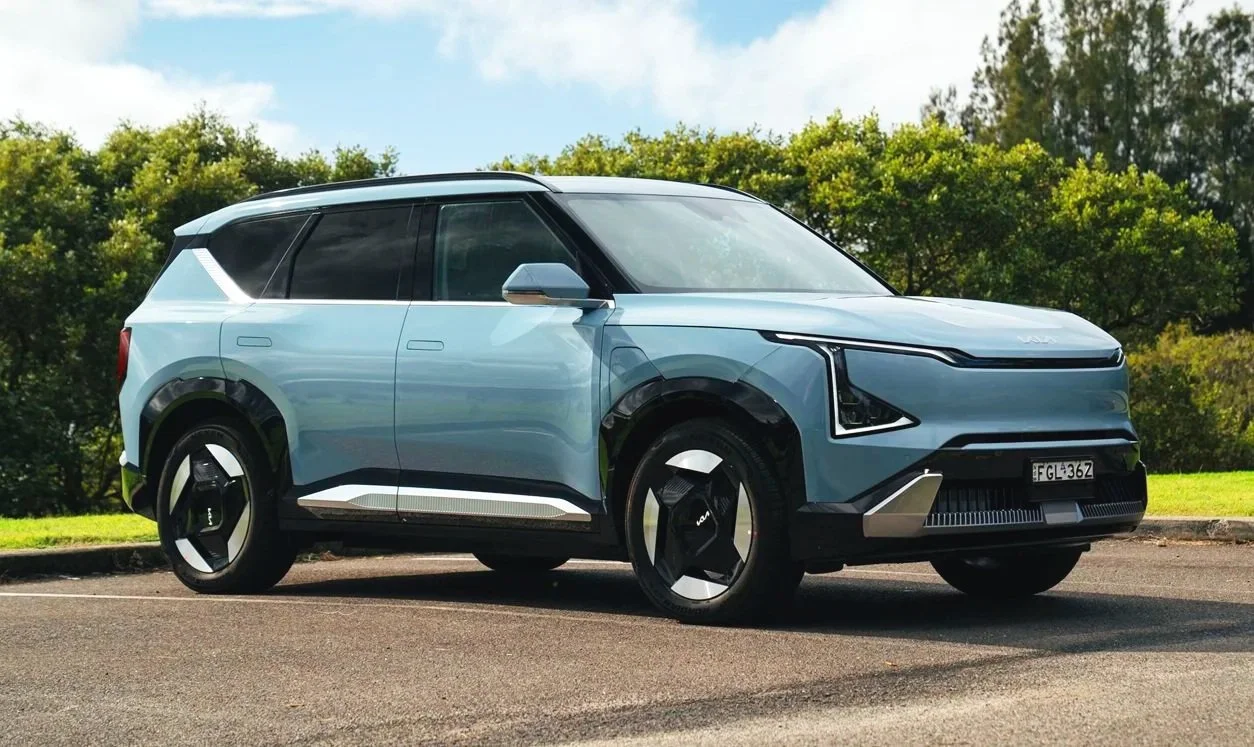
Kia is one of the only brands holding on during the Chinese brand market upheaval right now and it’s because of these core principles that have made it so respected.
And then we get to the fact the EV5 ticks such a long list of boxes it’s hard to make a counterpoint on price. That hasn’t stopped the Chinese brands from responding anyway.
More reports

The Kia EV5 is a medium SUV ideal for families ready to embrace electric vehicles, offering an impressive array of features, superb build quality and a feel of luxury seldom found at this price point.