
Jaecoo J5 hybrid review and buyer's guide
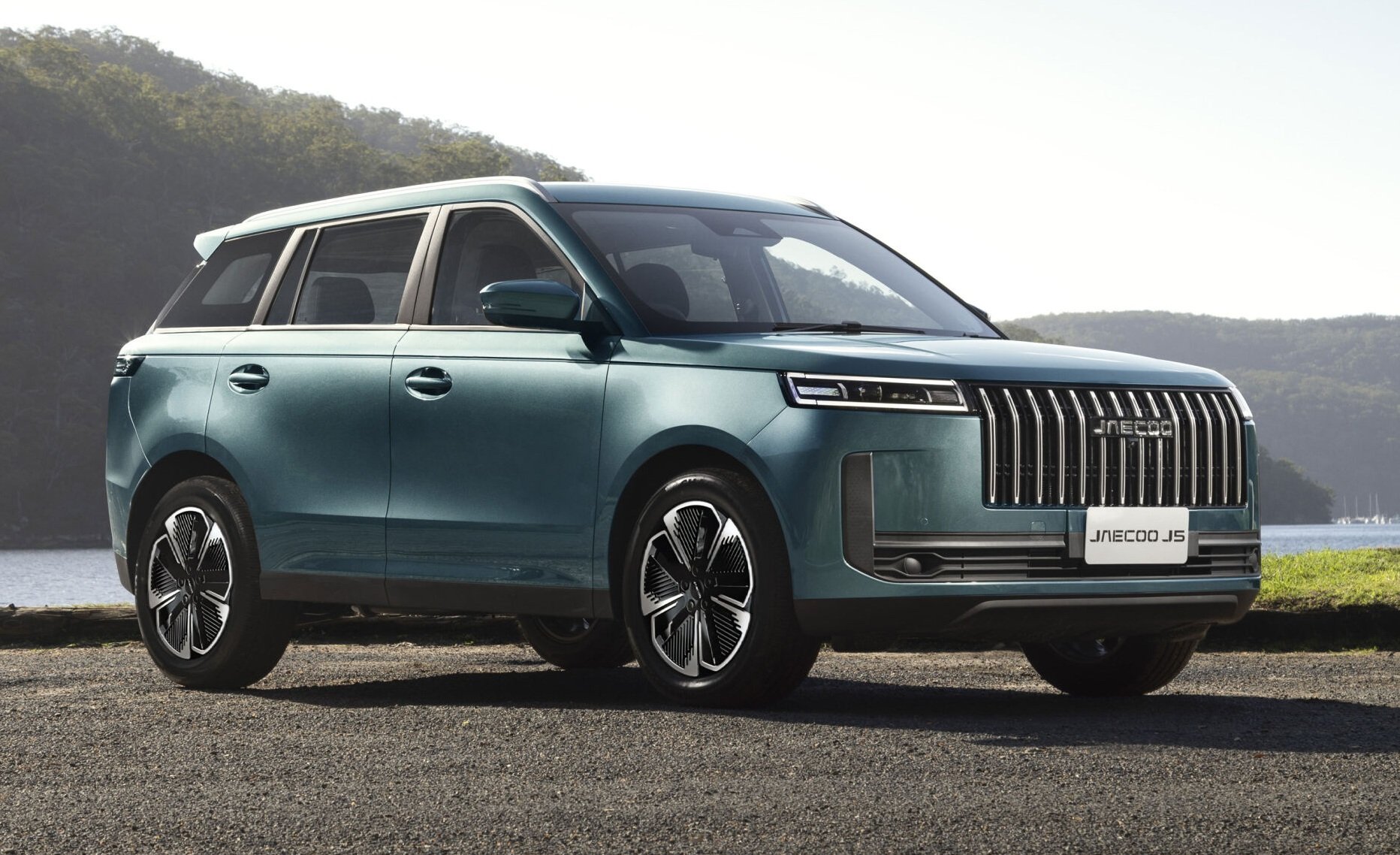
The Jaecoo J5 hybrid is a compelling small SUV for families in Australia. This interesting, high-value small-midsize upstart offers quality, practicality and comfort that beats many rivals.
Save thousands on a new J5
Fill in the form - we’ll get you a great price without the stress
The Jaecoo J5 is a small hybrid SUV that offers all the value of the new Chinese brands while also being competitive in terms of quality, fit-and-finish and notionally affordable luxury.
But the J5 is competing in one of the most congested new-car markets in the world with over 60 brands and only 26 million people buying 1.1 million new cars every year.
There’s no doubt that Chinese brands have successfully taken over the Australian new car market as the most popular source for vehicles having overtaken Japan, Thailand and Korea. So let’s see just how good the Jaecoo J5 is and whether it’s right for you.
You can have a J5 in either hybrid or fully electric form, or as an extremely enticing conventional combustion vehicle with a 1.5-litre turbo-petrol 4-cylinder. This review will focus primarily on the plug-in hybrid (PHEV).
The Jaecoo J5 powertrains include a regular petrol front-wheel drive starting at about $26,000 with a CVT (continuously variable transmission), a conventional plug-in hybrid also in front-wheel drive starting at $35K, or a front-drive EV with a 58kWh LFP battery (lithium-iron phosphate) - starting at $37,000.
Those stats alone are what keep conventional brands’ product strategists awake at night.
To help you understand the Jaecoo J5’s hybrid system, it is a conventional series-parallel hybrid, which captures kinetic energy that would be otherwise lost via the brakes, every time you slow down. This is what Jaecoo calls SHS-H, the -H denoting hybrid.
They also have SHS-P, which denoted ‘plug-in hybrid’ with the -P.
The J5 uses SHS-H, which means 165kW of combined power output from both the single AC electric motor on the front (making 150kW) and the 1.5 turbo-petrol (making 105kW). More on this in the ‘Engine’ section.
All Jaecoo J5 types come as 5-seat only and size-wise it is slightly bigger than a typical small SUV without getting as big as a medium SUV. It’s about the same size as a Mitsubishi Eclipse Cross or a Mazda CX-30 as opposed to the Mitsubishi ASX or Mazda CX-3.
The J5 is based on the Chery Tiggo 4 but has a significant improvement in the rear suspension that makes it far more comfortable and better handling.
Sales are already going strong for the J5 because having only been on sale for a few months, the figures are putting inferior, outdated and frankly boring models out to pasture.
Currently, J5 is outselling Nissan Qashqai, Skoda Kamiq, Subaru Crosstrek, Suzuki Vitara, and Toyota Corolla Cross, as well as Mitsubishi ASX, Kia Seltos, Honda HR-V and Mazda CX-30 - in no particular order.
Pricing is even more compelling when you look at the specs and pricing range - and the fact you get everything in just one model grade.
FEATURES & PRICING
JAECOO J5 HYBRID
SUMMIT: $26,000 driveaway | 1.5 turbo-petrol hybrid | FWD, 5-seats, CVT
19-inch alloy wheels (tyre repair kit)
Acoustic glass: front, side windows
8.8-inch LCD Instrument Cluster
13.2-inch Central LCD Display
Wireless Android Auto & Apple CarPlay
Intelligent Voice Command (Hello Jaecoo)
Passive entry and ignition, remote start
Selectable Drive Modes (Eco, Sport)
360 Degree panoramic view camera
Panoramic sunroof
Driver seat with memory function (including mirror position)
Heated steering wheel
Ventilated front seats
In-built dashcam
Puddle lights
Wireless Apple CarPlay & Android Auto
Colour ambient lighting (dashboard and doors)
Dual-zone climate control
8-speaker sound system
Inbuilt GPS Navigation
Synthetic leather seats
50W wireless phone charger
360-degree camera
Electric tailgate
3 Drive modes – (Eco/Normal/Sport)
Specifications and price may change at any time: always check before signing any contract or paying a deposit.
INTERIOR
The first thing you notice about the J5’s cabin is what some might call the homogeneity of modern car design - it looks minimalist, as is the trend these days, which you may love or hate depending on your tastes.
Given that this is the primary interaction point you have with the car, it’s going to be important to try this thing on before you buy, because staring at a bland, featureless cabin might work for you or it may not, again depending on what you prefer.
The lack of buttons and forced touchscreen interaction might be something you find is just a norm of today, or you might find it an irritating trend that lacks inspiration or skill. Either way, you will have to learn how the screen works and where everything is, as is the case with pretty much every new car these days.
Having said that, the screen’s software is pretty slick, it processes inputs quickly and with practice you’ll learn how to set the car up the way you want it.
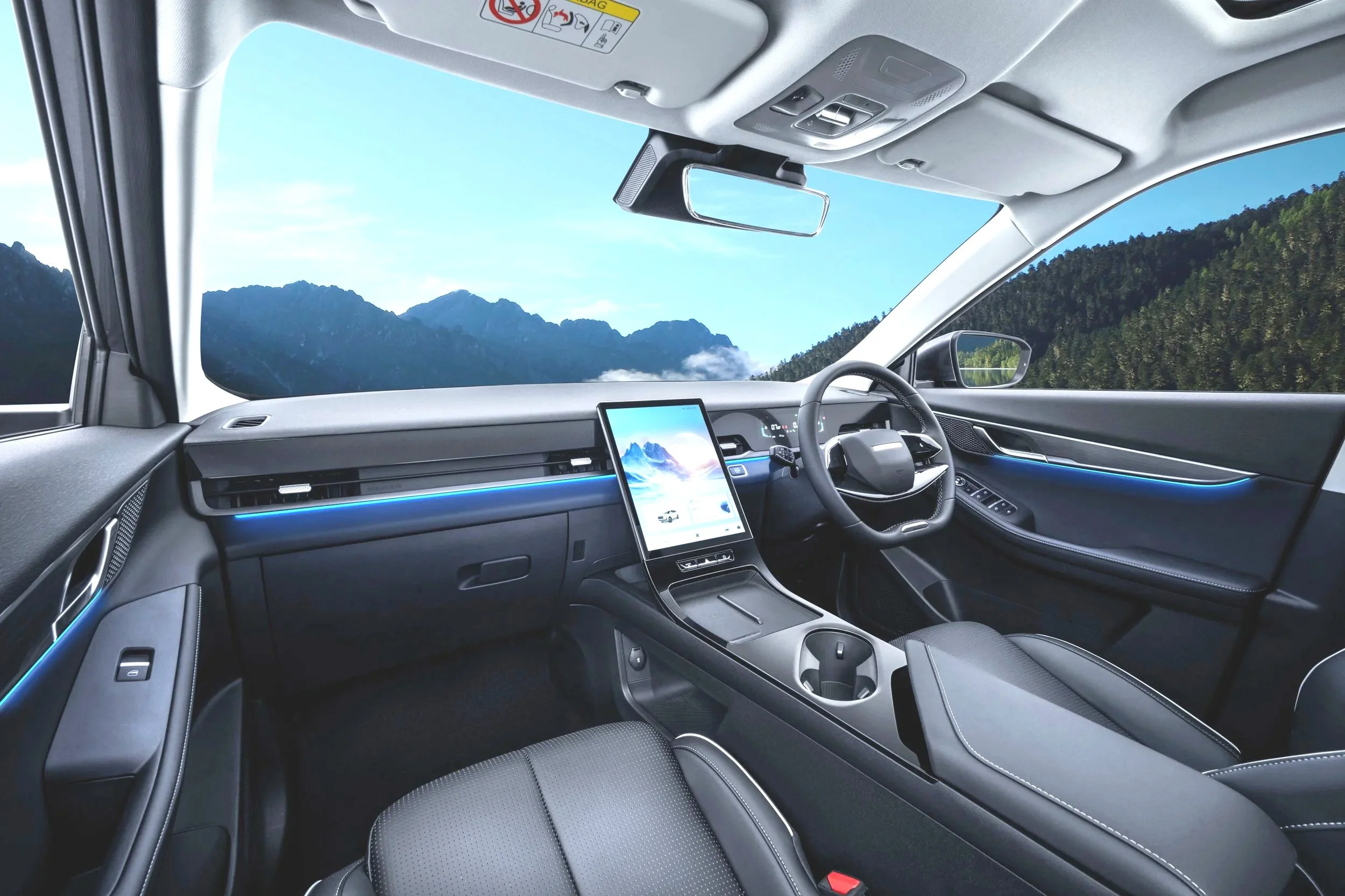
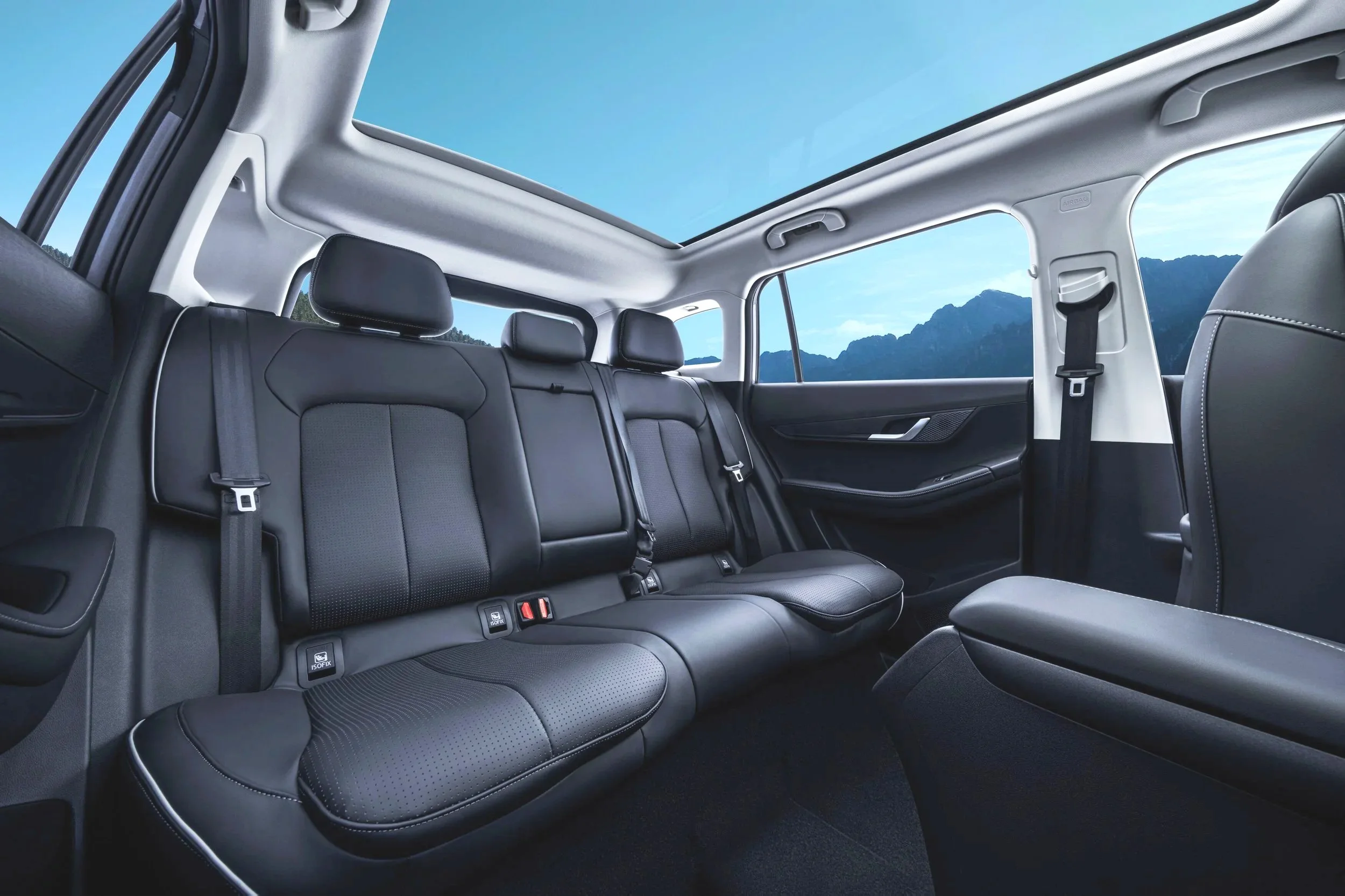
Having said that, what immediately woos you is the use of softer materials on the doors, centre console and dashboard. Most competitors at this price point and segment will use lots of scratchy, hard plastics.
You get good undertray storage below the dual wireless phone charging cradle where you can plug in USB cables instead of heating up your phone and prematurely degrading the battery. This underside cable management means that you don’t have those ports and the plugs, and the cable itself, cluttering the topside area and getting in your way.
There are no squeaks, or rattles, or creaks. The steering wheel feels premium and it positions in your hands just as nicely as any other small SUV. Unfortunately the door mirrors are mounted in the corner of the window where the A-pillar meets the doorline so you get a blindspot behind the mirror and A-pillar as a result. (As opposed to mirrors mounted on the door that leaves a visibility gap between the mirror and the A-pillar).
In the back seats you get a fold-down armrest but it doesn’t come with cupholders for the kiddies’ drink bottles. There is a partial solution by using the bottle holders in the doors, but this doesn’t work for kids in child restraints and short arms. If this shortcut was made in a Seltos or a Corolla Cross we would call the carmaker cheap for not giving the kids this tiniest convenience. Most parents would sacrifice the enormous panoramic sunroof for these basic necessities to keep the kids happy.
The centre console storage has a uniquely design lid which is angled in such a way that when you open it, as the driver, the lid is in your way as you try to retrieve your thing from inside. But hey, at least you get a gigantic sunroof for all that extra UV radiation you can expose your toddler to.
The portrait screen orientation does favour driver reach and access, but the driver’s display screen itself is raked in such a way that sun is going to bounce of it constantly for 6-8 months of the year if you live in NSW, QLD or WA. This is made worse by the complete lack of binnacle or shroud from the dash protecting if from glare and reflections.
As premium as the J5’s interior legitimately is and should be complimented on, because it sets it apart from established Japanese and Korean rivals who tend to skimp in this market segment, there are faults here that need to be reconciled with if you are considering putting one in your driveway.
ENGINE
In the J5 hybrid you get a 1.5-litre turbocharged petrol engine making 105kW of peak power, and 215Nm of peak torque. It’s a front-wheel drive and runs on 91 RON fuel. The combustion-only version of J5 gets the same petrol engine, only without the 150kW AC electric motor on the front axle.
Fuel economy for the regular petrol-only J5 is among the worst of the small-to-midsize SUVs with a claimed 7.5 litres per 100km based on official laboratory bench testing. That’s about 12 per cent worse than a Hyundai Kona FWD and it’s about the same as an AWD Crosstrek or the sporty Mitsubishi ASX but at least with those vehicles you’re getting a distinct advantage to offset that fuel economy. Having said that however, a Jaecoo J5 is going to cost you about $2500 less and you get more equipment.
The hybrid J5 uses a continuously variable transmission, just like the petrol-only version, only it’s adapted to work with the hybrid system to both deliver drive from the petrol engine and the AC motor. The hybrid has a single-ratio reduction gear as typical with other plug-in hybrids and EVs.
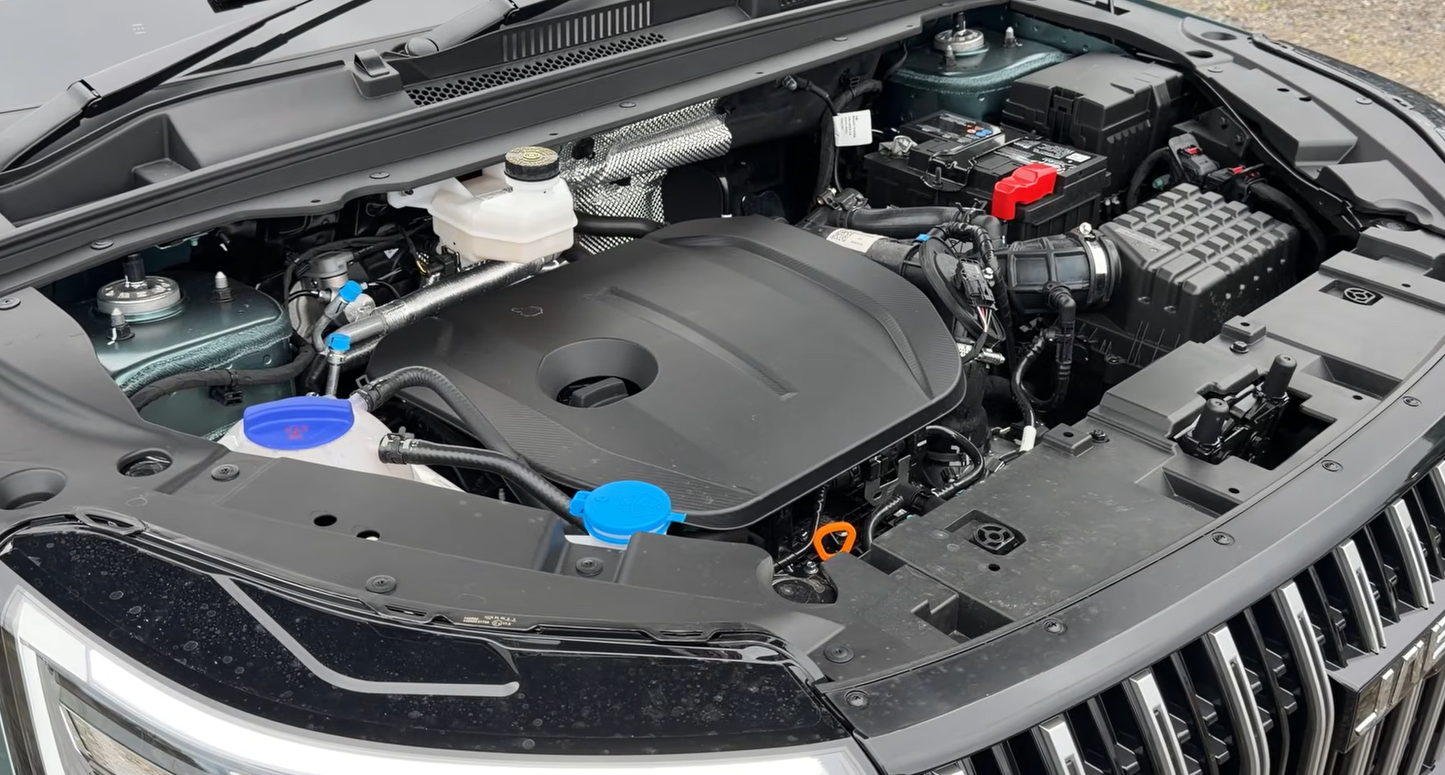
J5 combustion engine shown here. Image: CarSauce
For what they’re calling the SHS or ‘Super Hybrid System’, you get a 1.83kWh lithium-iron phosphate (LFP) battery pack which powers the 150kW electric motor that drives the wheels. It’ll get the vehicle going up to about 30-40km/h depending on how hard you demand acceleration.
The hybrid J5 is front-wheel drive only, so tractive effort is sent though what Jaecoo calls a ‘Dedicated Hybrid Transmission’, which is just a single-ratio reduction gear transaxle.
The powertrain works in series and parallel hybrid mode, using kinetic energy recovery (regenerative braking). Meaning, it will take off from the lights using the electric side before switching to the petrol side (series), but if you demand high load such as overtaking or hard acceleration the two systems will work in unison (parallel).
Jaecoo has made the wise decision to fit the J5 with a 51-litre fuel tank, not to give you excellent driving range, but because it drinks 5.6 litres per 100km - which is poor combined-cycle fuel economy in this day and age. It’s even worse being a hybrid. The petrol-only J5 is even worse at 7.5L/100km (combined).
Warranty is 8 years and unlimited kilometres with 8-year capped-price servicing, 8-year roadside assistance and an 8-year warranty on the traction battery, which is a strong pledge from such a new brand that either gives you confidence (if you’re an optimist) or leave you with doubts (if you’re a pessimist).
I'll help you save thousands on a Jaecoo J5
Just fill in this form.
No more car dealership rip-offs.
Greater transparency.
Less stress.
MAIN COMPETITORS
Here are the key points of comparison between the Jaecoo J5 hybrid and the best you can get from the established brands.
KIA SELTOS HYBRID GT-LINE | $40,000 driveaway approx. | 1.32 kWh battery
For more on Kia Seltos hybrid click here >
Less power: 142kW Kia Seltos (1.6 turbo-petrol hybrid) VS 165kW in the Jaecoo J5 hybrid;
Less torque: 265Nm Kia Seltos VS 310Nm for Jaecoo J5 hybrid;
Both are front-wheel drive;
18-inch alloys on Seltos VS 19-inch alloys on the J5
LENGTH: Seltos hybrid uses the same platform as current-gen Hyundai Kona, so they’re basically the same length, 4.3m
WHEELBASE: Seltos hybrid sits on a 2.66m wheelbase like the Kona hybrid. J5 is on a 2.62mm wheelbase which is negligible in terms of usable legroom for rear passengers.
PAYLOAD: Seltos hybrid carries about 400 litres of cargo in the boot, VS the J5 carrying 480L if you load to the roof, otherwise it’s 384L to the top of the seatbacks.
Seltos has a space-saver spare wheel, where the J5 offers a tyre repair kit which is useless if you have a sidewall puncture or gash in the treadface.
FUEL ECONOMY: 3.9 litre per 100km for current-gen Kona hybrid; 5.6L per 100km in the Jaecoo J5. It’s lucky the J5 has a 51-litre tank because it’s appallingly thirsty. That’s 43 per cent higher fuel consumption.
TOYOTA COROLLA CROSS hybrid | $30,000 driveaway
For more on Toyota Corolla Cross click here >
Less power: 140kW (2L petrol hybrid, non-turbo) VS 165kW in the Jaecoo J5 hybrid;
Both are front-wheel drive; Corolla Cross has the option of on-demand AWD which is reactionary to wheelspin
17-inch alloys on Seltos VS 19-inch alloys on the J5
LENGTH: 4.46m, a difference of 16cm, which you’re never going to notice in general driving
WHEELBASE: Corolla Cross hybrid sits on a 2.64m wheelbase which is virtually ideantical to both the Kona hybrid and the J5. So legroom is going to be effectively the same.
PAYLOAD: Corolla Cross hybrid carries about 425 litres of cargo, which is 9 per cent more than the 384L in the J5 to the top of the rear seats, or it’s 12 per cent less than the 480L loaded to the roof.
A space-saver spare wheel is available in all 2WD model grades or a tyre repair kit (useless for sidewall punctures or treadface gashes) in the AWDs. So only 2WD Corolla Cross wins on this front.
FUEL ECONOMY: 4.2-4.5 litres per 100km is good 24 per cent better economy on the 5.6L per 100km in the Jaecoo J5. Corolla Cross hybrid smashes the Jaecoo on fuel consumption.
DRIVING
Driving a Jaecoo J5 is going to be similar to most small SUVs in terms of steering input, braking and accelerating. But where it differs is in the details on ordinary suburban roads.
A test drive will reveal that the seats are decently comfortable on built-up suburban roads, you’ll find the brakes offer good feel and you’ll get a quick idea how punchy it is when you enter a freeway on-ramp at 50-70km/h and put your foot down.
But it’s the rear end of the J5 that should make waves because despite the price, Jaecoo (and parent company Chery) have not taken the cheapest path by offering torsion beam rear suspension.
You get properly independent multi-link rear suspension which means that each wheel moves of its own accord and is not joined by, effectively, a rigid beam between the rear wheels where one can have an effect on the other. Torsion beams are cheaper to design and make, but also easier to service, whereas multi-link has more components and is slightly more complicagted, albeit not detrimentally so.
Chery Tiggo 4, the vehicle the J5 is based on, uses a torsion beam rear and you notice it over tram lines, potholes and in sharp cornering where the rear corner tends to want to lift (or at least becomes light as the vehicle’s weight shifts). GWM Haval Jolion, MG ZS, BYD Atto 2, Mazda CX-30, Honda HR-V and Mitsubishi ASX all use torsion beam.
All-wheel drive versions of Seltos, Kona, Corolla Cross, as well as Nissan Qashqai, Crosstrek (independent wishbones), Chery C5, MG S5 and the old Mitsubishi Eclipe Cross all use independent mult-link suspension, which lends itself to those platforms where drive is being sent through the rear wheels. The point here is, you get the nicer suspension on a vehicle that doesn’t demand it.
Perhaps there is an all-wheel drive version coming, but for now, a afront-wheel drive small SUV that rides like as nicely as it does is a compelling package considering the kinds of roads and conditions you’re like to do the bulk of your driving in.
City streets, suburban roads, maybe the occassional laneway or freeway roadtrip - this is going to be the primary useage case for a family small SUV skewed toward comfort.
The most concerning issue for the J5 is what happens if you cop a flat.
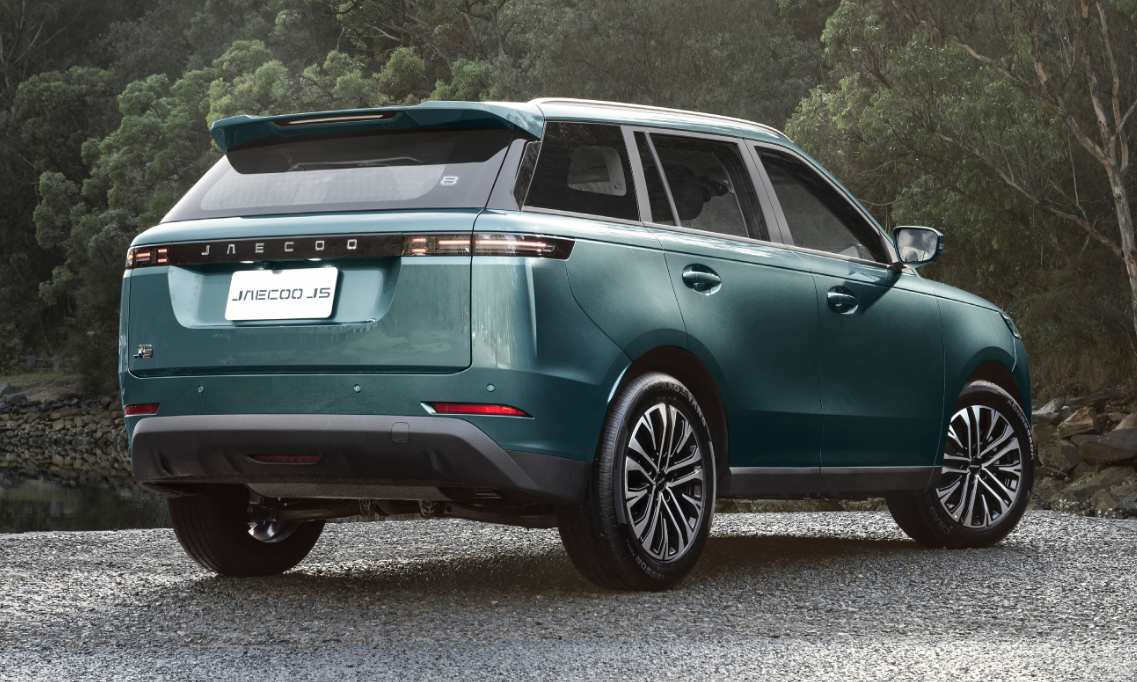
DRAWBACKS
BUYING CHINESE
Let’s be very clear here about what this report is about. It’s about the product as it stands on sale here in Australia.
This is not about the geopolitics between the notional democratic, capitalist West and the notionally communistic, authoritarian China. We’re talking purely about the product this company intends to sell to consumers here in Australia and whether it is justified for the price - for consumers like you.
So try your hardest to leave pre-conceived politics and xenophobia at the door and look at the Jaecoo J5 on merit, just as we might with any vehicle that comes from South Korea, Japan, Thailand, or India - or indeed developing nations like the US, the UK, or Europe. (That’s a joke.)
If you’re thinking about one of these cars, here’s what you might want to do next. Take a test drive. It might tell you how nice or rough it is to actually drive, use and sit in for 10 minutes around the dealer’s test drive route.
Have a play with its infotainment screen which dominates the cabin and far more vehicle operations than you might like. Buttons still have a place.
But it’s not going to answer bigger, more important questions around viability. There’s zero background on Jaecoo to go on. You don’t have a baseline.
We don’t know if Jaecoo is going to be good at fault-finding in the service department, if they’re going to provide in-depth technical training for staff, how big the dealer network is going to be outside of capital cities and what the spare parts inventory is going to be like.
But what you can see is the investment in dealership expansion - often into already established dealer showrooms. Chery, Omoda Jaecoo (two names, one brand), GWM, BYD - these brands have dropped a lot of money into dealership businesses with the intention to grow, and they certainly don’t seem to be slowing down.
So these aftersales aspects like technical traning and diagnostics, extensive onshore parts availability and general servicing and quality repairs in the service department - these are all set to improve.
You might also be quite willing to give them a try and be a lab rat, so to speak, and that’s okay. It’s absolutely allowed.
Or you can choose to wait 12 months and see how the experiment rolls.
Longevity and reliability are another question. You don’t want to get five years into this ownership and find the panels are rusting because of inferior metal surface treatment - not suggesting that’s going to happen - but it might. We don’t know yet.
We know how good Toyota, Subaru, Mitsubishi, Hyundai and Kia are at customer support, build quality, long-term durability.
A test drive at this point is going to tell you about ergonomics, design and execution, road-holding and sound attenuation, and you could even find yourself getting comfortable with the driver assistance (ADAS) features and the driver stalking camera.
But you simply won’t have a handle on how Jaecoo will comport itself commercially when or if you have problems down the track.
Australia has third-world roads and first-world expectations of our cars. On-road calibration is going to be the weakest link, most likely, in the Jaecoo J5. Chery/Omoda Jaecoo haven’t done any local Australian testing and calibration of suspension, steering and handling unlike Toyota, Mazda, Subaru, Mitsubishi, Hyundai and Kia.
This Chinese brand simply hasn’t had enough time and investment to understanding our unique market — yet.
SAFETY
The Jaecoo J5 has not been ratedg by ANCAP or tested by EuroNCAP in 2026. So for now, the best data to go off is a combination of the Chery Tiggo 4 and the Jaecoo J7.
The Tiggo 4 was tested/rated by ANCAP in 2023 and given a 5-star ANCAP rating, meaning it passed a now surpassed set of testing protocols. (This is not suggesting it is inferior or comrpomised in any capacity, it’s simply stating that a new tranch of testing criteria have been introduced for 2026-2028.)
The Tiggo 4 got an 88 per cent score for adult occupant protection, 87 per cent for child occupant protection and 79 per cent in vulnerable road user protection. These are the three primary pillars of crash testing safety that actually matter. ANCAP might suggest ‘Safety Assist’ is of equal importance, and for that Tiggo 4 gets an actually impressive 85 per cent, but there is little evidence to suggest crash prevention is actually working - in any developed continent.
While the vast majority of cars mixed out there on the roads remain older vehicles, especially in Australia, performance in destructive crash tests matters. For this reason, it’s good to see the Tiggo 4 does very well for such a small vehicle.
You can download ANCAP’s full technical report for Chery Tiggo 4 here >
According to the technical report, the Tiggo 4 gets decent overall crashworthiness scores across all tests. In the frontal offset test at 50km/h it offered ‘weak’ chest protection for the driver with 2.7 points deducted. This happened again in the oblique pole test at 32km/h with the driver’s chest score deduction of 3.9 points for a total of just 0.9 out of 4. This is concerning considering that these are the most common crash types and in such an incident at the roadside you’re incresingly more likely to suffer potentially fatal injuries - you are still likely to survive here, let’s be clear - but the worse the score the worse your chances are.
What’s critical to understand in context here is that the frontal offset test assessment uses a 1400kg mobile trolley, which represents a standard car. This an outdated rig that no longer represents the median vehicle out on Australian roads, which is much closer to a medium SUV at around 1700kg, like the mobile trolley used in testing in the US at the Insurance Intitute for Highway Safety (IIHS).
The reason for telling you this is because a 1400kg sled hitting a notionally 1400-1500kg Tiggo 4 is going to fair much better than against a bigger, heavier 1700kg SUV. So your chances of survival are better against that 1400kg car than that SUV because: physics.
Translation: if the trolley were more representative of the median Australian vehicle, it would be more like the SUV trolley in the US because Australia’s most popular vehicles are medium SUVs and utes - not cars. So the J5’s bigger sister, the J7, would perform better (on crash compatibility) if the trolley were bigger and heavier, but that would mean the J7 would fare worse in that same crash because of physics.
So, the J7 does better against smaller, lighter vehicles (than itself), but would do worse against bigger, heavier vehicles, which is a universal rule in the physics of crashes, generally speaking.
There is also a near-identical rear-left airbag deployment problem present in the frontal offset test (50km/h). You can see on the image below, taken from the test video provided by ANCAP, how the right-side rear airbag deploys appropriately, covering the window sill. But the left side has not come down far enough to cover the left window sill:
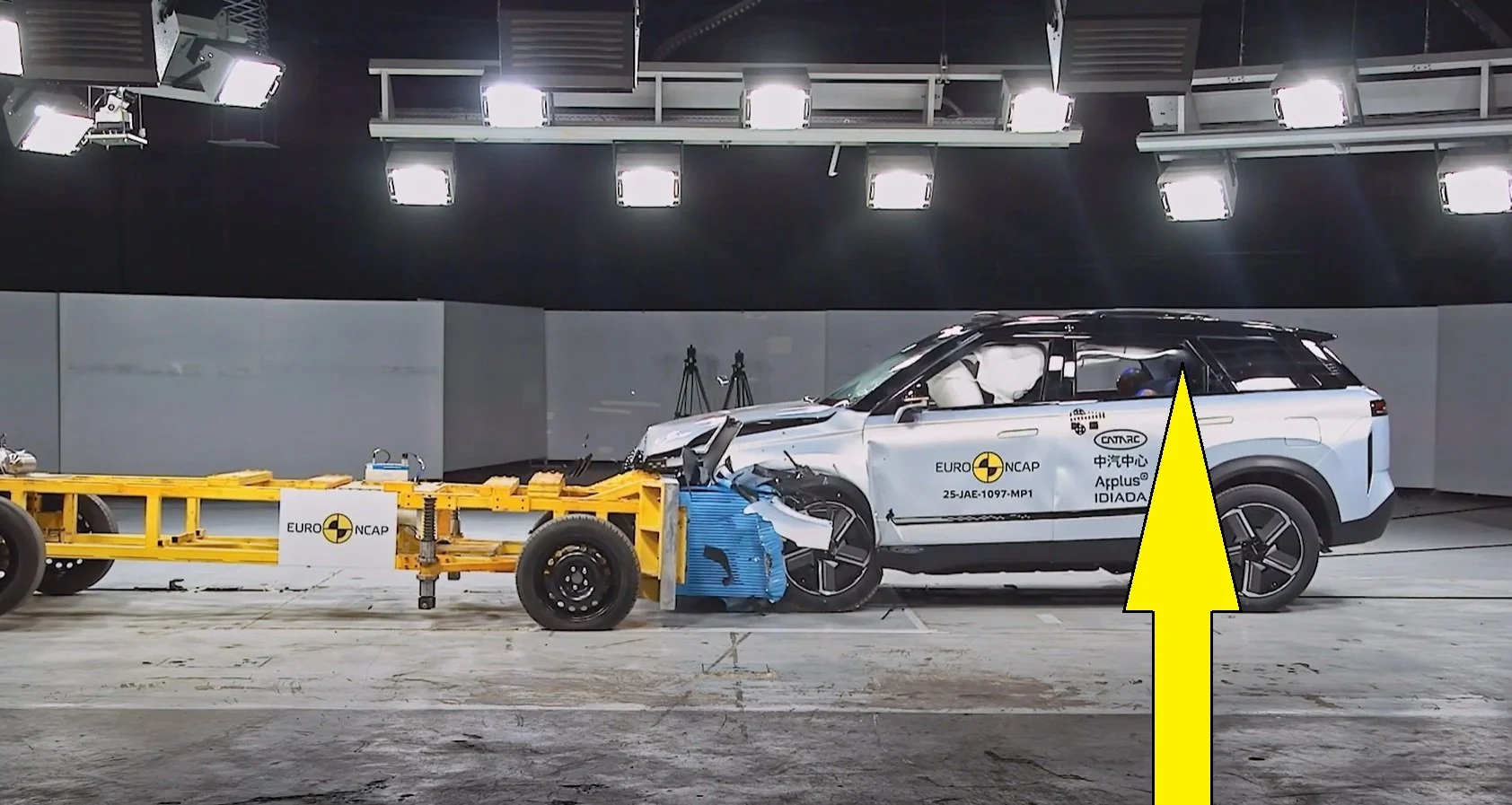
Looking rearward into the cockpit, you can see how the rear-left curtain airbag has not deployed in unison with the rest of the front airbags… Imagine if this was a Toyota RAV4: would that be acceptable?
With only a couple of tiny deductions for far side impact tests in those same side impact and oblique pole tests, the J7 does okay, and gets an adequate assessment for the neck on the 10yo dummy in the frontal offset test. Apart from that, child occupant protection is pretty good, as is adult occupant protection, with overall results of 85 per cent (42/49 points) and 80 per cent (32/40pts) respectively.
When it comes to vulnerable road user protection of pedestrians, cyclists and motorcyclists, it’s another 80 per cent (50 out of 63 points). But the biggest concern here is its ‘AEB (auto emergency braking) Backover’ rating which was poor and scored 0 out of 2 points, which is concerning given this is one of the most common scenarios for vehicle child fatalities: in the family driveway at home.

Do not expect your Jaecoo J7 to stop for pedestrians when reversing out of carparks or down the driveway
Also a let down was the cyclist anti-dooring alert which, according to ANCAP does provide an audible warning, but “the warning was not sufficiently early”. This system also does not prevent the door from opening despite detection of the cyclist.
CONCLUSION
Reliability really matters when you’re using a Jaecoo J5 every day, or your kids are using it to get to uni and so on. If this is going to be a vehicle you depend on for your life’s routine, then that’s an aspect we simply cannot answer with certainty yet.

The brand has only sent out its first few press releases and that’s all we have to go on. The fact they’ve set up a local head office in Sydney thus far doesn’t tell us much about what their vehicles are going to be like in the first three years of ownership.
The data we don’t have is the thousands of early adopters driving around in the J5s running the experiment, waiting for Jaecoo’s first opportunities to show us - you - what they’re capable of in terms of customer support, corporate culture and commercial stability.
This is the aspect of new car buying that the mainstream motoring media won’t talk about, because it jeopardises their relationships with the brands, with which they want to maintain cosied up to in order to access their press launches, advertising revenue and their test cars.
If you’re in need of a new hybrid small SUV, the Jaecoo J5 is a very exciting, very tempting new product that looks good both in the photos and on paper in a technical sense.
But if you can wait just one more year to see how the first adopters go, you’ll be able to make a much more informed decision. That is, of course, if you don’t want to go with that you know already about the Toyota Corolla Cross, Kia Seltos or Hyundai Kona hybrids, or the Mitsubishi ASX.
None of these established options will drink fuel like the J5, but they all cost more.

More reports

Hyundai Tucson looks futuristic and drives very nicely on Australian roads. It offers grunty, reliable engines, plenty of features and 5-seat practicality at a modest price that makes it an ideal, safe family SUV.