
Nissan X-Trail review and buyer’s guide
Nissan X-Trail has long been a family-friendly midsize SUV with soft-roading capability and light towing thrown in. But the brand’s dwindling sales and this complex hybrid don’t offer value, reliability or even a compelling reason to buy one…

Save thousands on a new X-Trail
Fill in the form - we’ll get you a great price without the stress
The Nissan X-Trail is a medium SUV with a long pedigree going as far back as the Toyota RAV4, Subaru Forester, Mitsubishi Outlander and the Honda CR-V.
But a lot has changed in 26 years, including the future viability of Nissan here in Australia, which has serious potential implications for you as a consumer who might be considering an X-Trail for your family.
So let’s take a look at what makes this fourth-generation X-Trail good, the bad things working against it, and make sure you’re making an informed purchasing decision - or whether it’d be best to stick with one of its competitors.
This current generation of X-Trail launched here in Australia fresh out of the COVID pandemic in 2021. Nissan Australia tried to be clever, notionally, by seeing if they could make you think their e-Power e-4ORCE hybrid was actually good. In short, it wasn’t. It was an afront to basic engineering and thermodynamics, but we’ll get into that in detail below.
The rest of the X-Trail has been a good news/bad news story, starting with sales, which have actually been reasonably positive in the context of how many options there are when buying a medium SUV in Australia today.
You can download the Nissan X-Trail spec sheet here >
As recently as 2025, X-Trail actually sold in decent numbers, at almost 1000 units per month so a full-year’s total of 15,708 units. The fact it’s still over 15,000 units in is a good thing in the context of a sea of Haval H6, Chery Tiggos, Hyundai Tucson and Kia Sportage, the explosion in Outlander sales and the ever-dominant Toyota RAV4.
But that 15,700 is also over 50 per cent down on what it was selling in 2024 (about 17,000), and that’s not where the bad news ends in this domain. X-Trail managed over 12,800 sales in 2023, and just shy of 8000 in 2022 after 13,860 units in 2021 and 14,291 in 2020.

Now initially you might think that this is actually a decent sales trajectory for X-Trail, with some ups and a few downs, which is true to some extent. But in context with the rest of the medium SUVs, this is how it compares:
2025 most popular medium SUV
The concern here is not that X-Trail is in the mid-pack on sales, but that the models ahead are increasing, and the likes of H6 and Tiggo 7 are also increasing sales. This affects your potential resale value in years to come.
According to Redbook.com.au data, a Mazda CX-5 MY2022 (Akera petrol) is currently trading for $34,800 from a purchase price of $53,800. That’s an 35 per cent depreciate rate in less than four years, and it’s 25 per cent if you’re selling privately (at $40K approx.).
Whereas the X-Trail Ti-L hybrid (the top-spec one), sold new for roughly $57,700 and is now trading for $36,800 - a 36 per cent depreciation in under four years - and selling privately for $42,500. That’s a 26 per cent drop in value.
What this means is someone effectively paid more for an X-Trail and is still selling it at about the same or less than what a CX-5 is selling for, so the Mazda has held its value better over the same period. Not to mention how the CX-5 platform is over 10 years old at this point compared with the X-Trail, brand-spanking new in 2022.
Let’s see if there are and advantages to paying slightly more for an X-Trail than its rivals that tips the balance in favour of the Nissan.
FEATURES & PRICING
X-Trail ST: 2.5L 4-cyl petrol (FWD) | $42,167 approx. driveaway
X-Trail ST: 2.5L 4-cyl petrol (AWD) | $45,250 approx. driveaway
17-inch alloy wheels (235/65 R17 tyres, space-saver spare non-hybrid only)
Rear view camera
Rear parking sensors
Forward Collision Warning, auto emergency braking (incl. junction assist, pedestrian/cyclist)
Reverse auto emergency braking
Rear Cross Traffic Alert, Blind Spot Warning, Blind Spot Intervention
Lane Departure Warning, Intelligent Lane Intervention,
Intelligent Driver Alert
Intelligent Cruise Control
Traffic Sign Recognition
Trailer sway control
Rear seat (door) alert
7-inch TFT Advanced Drive-Assist Display instrument cluster
Air-conditioning
Second row air vents
Intelligent Key with push-button engine start
Approach unlock & walkaway lock
Automatic LED headlights
Automatic rain-sensing front wipers
High Beam Assist
Power adjustable, power folding, heated door mirrors
Capless fuel filler door
12.3-inch touchscreen
Wireless Apple CarPlay & wireless Android Auto
Wireless smartphone charger
Bluetooth∞ phone & audio streaming
6 speaker audio system, DAB+ digital radio
4 USB | instrument panel (data & charge): 2x USB-C | second row, (charge only): 2x USB-C, 2 12V outlet (1 x instrument panel, 1 x cargo area)
Steering wheel – urethane
Butterfly opening centre console
Front row sun visors with illuminated vanity mirrors
6-way manually adjustable driver seat (including 2-way power lumbar)/4-way manually adjustable passenger seat
Seat trim – cloth
LED headlights, tail lights, daytime running lights, high mounted stop light, door mirror indicators
X-Trail ST-L: 2.5L 4-cyl petrol (FWD) | $46,777 approx. driveaway
X-Trail ST-L: 2.5L 4-cyl petrol (AWD) 7-seat | $50,000 approx. driveaway
X-Trail ST-L hybrid: 1.5L 3-cyl petrol | | $53,376 approx. driveaway
18-inch alloy wheels (235/60 R18 tyres, space-saver spare non-hybrid only)
360-degree camera with moving object detection, Skeleton Hood and T-Junction View
ProPILOT +
Front parking sensors
Tyre pressure monitoring
Automatic dimming borderless rear view mirror
Steering wheel – leather-accented
10-way power adjustable driver/passenger seat (including 2-way power lumbar)
Heated front seats
Sliding second row seats (7-seat only)
Seat trim – genuine leather-accented
Silver roof rails
Privacy glass (second row & rear windows)
X-Trail Ti: 2.5L 4-cyl petrol (AWD) | $56,000 approx. driveaway
X-Trail Ti hybrid: 1.5L 3-cyl petrol | | $59,151 approx. driveaway
19-inch alloy wheels (235/55 R19 tyres, space-saver spare non-hybrid only)
12.3-inch driver’s display screen
10.8-inch head-up display
Tri-zone automatic climate control
Adaptive headlights (low beam)
Motion sensing power tailgate with position memory
Built-in rear door sunshades
Auto-dimming rearview mirror
Ambient interior lighting – console tray
Configurable cargo system
Black painted roof
Tilt & slide power sunroof with panoramic glass roof
X-Trail Ti-L: 2.5L 4-cyl petrol (AWD) | $59,000 approx. driveaway
X-Trail Ti-L hybrid: 1.5L 3-cyl petrol | | $63,141 approx. driveaway
Remote engine start
Memory system (driver seat & door mirrors)
Power adjustable, power folding, heated door mirrors with tilt to reverse
Bose 10-speaker premium audio system
Heated steering wheel
Ambient interior lighting – console tray & door trim
Heated second row outboard seats
Seat trim – quilted Nappa leather-accented
Specifications and price may change at any time: always check before signing any contract or paying a deposit.
SAFETY
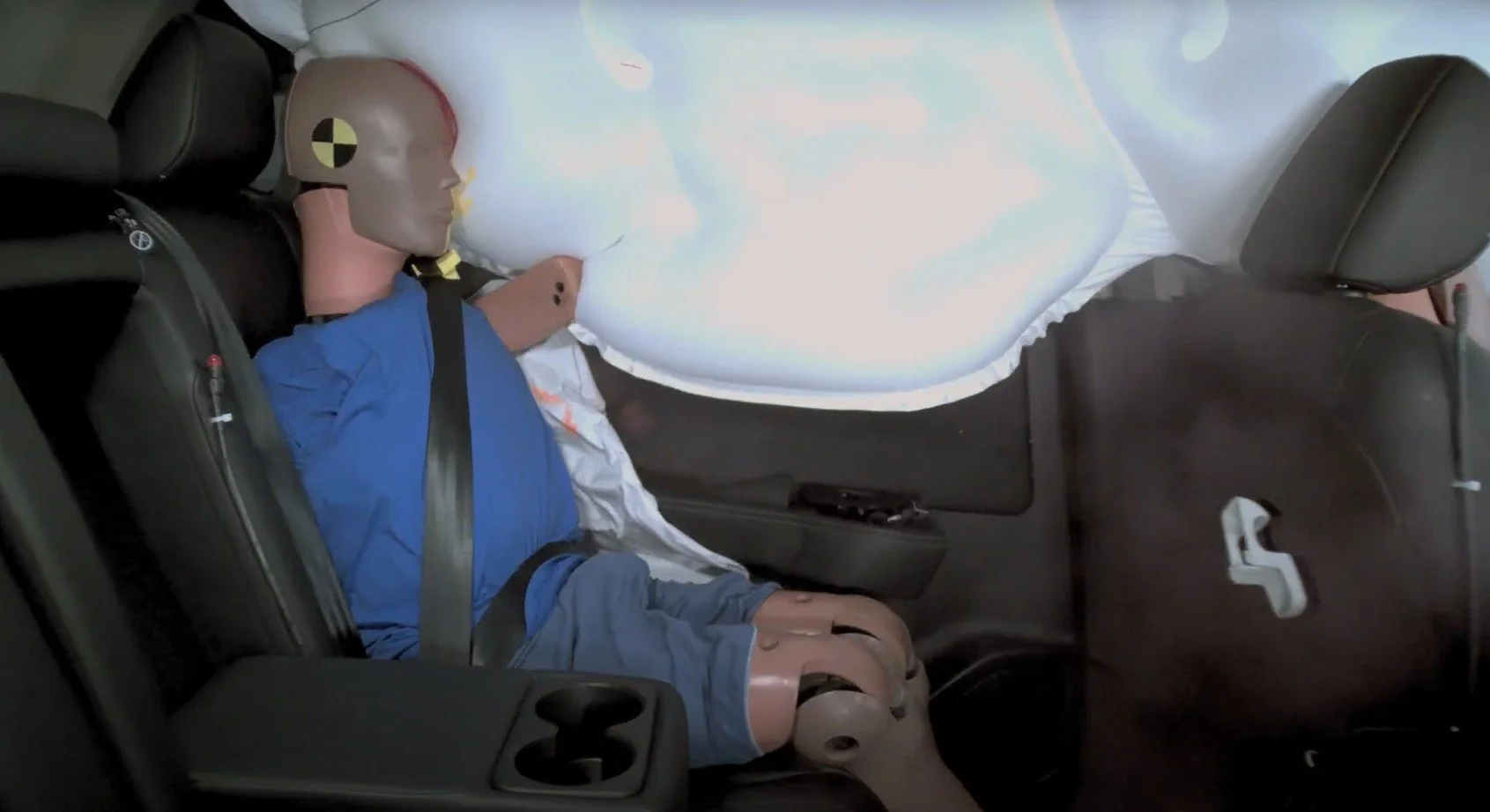
The Nissan X-Trail was crash tested by EuroNCAP in 2021 and gets a five-star rating. It was also tested by the Insurance Institute for Highway Safety as the Nissan Rogue as recently as 2025 when it received a 2025 Top Safety Pick rating.
The moderate overlap test conducted in in the US shows pretty good results, although not perfect, in this 64km/h test with 40 per cent of the X-Trail’s frontal area overlapping with the immovable crash barrier. X-Trail scored an ‘A’ for ‘acceptable’ which, in the IIHS testing regime, is more like a B+.
The X-Trail gets good results in both tests, partcicularly the small overlap test where only 25 per cent of the frontal area hits the barrier (also at 64km/h). This is a particularly severe crash test with high impact loads concentrated on a very small area of the vehicle. Here’s X-Trail actually did better than in the moderate overlap test, earning a ‘G’ rating for ‘good’.
What’s important in these tests is that the seatbelt pretensioners worked correctly and the airbags deployed as intended, meaning harm minimisation for the dummies was successful. You can read the full IIHS report on Nissan X-Trail here >
What’s interesting to note here is that X-Trail scores very well in testing despite looking like it bounces quite far in both the ANCAP and the IIHS tests when hitting the deformable barrier or the mobile barrier at 64km/h. Clearly the initial impact, which is the primary cause for concern, is being dealt with by the fundamental crash structures and the occupant protection systems are doing an outstanding job slowing down the dummies in the milliesecond domain.
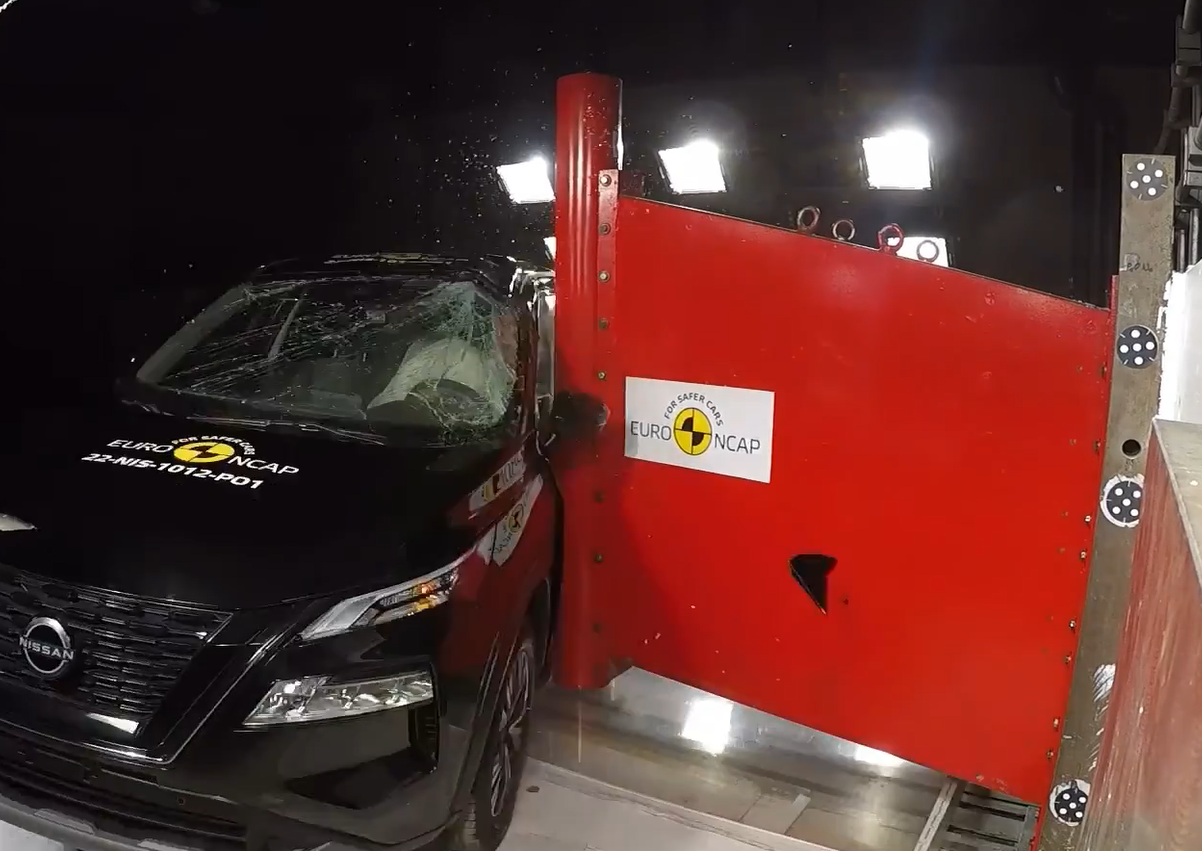
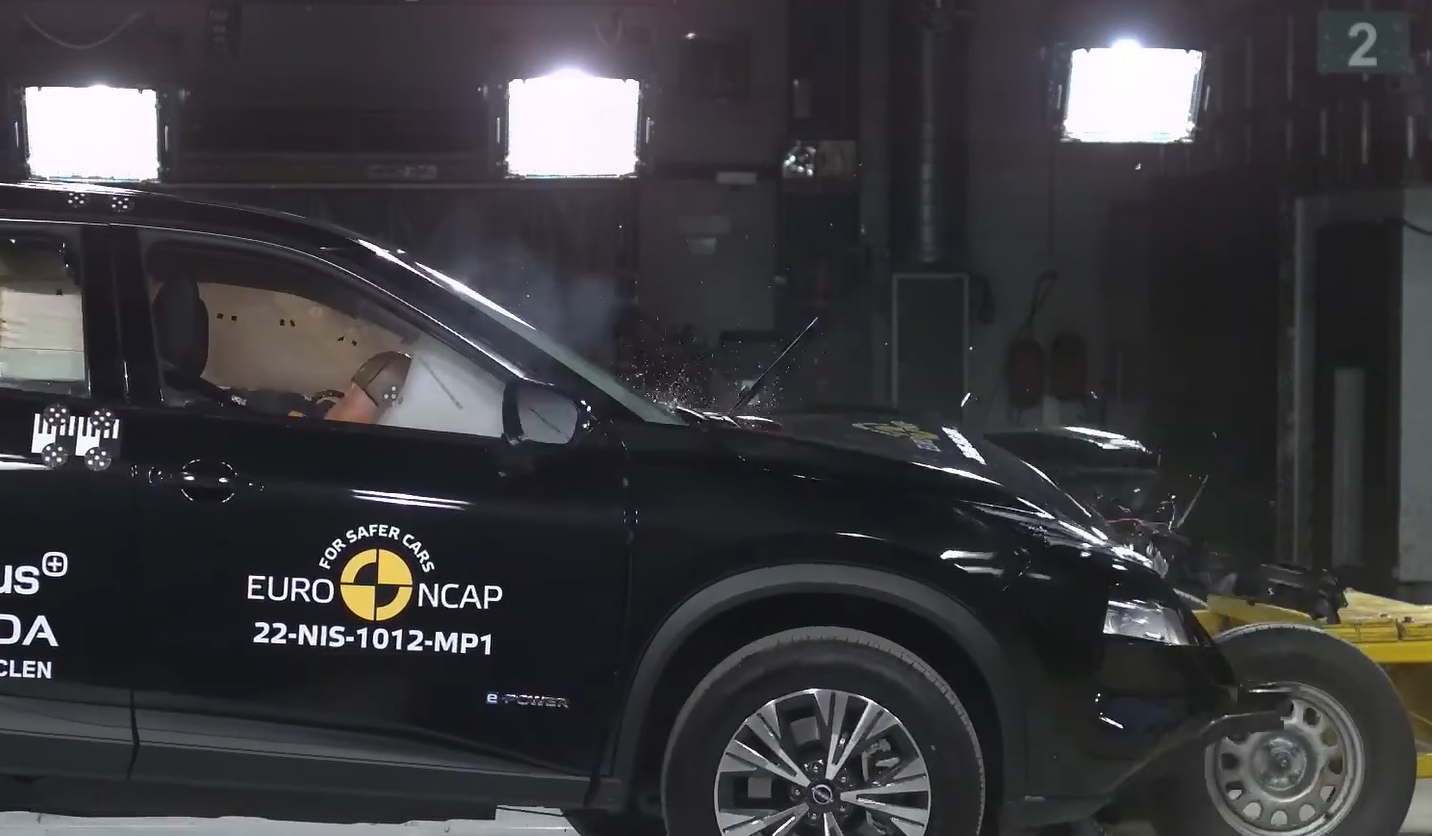
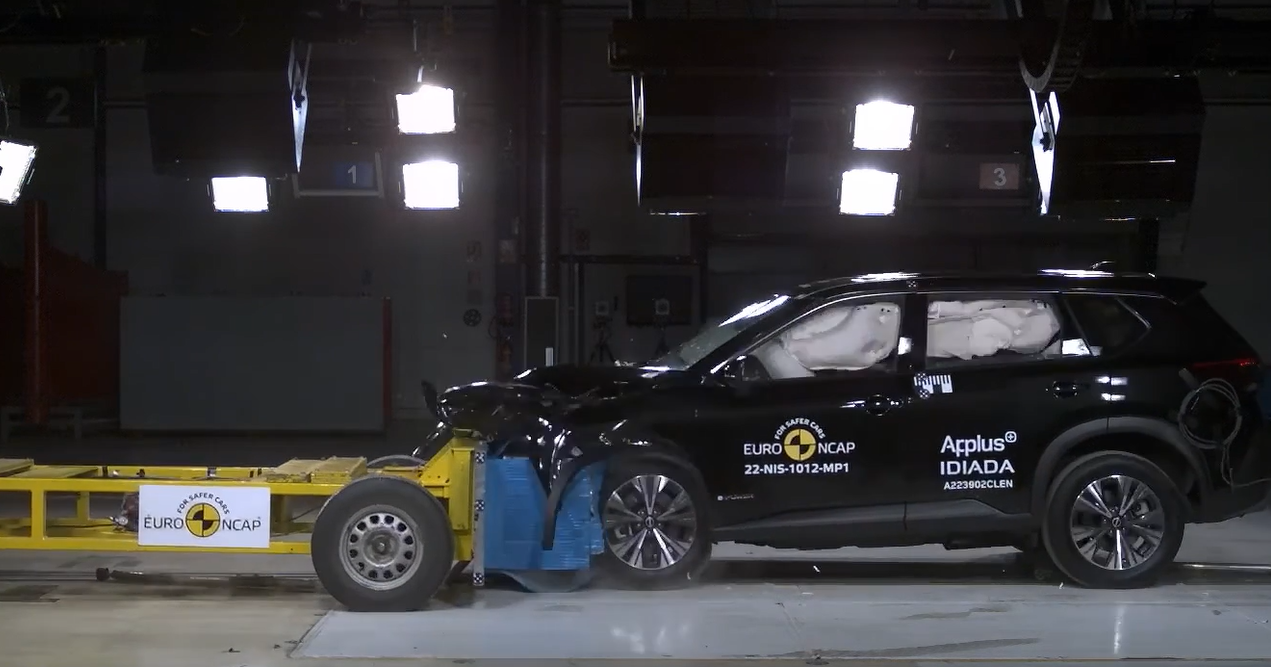
There’s a balance to strike here regarding the intervention of the crash prevention systems, such as auto emergency braking, between the X-Trail avoiding a collision with a cyclist early (but running the risk of being overbearing and premature in its intervention) and leaving it too late and missing the cyclist by a whisker (but also reducing the number of false alarms compared with reacting too early).
It’s fari to say the X-Trail seems to intervene at the Goldilocks moment and avoids pretty much all the extra-vehicular obstacles like cyclist, pedestrian and other vehicles - including motorcycles - with confidence. (It’s particularly good to see auto emergency braking in reverse included as standard even back in 2021 when tested).
But here’s the kicker: X-Trailw as last tested in the older testing regime, before the more involved motorcyclist test, for example, which newer vehicle shvae had to pass in the 2023-2025 protocols. So keep that in mind: the suits or tests the X-Trail has had to pass were not as extensive as some rivals.
Click here to download the Nissan X-Trail report >
X-Trail looks quite confident under those heavy emergency braking applications and holds up well in the destructive crash scenarios. But in the case of EuroNCAP, it’s facing off against a car-like 1400kg mobile sled, which is not the same animal as the 1700kg SUV representative sled in the IIHS testing, which would be much more realistic in the context of Australian roads.
What is certain is that hitting an X-Trail (weighing 1700kg approx) with a sled also weighing 1700kg is going to result in a lower survivability rate than agains the lighter, smaller one. This is how it looks in the original side impact test conducted by the IIHS in 2021 where you can see the point the impact starts, and how far away both vehicles finally come to a stop, about 10 metres away (or 2 car lengths).
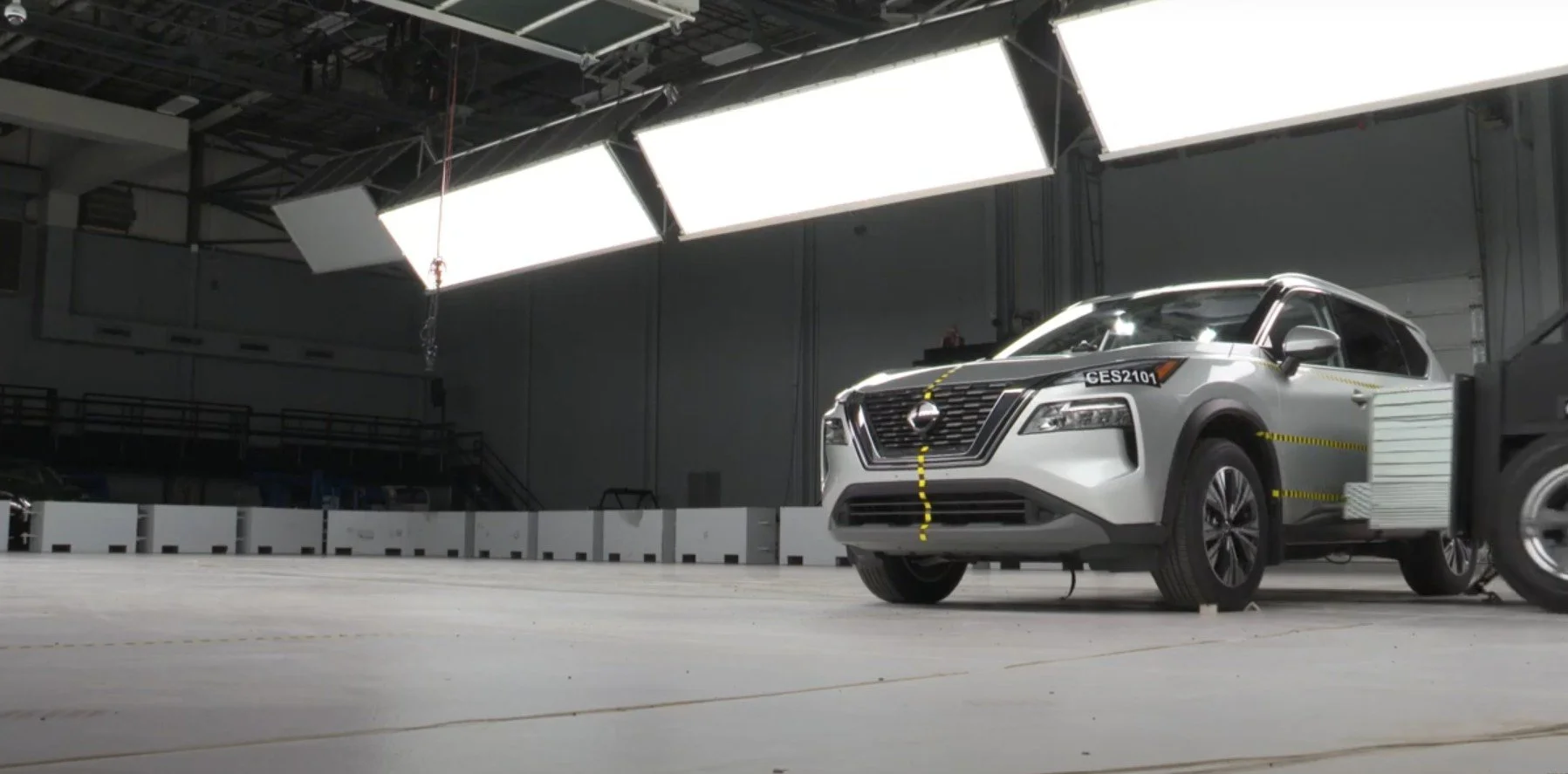
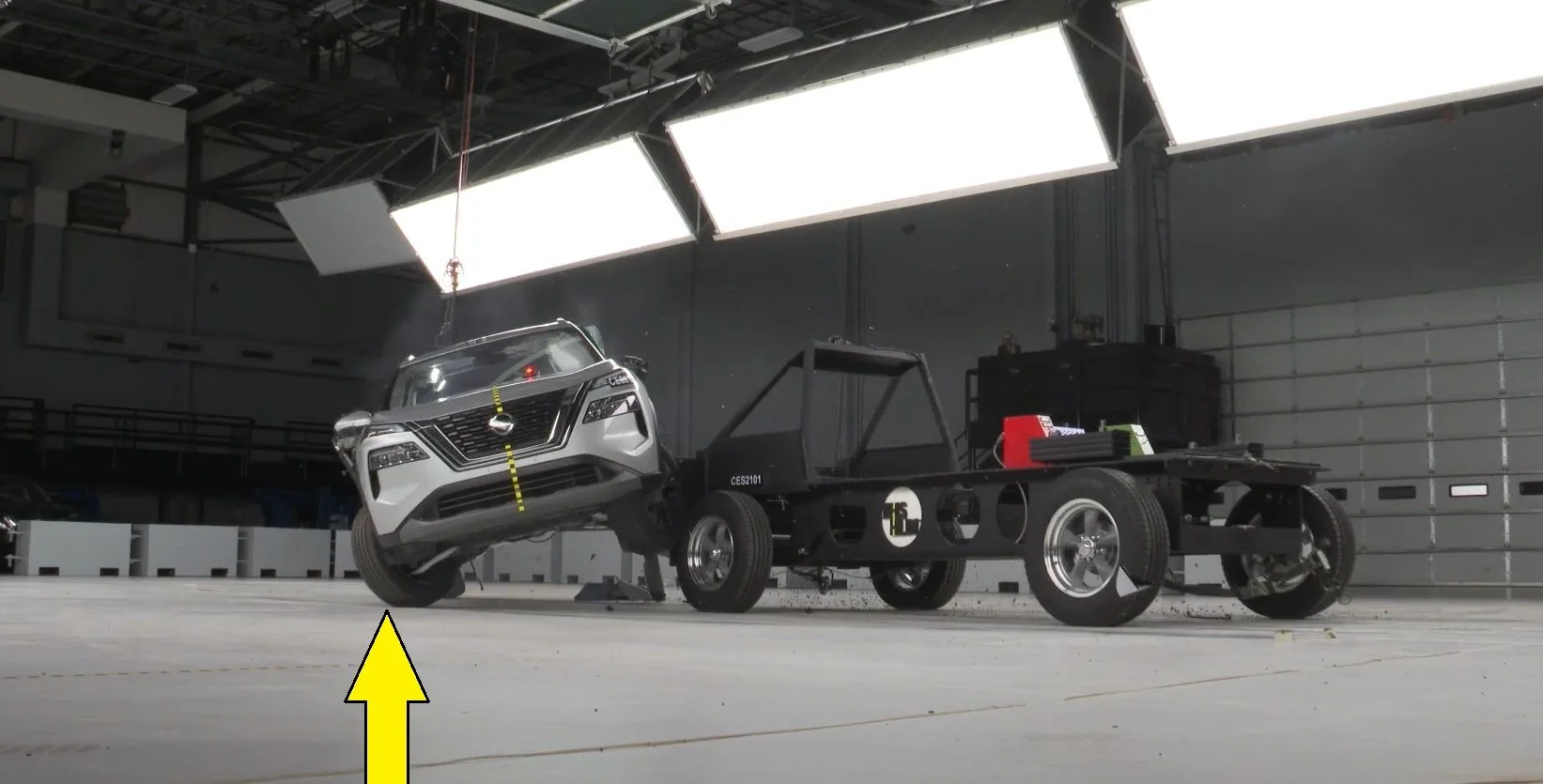
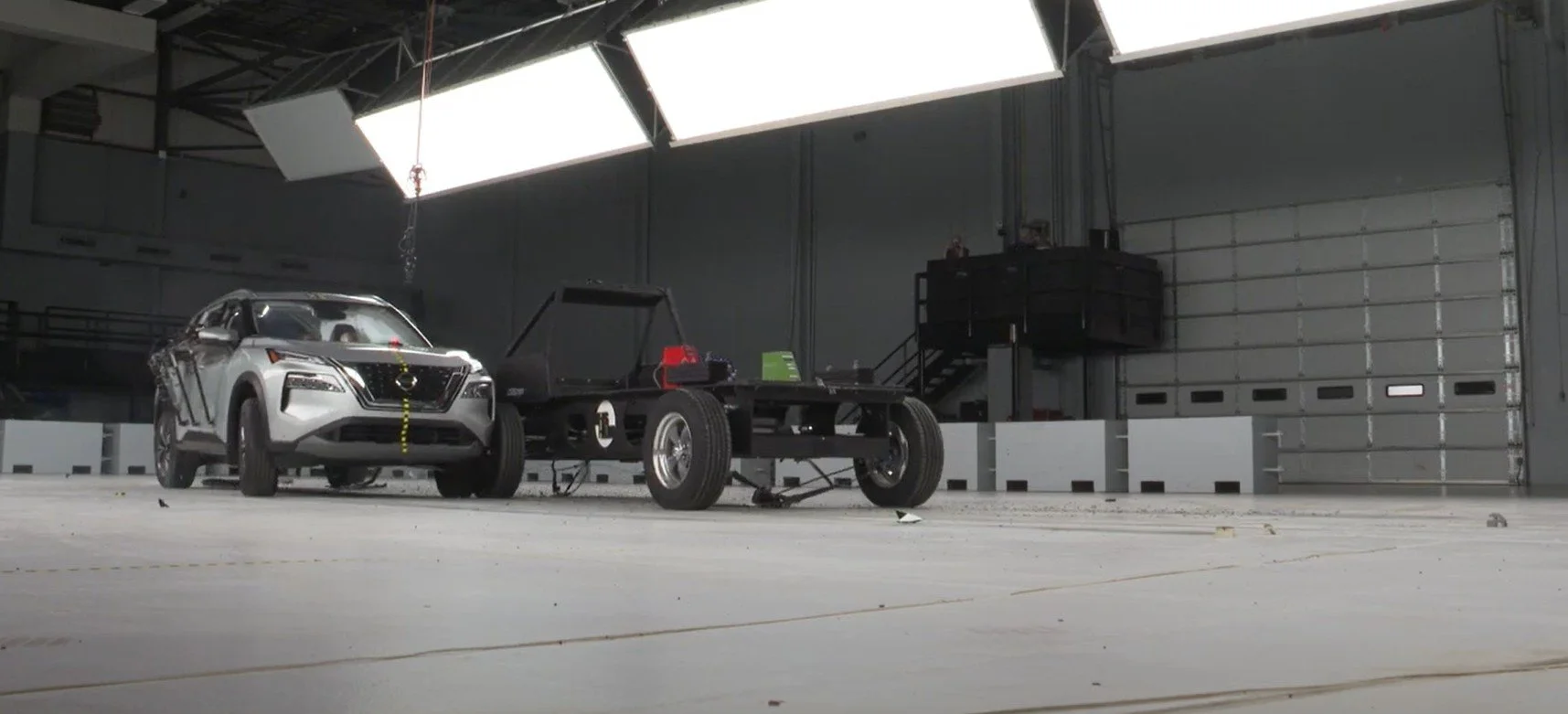
However, it’s also in the side impact test where we see the original X-Trail had to to be updated. Put simply, the dummy heads:
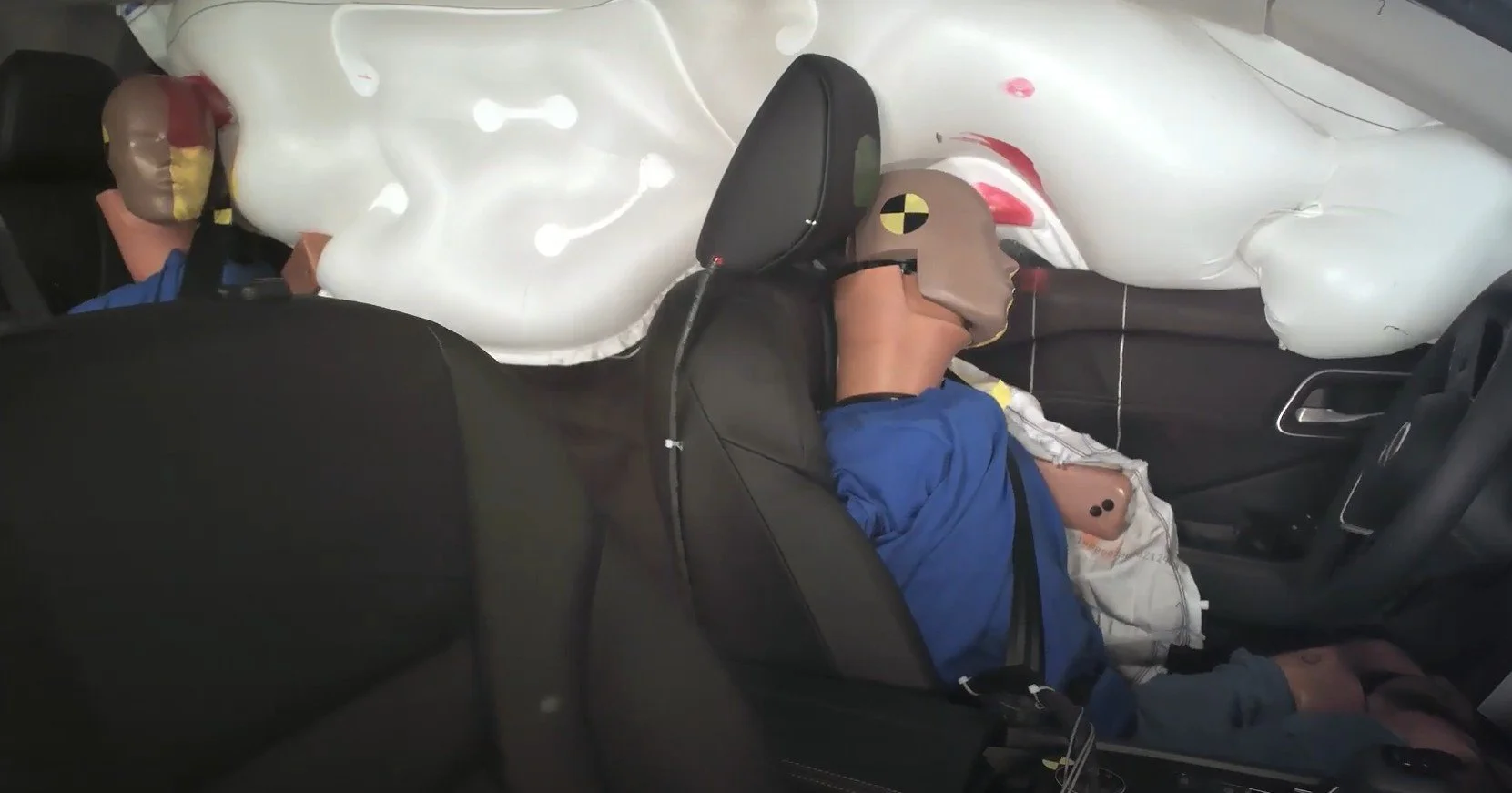
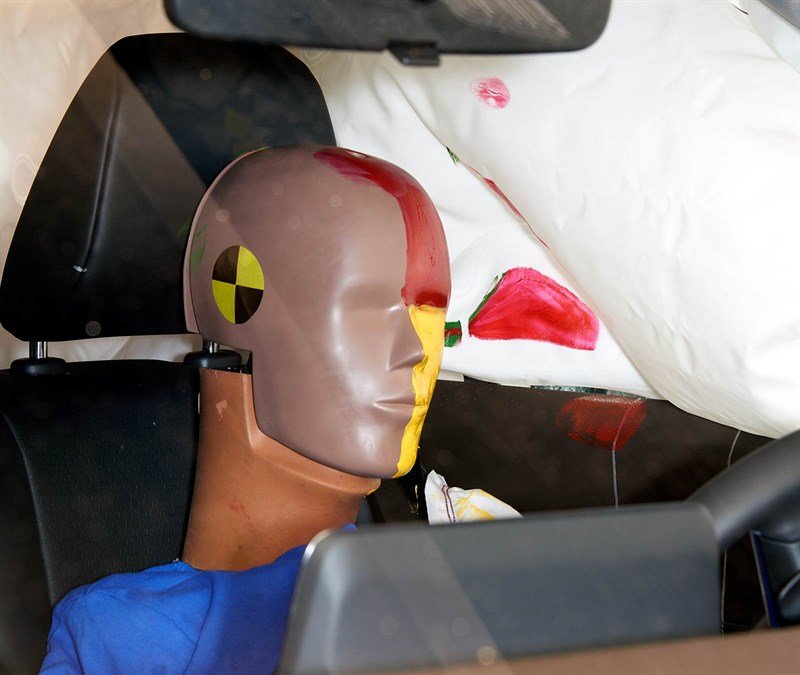
contacted the C-pillar hard, through the side curtain airbag. The head protection is inadequate.
The IIHS report explains that the rear passenger dummy head itself doesn’t actually hit the pillar through the curtain airbag, but in fact it comes to close to missing the airbag entirely that it must be penalised. This is because with only the slightest change in crash scenario, an occupant’s head could have easily:
produce(d) a direct hit to a person's head.
As for the driver' dummy’s head, it:
struck the window sill of the driver door hard, while the head was in proximity to the intruding barrier.
This phenomenon resulted in a ‘marginal’ rating for the pre-2026 Nissan X-Trail/Rogue. For 2026 models onward, Nissan has:
made changes to the side curtain airbags to improve occupant safety in side impact crashes.
The IIHS highlights that because Nissan has not changed the structure of the Rogue, it can use the internal testing data supplied by Nissan in re-testing (conducted in 2025) of the X-Trail’s side impact performance again. Otherwise, had they changed the structure, IIHS would not be able to re-assess and would have to re-test the vehicle again (because changing the structure is effectively making it an entirely new vehicle to crash test).

So as the very least, it’s good to see the X-Trail’s crash avoidance systems are effective, but what we are yet to find out is how it fares in the human factors test. Is it pesky and invasive and distracting to the point of being infuriating and overbearing, or is it manageable?
INTERIOR
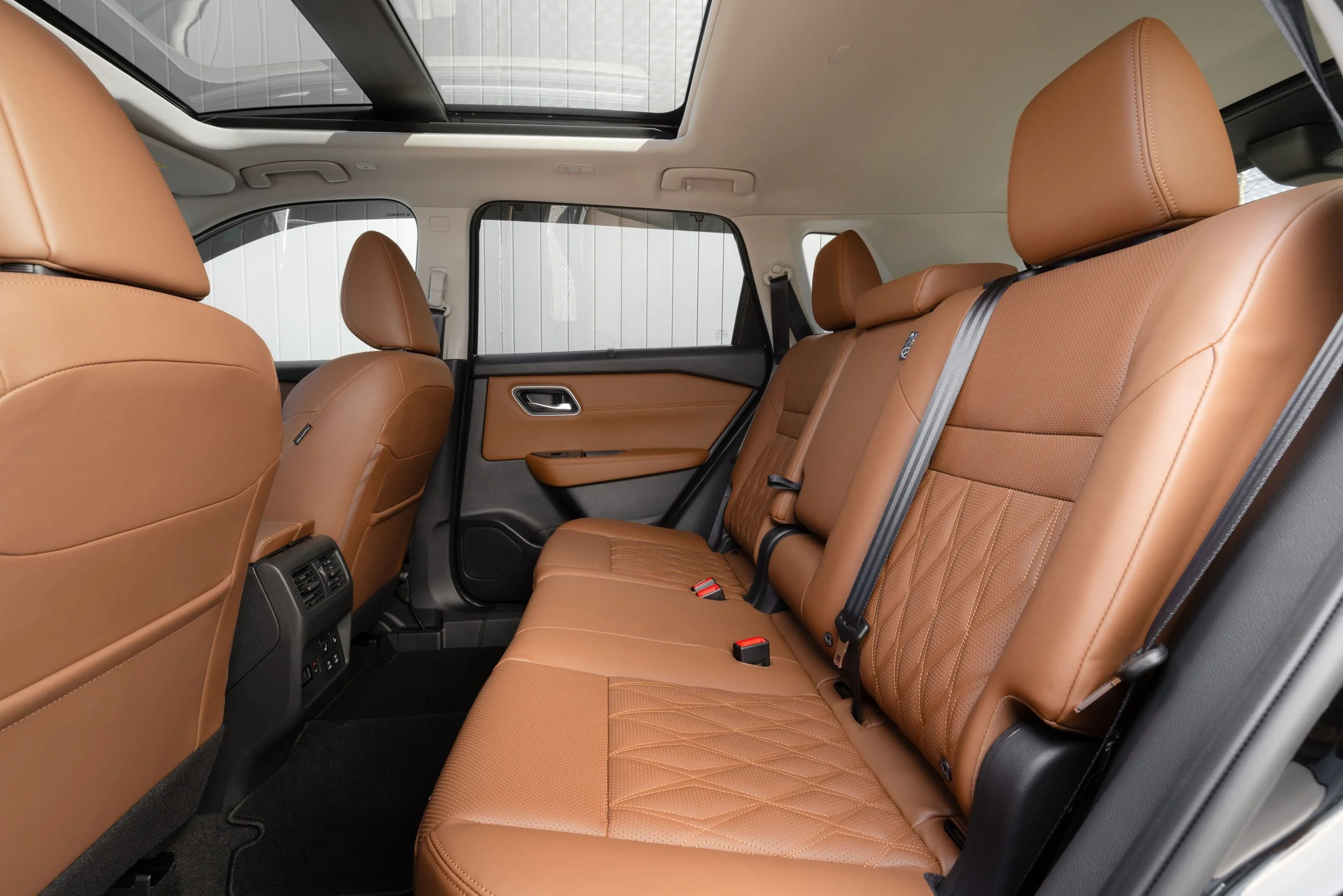
The interior on this $60K X-Trail in Ti-L model grade is unexpectedly good for a Nissan in the mainstream SUV section of the new car market. It does put a question mark over why you might consider spending more than that on something from Lexus, but the struggle here is that a Mazda CX-5, Kia Sportage or even a Mitsubishi Outlander offer similar or better.
We’re looking at the Ti-L in these pictures and as seductive as the tan Nappa leather is and, as airy and spacious as the cabin feels thanks to the double-pane sunroof, there isn’t much that sets it apart from the competition. And the further down the range, the sooner that lack of differentiation becomes apparent.
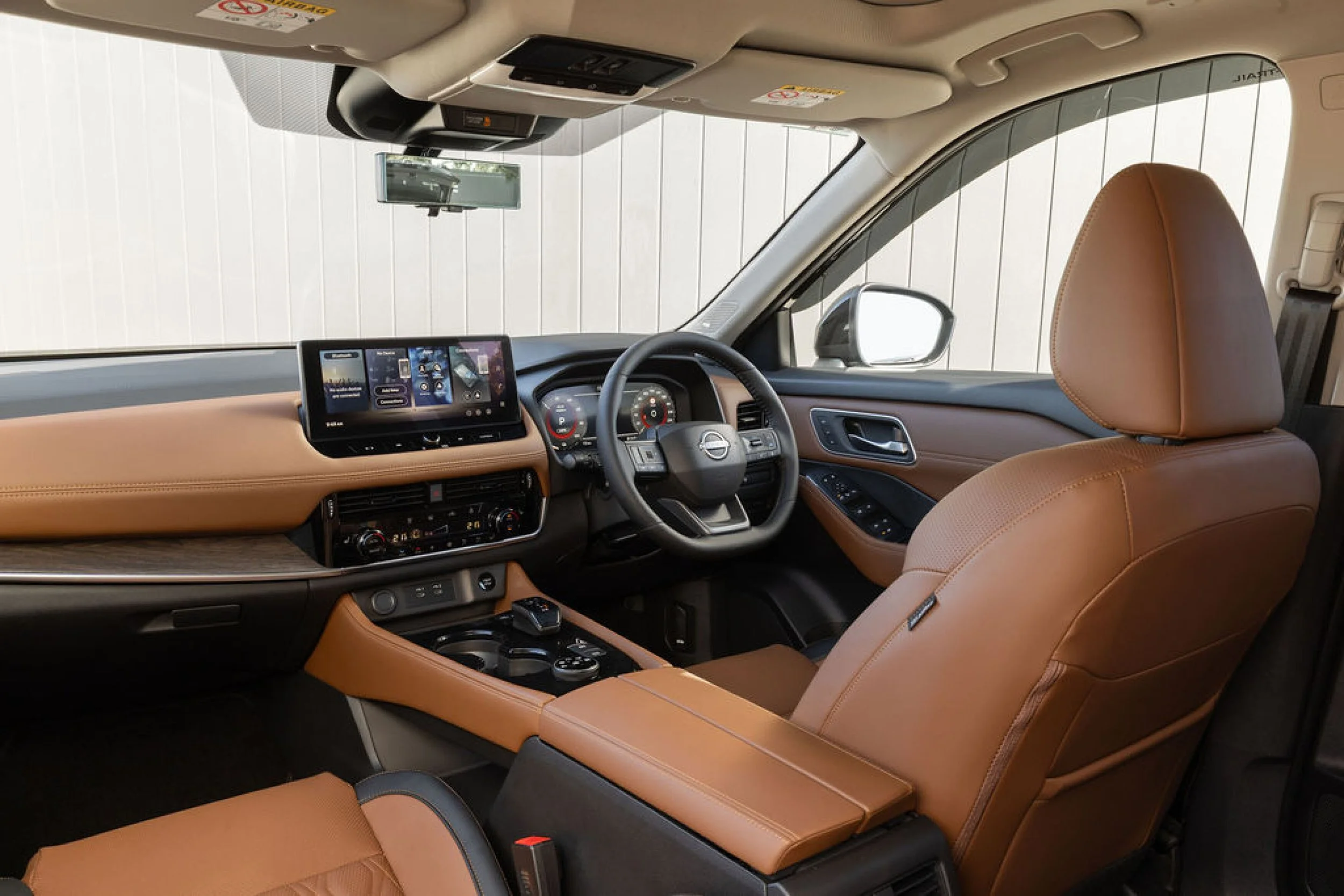


It’s nice to see Nissan has retained the conventional driver’s display binnalce that shades the screen from glare and reflections - hooray for bucking trends for functionality.
This logic continues to the layout of the HVAC controls: there are bottons. How weird it is to praise such a thing in 2026. The same compliment flows to the steering wheel, albeit looking strikingly similar to that of the Mitsubishi Outlander to which the X-Trail shares platform architecture, but credit to Nissan for not trying to fix something that ain’t broken.
The correct buttons are on the correct side of the sttering wheel: entertainment/comms on the left-hand side; vehicle controls/cruise settings etc on the right-hand side. Happily the indicators and wipers follow this standardisation rule as well: indicators on the right-hand side because we use them constantly in a prediminantly right-hand drive market; wipers on the left-hand side.


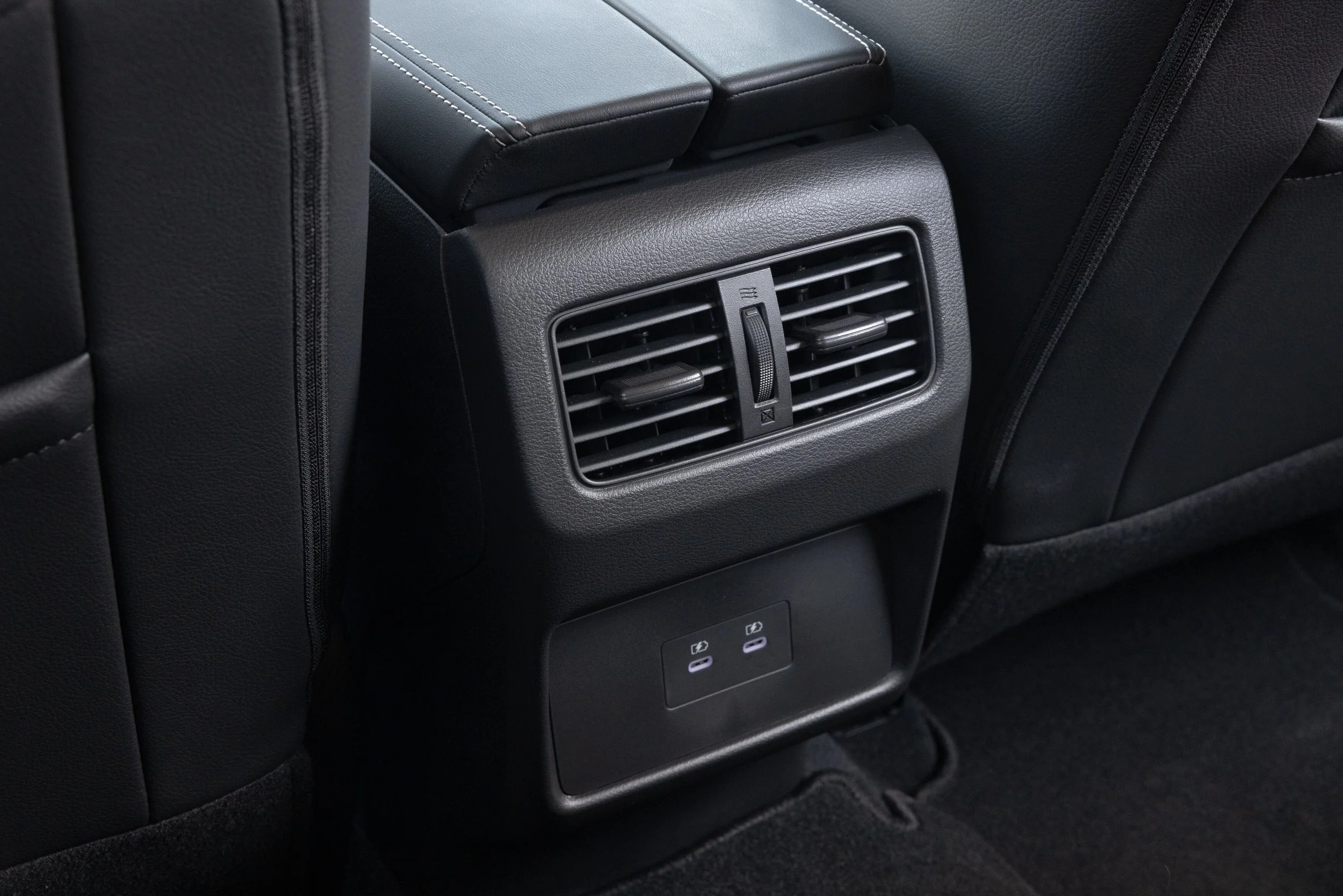
The use of a material on the centre console that is not piano gloss black is a welcome alternative than the swathes of the stuff used by Hyundai and Kia, and to a lesser extend Toyota and some of the Chinese brands.
Instead, you get a textured, grain-like surface that refracts light and also has a matte finish that refuses to let you see the dust and grease that acumulates over time. You can see this as either a positive or a negative, but at least you know now.
The infotainment screen is a landscape 12.3-inch job, the same size as what you’ll find in the Sportage or Tucson, and with a processing speed that’s about the same when you swipe or toch the various icons. It’s also nice to see the root menu and ‘home’ icons located on the correct of the screen, i.e. on the right-hand side (ya know, where the driver can reach them.)
There’s even a volume knob atop the dashboard so your dearly-beloved passenger can turn down the music you just cranked up. What a time to be alive.
What’s going to be important here is that you actually take out your phone and try connecting it, have a go with the X-Trail’s user interface, see how quickly it connects, and see if you can navigtate the thing before actually buying it.
Most new cars are going to feel nice to drive compared with your old car, but engaging with the features you’re going to use daily: the HVAC system, the media system, making a phone call are critical to making sure you don’t get stuck with an infotainment screen you hate for the next five years.
I'll help you save thousands on a new Nissan X-Trail here
Just fill in this form.
No more car dealership rip-offs.
Greater transparency.
Less stress.
ENGINE
Nissan wants you to truly believe they’ve developed some clever hybrid powertrain when in fact what they’ve done is a shambolic attempt to bamboozle you with words like ‘hybrid’ and ‘ePOWER’.
The total power output is 157kW, 106 of which is the 3-cylinder combustion engine doing its work in the background but not actually driving the wheels - at all. In fact, the combustion engine is so far up the powertrain that it becomes absurd when you realise a diesel Kia Sportage is putting out 137kW and 26 per cent more torque at the same revs.
So even though the official power-to-weight ratio from the X-Trail is 84kW/tonne (versus 78kw/t in the Sportage), the Kia is further up the road - and can tow 1900kg with an official 100kg towball download limit.
The 489 kilograms of payload in the X-Trail is also pipped by Sportage’s 496kg on account of the Kia weighing 7 per cent less. Yet again, diesel proves more efficient than hybrid.
Oh, and the official fuel economy figure on Sportage is 6.3 litres versus 6.1 on the X-Trail, meaning: negligible (it’s about 3 per cent). Official CO2 emissions are less in the Sportage compared with the 4-cylinder 2.5-litre petrol engine alternative, too.
Seriously, just buy the Sportage if measurable criteria actually matters to you.
The underlying engineering architecture is what we need to focus on, because it’s a crime against physics and a frontal assault on thermodynamic efficiency.
So aside from being complex, expensive, heavy and insufficiently fuel-efficient - and a Nissan Australia product - it sounds like a perfectly serviceable idea. (That’s sarcasm.)
Here’s an example of the absurd proposition Nissan Australia makes to you about the e-Power e-4ORCE X-Trail:
…unlike conventional hybrid systems, e-Power delivers an EV like drive experience all of the time without needing to plug in
So plugging in is bad, is it? No, it’s not.
Unfortunately, the cost of all of this phenomenal complexity is you get this situation: internal combustion touting itself as ‘electric’. It's bullshitting its way to electric green virtue. Because not only is using a petrol engine to charge a battery to power a motor not the most efficient way to do this, but plugging in is also a win for you economically.
Here’s the fact: Plugging-in is an advantage because the electrons are cheaper than the liquid fuel, typically. Especially if you've got rooftop solar and you're at home during the day and you plug in during the day. But even if you don't, the electricity is still cheaper.
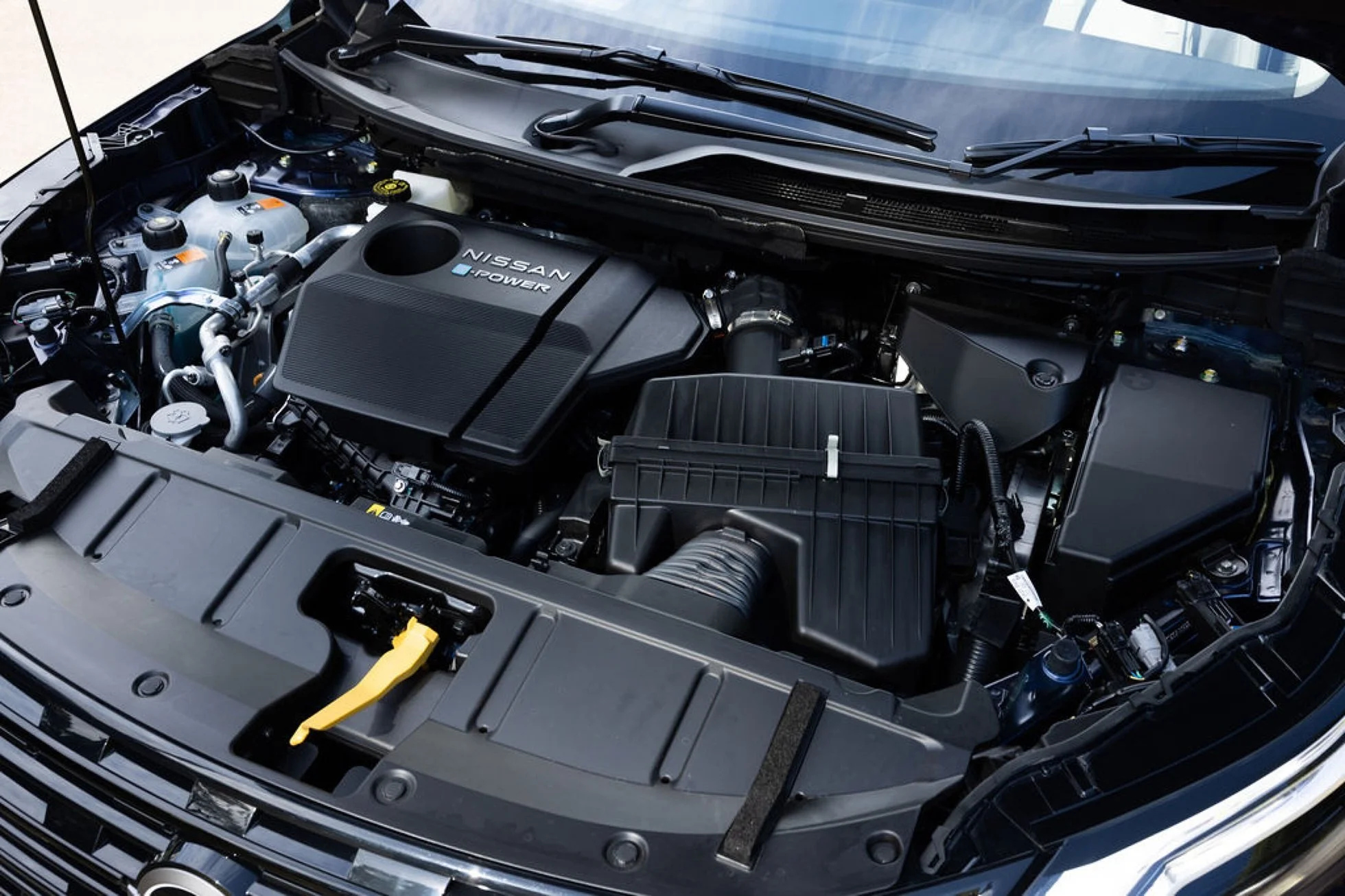
X-Trail’s 3-cylinder petrol uses clever variable compression ignition which is technologically impressive
If you're unfamiliar with the concept of the e-Power’s hybrid setup, it works like this.
You've got an internal combustion engine running all the time, whenever the wheels are turning, the engine is more-or-less burning, because it drives a generator. Just like the one you take camping, only somewhat more sophisticated.
The generator charges up a tiny little battery - in this case 1.8 kilowatt hours, which is utterly anorexic in the context of EVs - and even in the context of plug-in hybrids, it's anorexic.
Then you've got the battery driving an inverter that produces alternating current (AC) to drive the traction motors; there's one on the front axle and one on the rear axle.
So this is a very complex system with a lot of steps, and philosophically ‘moving’ parts, and there are definite second law of thermodynamics disadvantages to doing it that way. We get to that in the full video report above.
There is a real headline though (which is completely underrated here), which is that the 1.5-litre three-cylinder engine has variable compression ratio.
As I understand it, it's the first production example of a properly variable compression ratio engine, which is really brilliant - it just is. So, small round of applause goes to Nissan engineers for getting that across the line and working, owing to the technical complexity of achieving that.
But to save you the rather technical nature of this engine, I think if they had just come out and celebrated their new engine, I'd be in agreement because that is impressive. Getting VCR into production is very difficult.
Not sure I'd want to be a lab rat for the first couple of years worth of in-service testing, effectively, by owning the vehicle however. Because who knows what can go wrong with something this complex?
Until there are millions upon millions of in-service real-world kilometres under the belt, it's going to be interesting to see. I've got a great deal of respect for that engine, and that’s genuine praise for a legitimately beneficial technical exercise.
FUNCTIONALITY
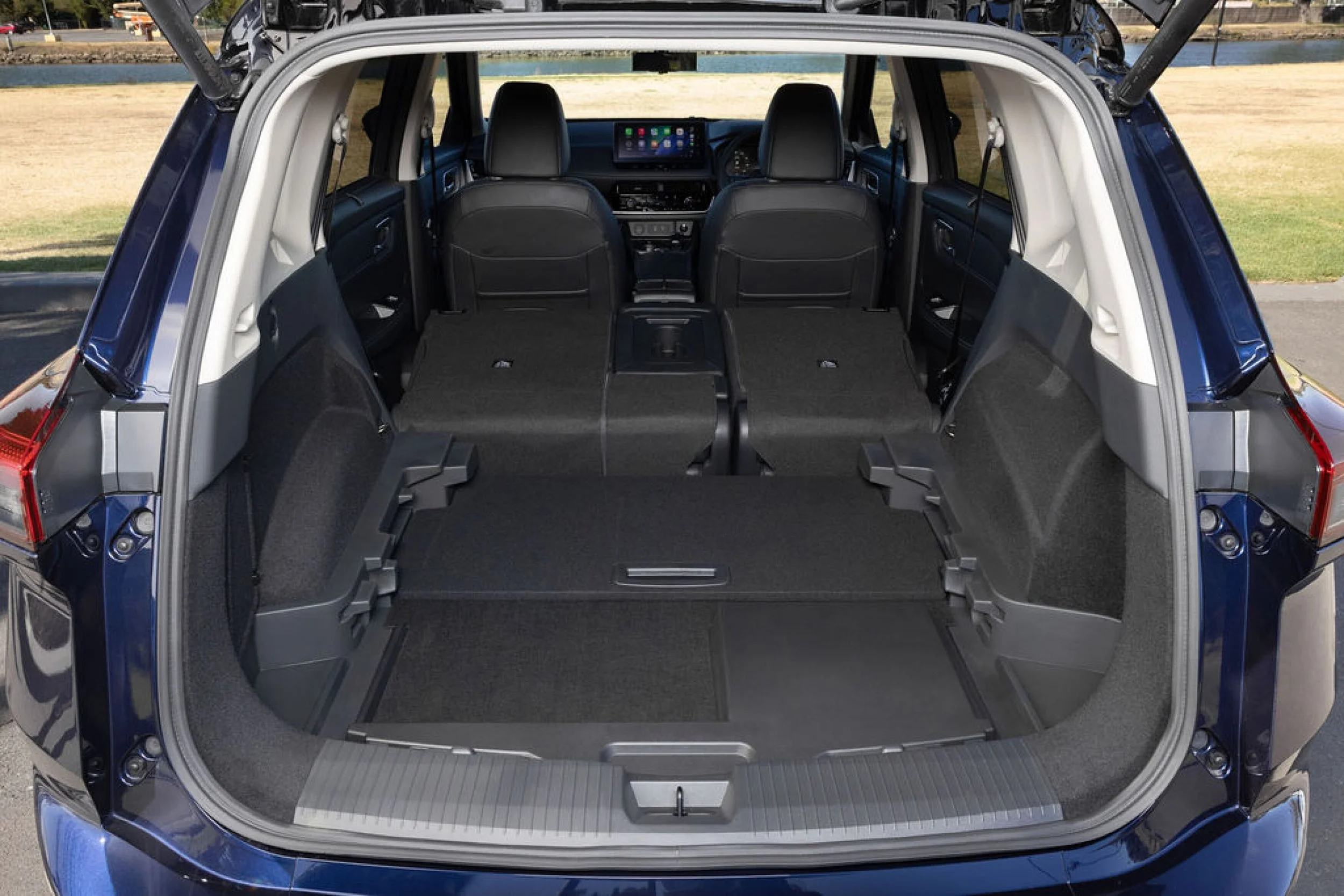
X-Trail has a unique selling proposition in terms of how you can do cargo management for those stereotypical Australian roadtrips, because you can adjust the floor panel to sit lower than its standard height.
Initially this seems like a clever idea, until you realise it’s only possible because of two things: 1. there’s no full-size spare taking up that extra inch or two of height; and 2. the battery is so small it doesn’t imponge on the cargo space. This is the engineering compromise inherent in hybrid packaging and design.
So the X-Trail does have an edge if you want an almost-flat floor, but would also like the ability to drop said floor slightly to offer you precious inches of visibility out the rearview mirror when you’re packing to the rafter, so to speak.
But the fact the hybrid lacks even a space-saver is s problem for regional mobility if you get a sidewall puncture, whereby the ‘tyre repair kit’ will likely be unable to repair it sufficiently. Fortunately the combustion-only X-Trail does get a space-saver, making it much more conducive for driving in places where the local mechanic (which doubles as a tyre fitter) closes at 5 and doesn’t open at all on Sundays (which is always when you get the flat, right?)


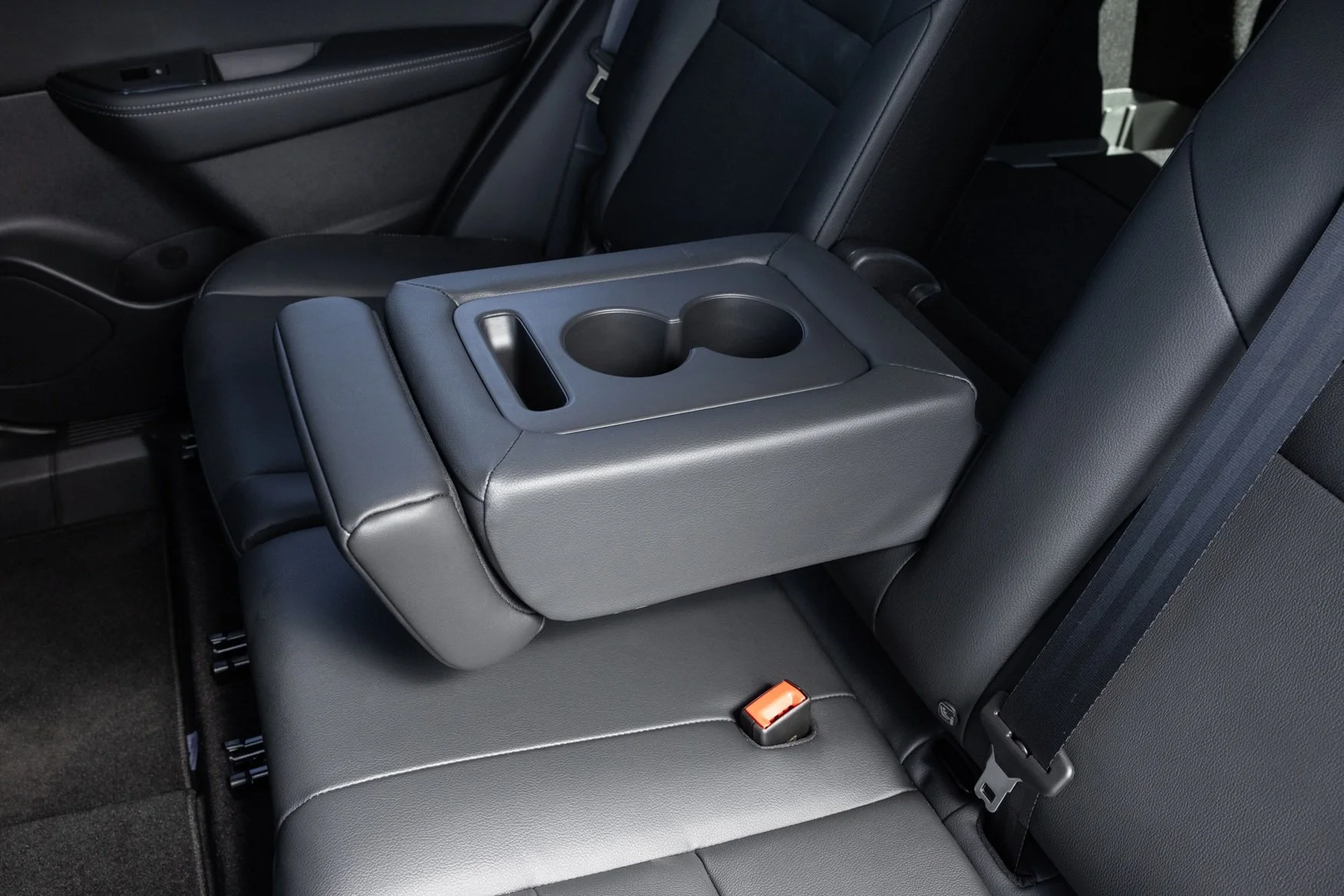
Fitting child restraint ISOFix tethers is phycally possible thanks to their easy location in the fold of the row 2 seats, but if you have reasonably short arms you are going to struggle clipping on the top tether anchor to its respective anchor point on the seatback.
This is because Nissan/Mitsubishi have attached it right down the bottom of the seatback, out of arm’s reach of most average-height parents. You’ll likely need to resort to lifting the seatback adjustment tab on the side of the seat to tilt it forward, clip the thether, and fasten the seatback into its original position.
Towing capacity on the X-Trail is a mixed bag in terms of functionality. You get a rated braked capacity of 2000kg on the convetional petrol powertrain, which reduces to 1650kg for the hybrid.
But what’s concerning here is that Nissan Australia makes no effort to publish what the towball download limit should be for either the hybrid or the petrol. This makes it difficult for you to do the responsible thing and accurately measure your trailer and X-Trail’s respective weights.
See if you add a trailer to the back of your X-Trail you’re also adding payload to the vehicle in the form of towball download - because the X-Trail has to carry the trailer, obviously. But if you don’t know what the towball download limit is, you could be, notionally, overloading the vehicle by adding 10 per cent of the 2000kg max trailer weight.
With a gross vehicle mass of 2135kg, and sporting a 1678kg kerb weight, that only leaves you with 457kg of payload capacity. This is starting to make sense as to why they haven’t told you the towball download limit. Because if you add two adults at 100kg each, and two kids at 50kg each, that’s 300kg of payload, with just 157kg left. Take away 7kg for the child restraints they’re sitting in, now you’re at 150kg - which needs to include the towball download.
See the problem yet? If the towball download limit was, hypothetically, 10 per cent, ie 200kg - you’re overloaded putting that on the back of your X-Trail. And you haven’t even put any luggage in the car; just your family.
Let’s hypothosise the towball download is actually 100kg, that’s 5 per cent of the maximum braked towing capacity of 2000kg. It’s also a potentially dangerous towing set-up having just 5 per cent borne by the X-Trail, which itself weighs less than 1700kg. Only 5 per cent leaves the towing combination susceptible to invoking trailer sway, notionally.
Putting the towing aspect to once side, the X-Trail does redeem itself by offering decent luggage space in the boot itself. You get 585 litres.
DRAWBACKS
The lack of a full-size spare on either powertrains variants of X-Trail, not even on the poverty pack petrol version, is a serious let down for a vehicle Nissan is encouraging you to take into the hills.
You do get a space-saver on the X-Trail with the 2.5-litre engine, but for the e-Power so-called hybrid, it’s a tyre repair kit only. This is not to say these options aren’t useful if it’s just you on board, sure, they’re okay. But if you intend to fill the boot, put kids on every seat, maybe even do that light towing assignment to take the family camping on some slippery mountain backroad, it’s a good idea to be running on correct-sized rubber.
The reason you should want to be driving on matching tyres is because of the fact you’re getting on-demand all-wheel drive from an electric motor. If you’re driving in wet conditions with only three full-size tyres and one skinny, it can cause dynamic instability when cornering and braking. The last of contact patch can mean braking is compromised in emergency stopping situations.


And of course the primary drawback with the hybrid X-Trail is the aforementioned hybrid system itself which is pointless in terms of trying to conserve fuel or be environmentally conscious. Burning fuel to run a generator to charged a battery is just adding processes which inherently lose available energy every time you do it.
It would be more beneficial to just burn the fuel to drive the vehicle - it’s a thermodynamics fact.
MAIN COMPETITORS
Mazda CX-5

Certainly the best-looking of the bunch, but Mazda’s styling, and being nice to drive, doesn’t necessarily make up for such a small-ish boot (442 litres rear seats up/1342 litres rear seats down), a space-saver and a 10,000km first service interval. The 360 degree camera is a bit underdone, but not terrible.
The 2.5 turbo petrol makes up for reduced stowage - so does the epicyclic auto transmission kickdown switch. It takes regular 91 RON, there’s no hybrid or diesel option anymore. But you do get a decent 193 mm of ground clearance which is very close to the ground clearance class-leader, the Subaru Forester.
The new CX-5 is hardly new, it’s exactly the same platform that debuted back in 2015 (11 years ago), but having said that, CX-5 gets good resale value, it;s very highly equipped and probably still holds the crown for best medium SUV interior. Remembering of course that it’s the interior we spend the most amount of time in.
Kia Sportage GT-Line: $54,990 driveaway:
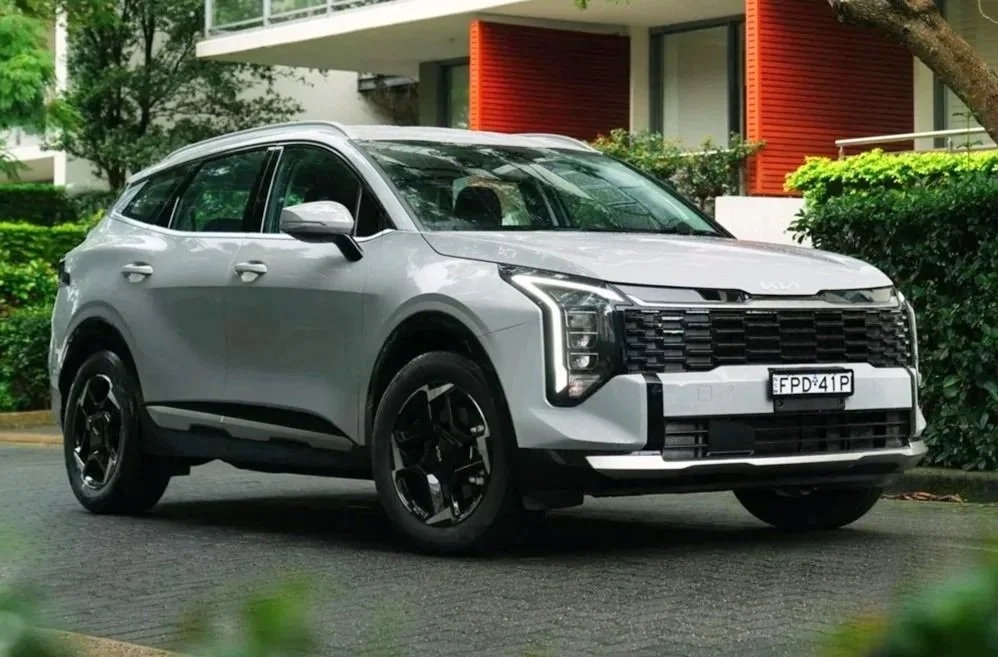
Not quite as smooth as the CX-5 in petrol form, but the diesel is sublime. (Everything above for Tucson, pertains to Sportage as they’re essentially the same vehicle.)
Kia’s 2.0-litre turbocharged diesel is a masterpiece in urban environments, especially compared with the 1.6 turbo-petrol with dual-clutch transmission.
Diesel comes with lockable all-wheel-drive, 1900kg towing capacity (1.6 petrol - 1500kg). On the road it’s really well sorted out, dynamically, it’s well damped and agile when you’re on the move without feeling bulky and cumbersome. That’s the local suspension tuning that Kia does - it’s a real point of difference versus Tucson.
Sportage GT Line is expensive, compared with its more affordable sub-variants, but you get trimmings: 19-inch alloys (with matching spare), proxy key, flat-bottom steering wheel with paddle-shift, front powered seats, bi-xenon lights, LED foglamps, powered tailgate, wireless phone charging, all the collision avoidance gear (incl adaptive cruise) and auto parking.
A strong on-road all-rounder with lots to offer, excellent customer service and loads of standard equipment. Plus, Kia offers a 7yr warranty.
Toyota RAV4 Edge: from $52,333 before on-road costs:
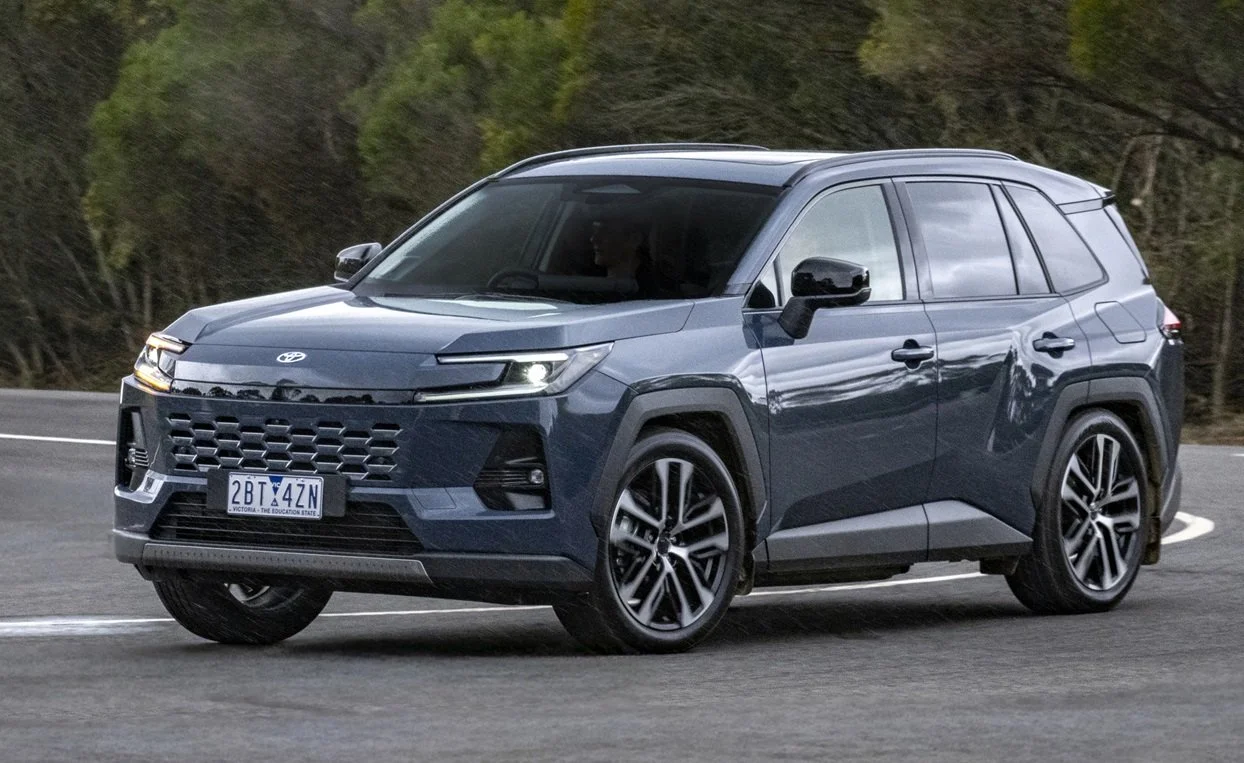
A popular all-rounder from the country’s top-selling car brand. (Toyota is still experiencing massive delays on some models so don’t be surprised to learn that ‘your’ RAV4 is 12 months away.
RAV4s are good enough (just). As market leader, Toyota does the minimum required to stay on top, and this is reflected in the vehicles. They are, however, typically reliable, and the resale value is high.
Good luck getting your RAV4 Hybrid on the 6-12-month waiting list, but when you do you’ll enjoy 542 litres of boot space, but also at the cost of a space-saver spare lurking beneath the boot floor. Reliable, grunty petrol and hybrid powertrains (although naturally aspirated isn’t particularly explosive) and no diesel.
Top-spec price at $52k is hard to swallow considering towing is capped at 1500kg braked in AWD/hybrid, and just 800kg braked in 2WD variants. Hybrid is comparatively heavy too, at 1745kg (kerb). Only 195mm ground clearance. Pro Tip: Getting the Hybrid means filling with 95 premium petrol.
Mitsubishi Outlander Exceed: from $52,000 driveaway:
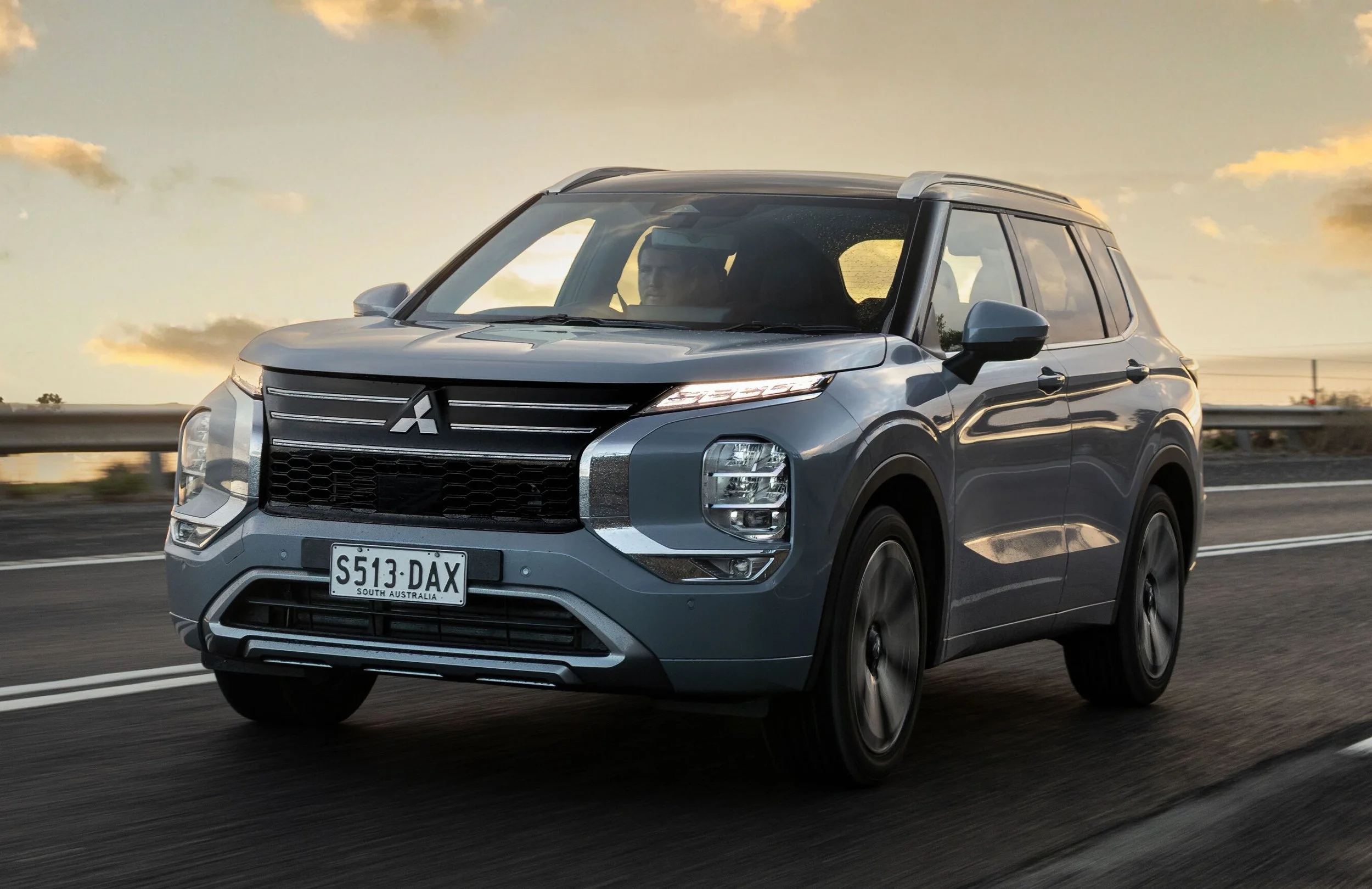
Respectable in almost every sense, except where aesthetics are concerned. That face... Still, you can’t see it when you drive.
If you want practicality in spades, the only seven-seater in this group is the Outlander. (It is pretty cramped back there, however.)
What the Outlander does is offer occasional-use third row seating for .
You get the same 2.5L atmo petrol engine from X-Trail, 8sp CVT with paddle-shift, good equipment levels including entertainment and safety systems, adaptive cruise, auto emergency braking and the rest, plus pretty good boot space at 477L (third row down). Plus there’s five extra years of warranty (total of 10) if you get the car serviced on time at a Mitsubishi dealer.
Offers 7-seat functionality for the price of a 5-seater, generous luggage space, pretty good AWD system called Super All-Wheel Control which rivals Subaru AWD, and plenty of features. Takes 91 fuel; gets a space-saver spare.
Hyundai Tuscon Highlander: from $50,619 driveaway:
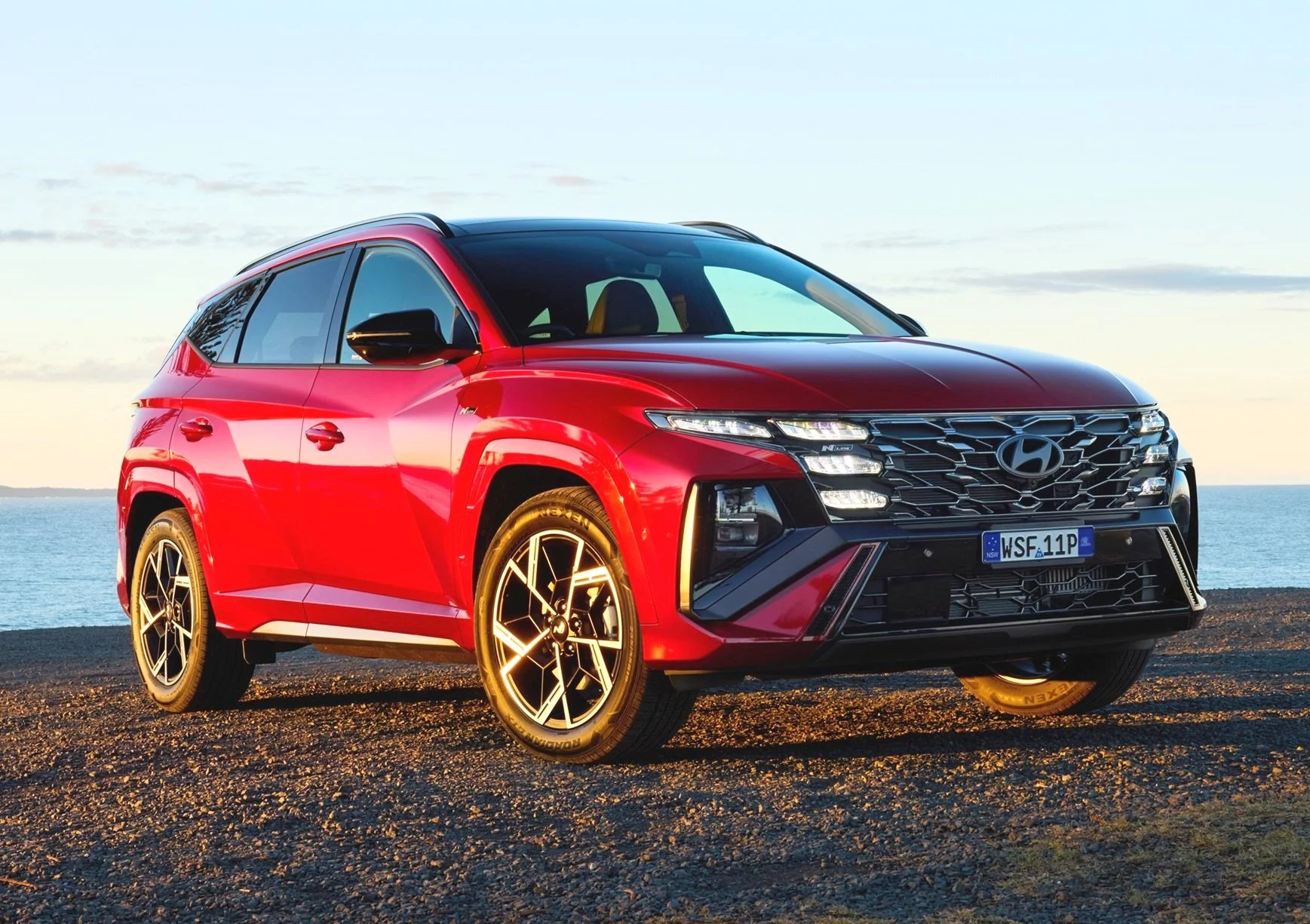
Possibly the best value mainstream mid-size SUV. It is basically the same vehicle as a Sportage, with different styling and design execution.
The Hyundai 1.6L hybrid powertrain is unbelievably smooth for city commuting and suburban running around, and a cargo space to meet that parental brief.
You get great mid-range power and good fuel economy with a slick interior and fantastic driver ergonomics. A unique Australian ride and handling tune makes it one of the best medium SUVs to drive on our terrible roads.
Highlander spec does give you all the safety gear, from adaptive cruise to auto emergency braking etc. Hyundai’s customer care is slightly better than Mazda’s, if something goes wrong. Great customer support from Hyundai Australia, too.
Subaru Forester (Hybrid Touring: approx $62,000 driveaway)
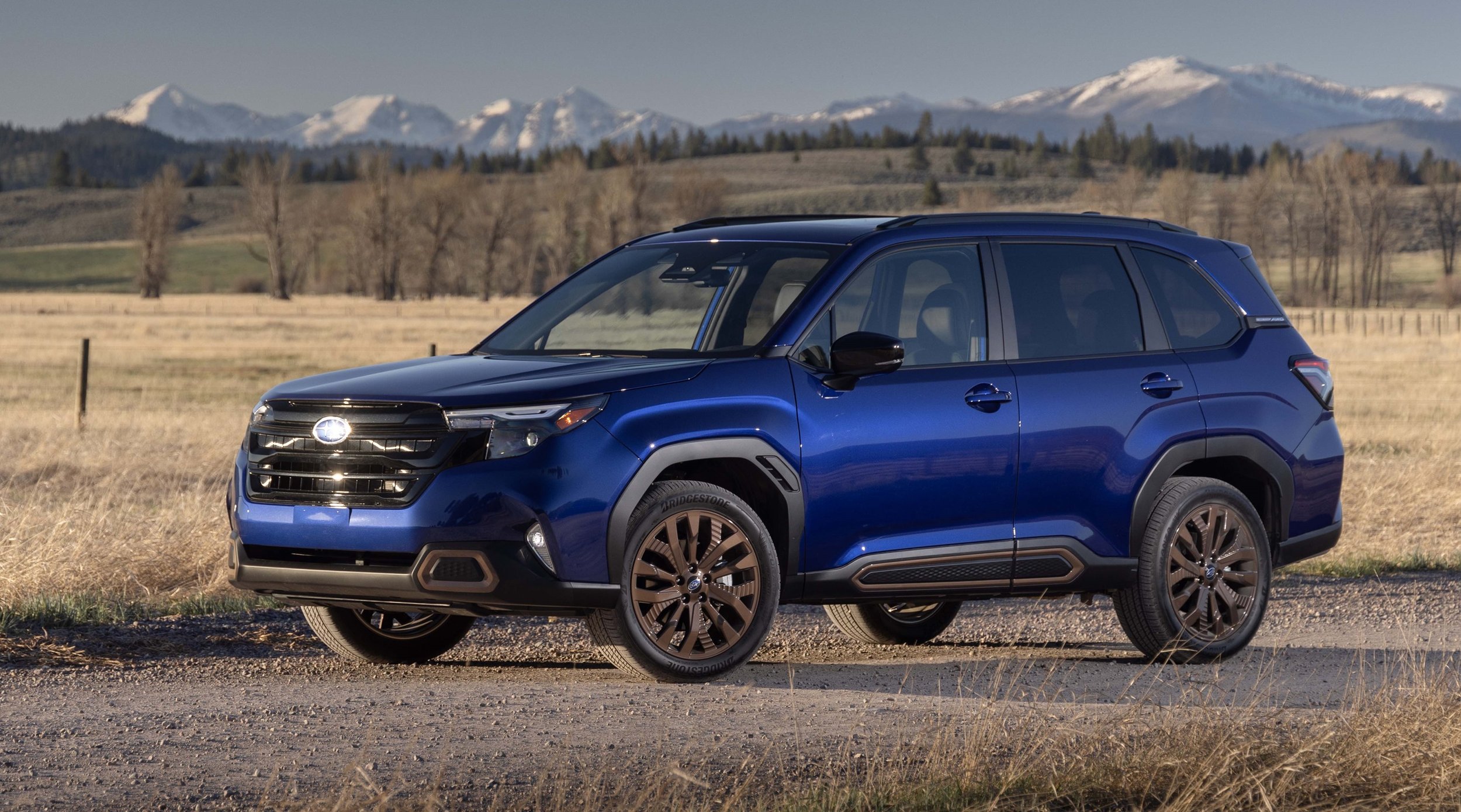
Undoubtedly, Forester is the most soft-roading SUV. The next step up for going off-road involves a low-range gearbox, locking differentials, but Forester is not that.
Forester’s X-Mode, combined with Subaru’s renowned symmetrical all-wheel drive is excellent for light to moderate conditions like wet compacted sand, dirt and gravel tracks, traipsing up and down slippery slopes and heading up to the snow without chains (but definitely with an air compressor) aboard.
Forester also offers the best ride height: 220mm. Plus, superb ergonomics, and 498 litres of luggage space. It also has the tightest turning circle of the group at 10.8m versus 11m on CX-5, RAV4 and Sportage, while taking standard 91 octane petrol.
A full-size spare treats your safety with greater respect in the boonies. Subaru’s CVT drones a bit, but it is one of the better-implemented CVTs around. If you’re the regular camping type, Forester is a hot contender.
A hybrid is available which is now a decent powertrain choice, but the petrol-only is still nice to drive without being the silkiest to drive. But the CVT integration is smooth, despite the ignorance out there in the public. A reasonable light towing capacity and good luggage space with a full-size spare wheel under the floor make it practical for regional Australian use.
CONCLUSION
It’s important to contextualise the Nissan X-Trail and remind you that this is not a bad vehicle. In fact, it’s surprisingly impressive in implementing some very tricky combustion technology. We just don’t know what the long-term reliability of that innovation will be - and it could actually prove very good.
The other aspect to this vehicle is that it has imprints of Mitsubishi on it as well, because it’s the platform with which they’ve also based the Outlander on, and Mitsubishi tends to be the adult in the room of the alliance with Renault and Nissan. At least in an historical sense.
The X-Trail just over complicates the implementation of a hybrid powertrain. Now complexity isn’t necessarily a bad thing if the end result is reliable, and derives a benefit like economy, performance or some combination of both.
But the hybrid X-Trail does neither of these things. There’s no compelling reason to buy the hybrid apart from its EV-adjacent driving behaviour. It kinda feels like a hybrid to drive, but the petrol engine comes on in weird moments and is only charging the battery, which is less efficient than just driving the wheels directly.
For this reason, you’re left with the regular 2.5 petrol 4-cylinder X-Trail and that’s just an Outlander in different clothing, which you can also get an 7-seat configuration. So why bother with the Nissan?
Then there’s Nissan Australia itself. As a commercial entity into the future, you’d have to look at the struggling sales and wonder how their dealer network can sustain its current footprint when they’re only selling the Patrol, Navara, X-Trail and Qashqai - the latter three of which are fighting for sales.
Against the influx of Chinese alternatives, it can really only be Nissan’s fleet sales offering stability, because X-Trail sales are half of what they were in 2025 and there are now even more models to choose from than there were when it launched in 2023.
The very last point to make related to all of this is that as the brand continues to struggle, customer technical support, onshore parts and dealer technical investment will dwindle as the financial chasm widens for Nissan Australia. Furthermore, depreciation will hit the X-Trail harder as the sales decline and fewer people want to own one in the second-hand market.
For now, it might be worth erring on the side of caution and trying the Mitsubishi Outlander instead.

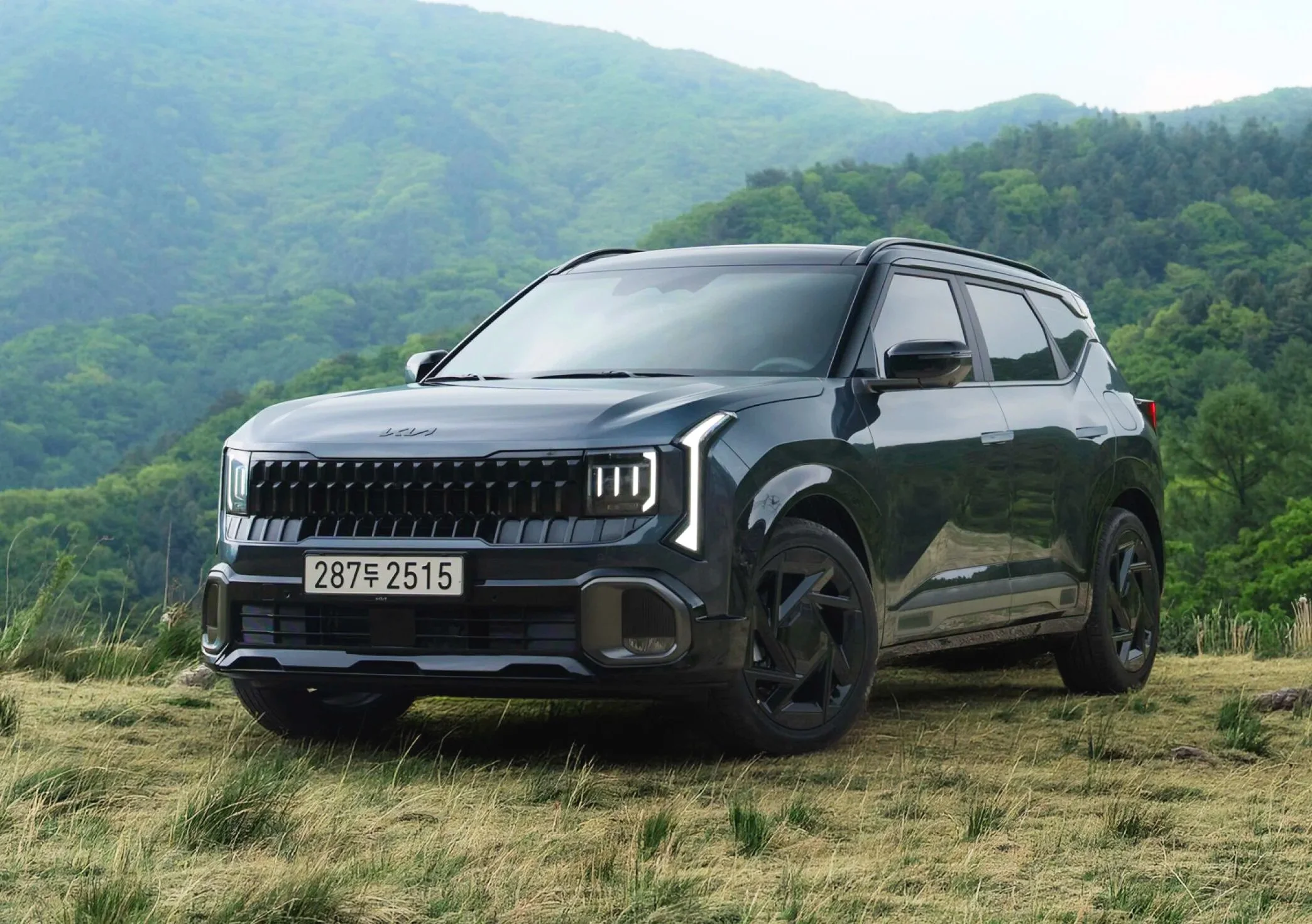
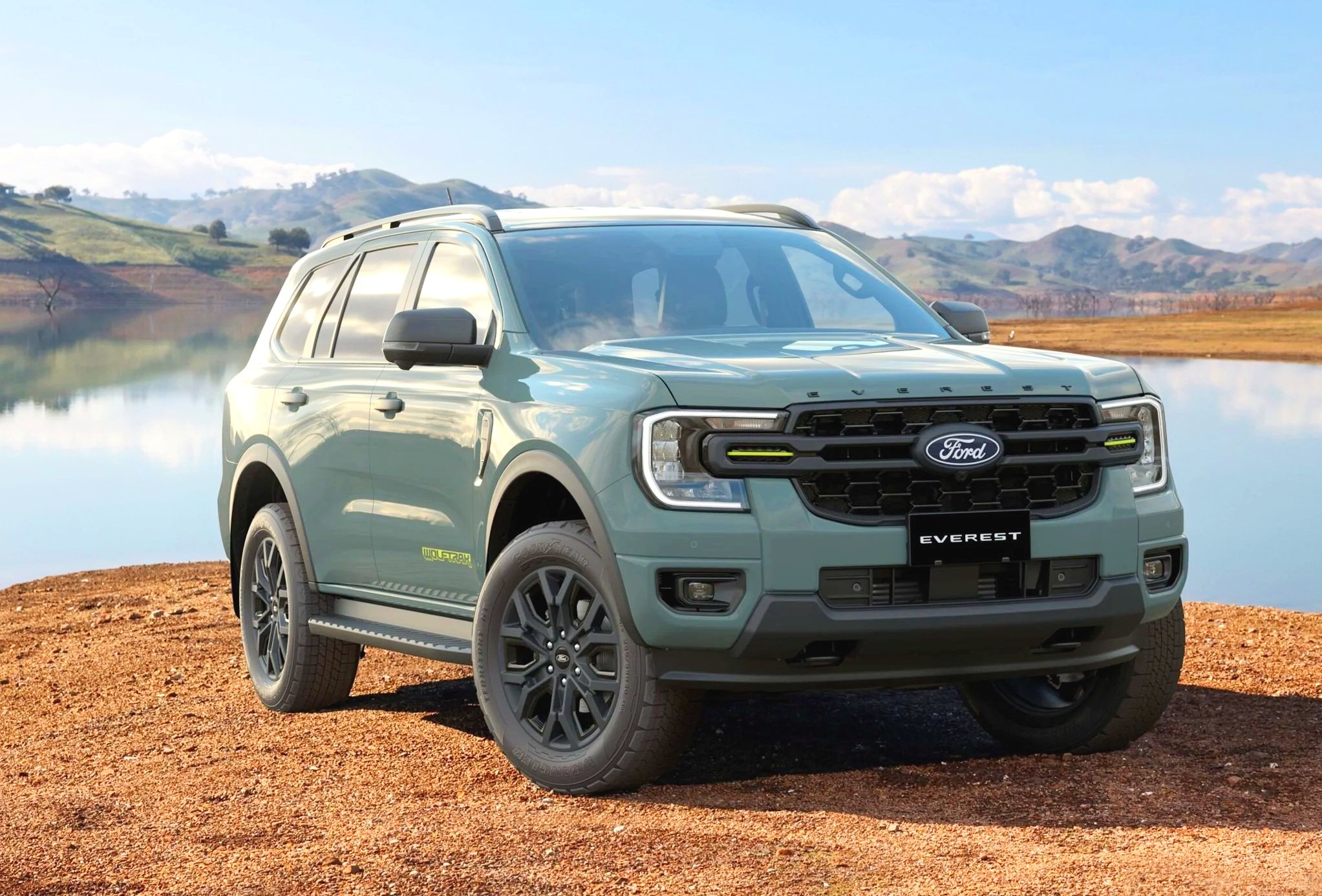
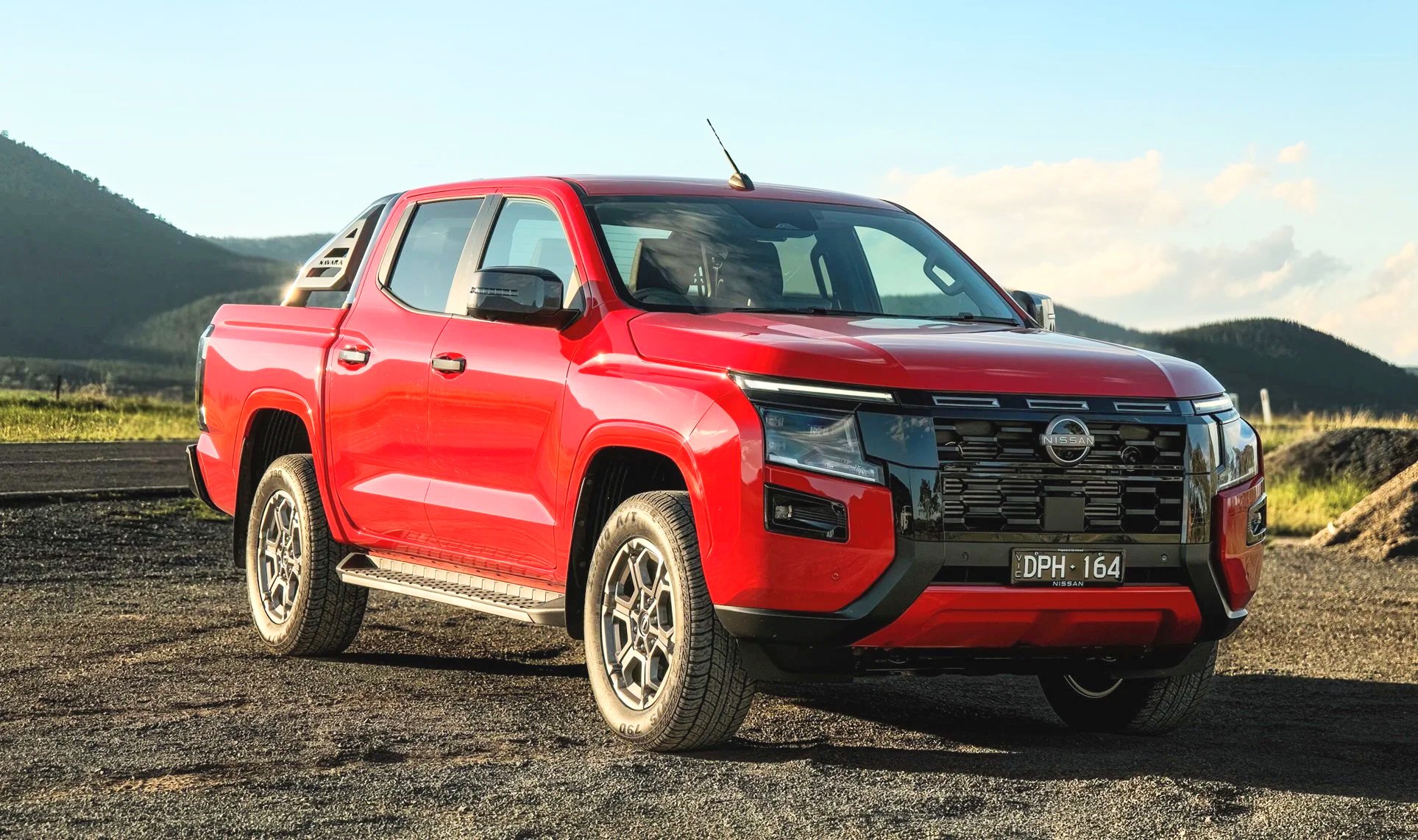
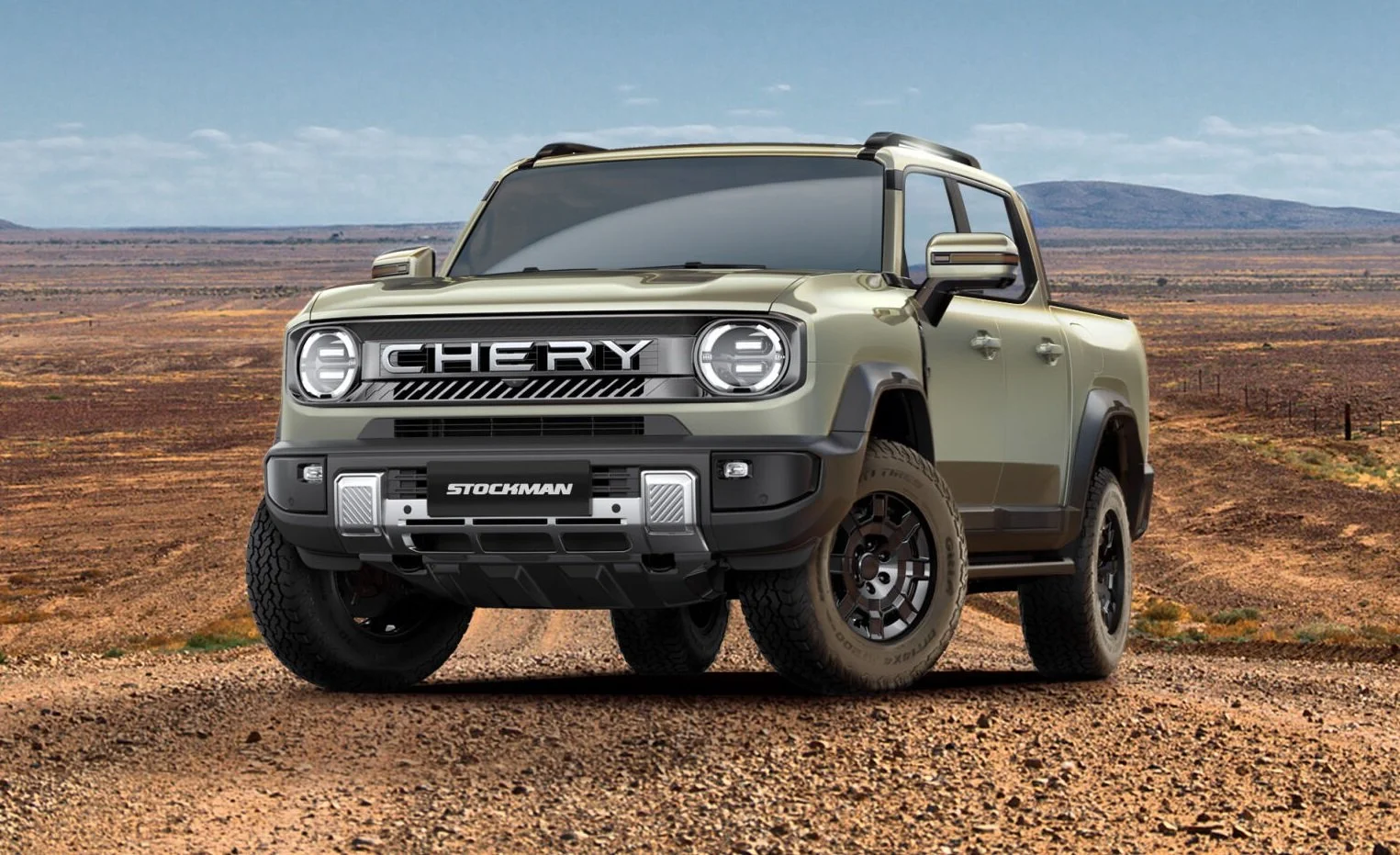




Hyundai Tucson looks futuristic and drives very nicely on Australian roads. It offers grunty, reliable engines, plenty of features and 5-seat practicality at a modest price that makes it an ideal, safe family SUV.