
Haval Jolion review and buyer's guide
The GWM Haval Jolion has quickly become a very popular SUV in Australia thanks to its compelling value, the generous equipment levels and modern styling. What’s missing from making it a truly great family vehicle to drive, lies under the skin.

The Haval Jolion is a small SUV that promises value, city-driving comfort and design that cannot possibly either offend anyone, nor bore them. It looks good, it’s nicely designed inside, and sales are strong.
The Jolion is made by GWM, the same brand that brought us the Cannon Alpha hybrid dual-cab ute, the Tank 300 and 500 4X4s, and the bigger SUV brother, the H6.
So it’s fair to say GWM has built up a pretty decent inventory, which comes with plenty of sales momentum in 2026. GWM is no longer a small fish in our small pond.
When you consider that a Toyota Corolla Cross hybrid is as cheap as $42,000 for a GX base model, seeing a Haval Jolion hybrid at $24,000 for the ‘Premium’ variant on the December side of a new year 2026, you’d be forgiven for thinking the economics were upside down.
How is a Toyota Corolla-based raised SUV almost twice the price of a so-called upstart brand like Haval/GWM? But that’s the thing. GWM has been selling cars in AUstralia for over 15 years now, and despite some teething issues with earlier models (even with one or two of the more recent models, let’s be hoenst), they’re now punching up with the big Japanese and Korean brands.
No question, there is compelling value in a Haval Jolion right now, and the sale figures reflect that.
Jolion sales have reached almost 19,000 units registered at the end of 2025, behind the Hyundai Kona on 23,000, the MG ZS on 20,000, and the Chery Tiggo 4 Pro on about 20,000 as well.
Adding to the growth of the Jolion is that it’s gradually displacing other brands and their respective models like the Nissan Qashqai, Subaru Crosstrek, Suzuki Vitara and the Mitsubishi ASX. It’s making the market harder for those brands to make sales with their models as prices have crept up and up over the years.
But that doesn’t mean the Jolion is without flaws, and we’ll get to those.
You can download the official Haval Jolion brochure & specifications here >
FEATURES & PRICING
Jolion Premium | 1.5L turbo-petrol 4cyl (105kW) | 7spd DCT, FWD | $24,000 driveaway approx.
Jolion Premium hybrid | 1.5L turbo-petrol 4cyl (140kW) | 2spd auto, FWD | $29,000 driveaway approx.
includes:
17-inch alloy wheel (chrome), space-saver spare
Auto wipers
Roof rails
paddleshift
cloth seats, manually adjustable (driver & passenger)
60:40 folding rear seats
3.5-inch driver’s display (manual guages)
10.25-inch infotainment touchscreen, wired Apple CarPlay & Android Auto
4-speaker stereo system
4 x USB charging ports: 2x front, 2x rear
Smart proximity key w/ push-button ignition
Manual dimming rearview mirror, auto up/down window (driver only)
manually folding electrically adjustable door mirrors
Tyre pressure monitoring
Dashcam USB port
Reversing camera guidelines
Adaptive cruise control
Rear parking sensors x4
Driver assistance: Emergency lane keeping, centring keeping assistance & departure warning; auto emergency braking (incl pedestrian & cyclists detection), blindspot detection, lane change assistance, rear collision warning, driver drowsiness detection
Halogen headlights, rear foglight
Manual air conditioning, row 2 air vents
Jolion Lux | 1.5L turbo-petrol 4cyl (105kW) | 7spd DCT, FWD | $28,000 driveaway approx.
Jolion Lux hybrid | 1.5L turbo-petrol 4cyl (140kW) | 2spd auto, FWD | $35,000 driveaway approx.
adds:
Faux leather steering wheel -
Sun-visor with illuminated vanity mirror
Luggage cover
Faux leather seat trim
6-way electric adjust driver seat
Front seats: heated
7-inch full colour instrument cluster
6 Speakers + DTS
Rear privacy glass
Auto dimming rear view mirror
Power mirrors + electric folding + indicator + heated
360° camera
LED headlights
Split Daytime Running Lights (DRL)
Dual-zone climate control
Jolion Vanta | 1.5L turbo-petrol 4cyl (150kW) | 7spd DCT, FWD | $34,000 driveaway approx.
Jolion Vanta hybrid | 1.5L turbo-petrol 4cyl (140kW) | 2spd auto, FWD | $39,000 driveaway approx.
adds:
18-inch black alloy wheels (space-saver spare), 225/55 R18 tyres
Launch control
Panoramic sunroof
Wireless smartphone charging
4-way electric adjustable front passenger seat
Ventilated (cooled) driver’s seat
12.3-inch infotainment touchscreen
Head-up display
Auto up/down windows (x4), key fob window close
Auto parking assist
Front parking sensors (x6)
Ambient lighting
Side ceiling light $24,000 driveaway approx.
INTERIOR
As far as interior design goes, the inside of the Jolion is rather plain, and not necessarily in a negative way. But it’s certainly not in an all-positive way either.
The term ‘featureless’ comes to mind when you realise there isn’t much of a ‘design language’ as they say in the automotive industry. This usually refers to some overarching theme or a centralised area of the cabin; something that gives it depth of character and inspiration. The Jolion is just, kind of, okay. Some might call it clean, others might call it bland.
It’s not bad. There are buttons, the screen is a decent size and orientation without being OTT, and the central console area is also nicely designed, with reasonably good fit-and-finish.
There are storage nooks in all the right places, the centre console storage is okay, the door bins are functional and even the button arrangement on the steering wheel will be adaptable within the first few weeks of ownership.
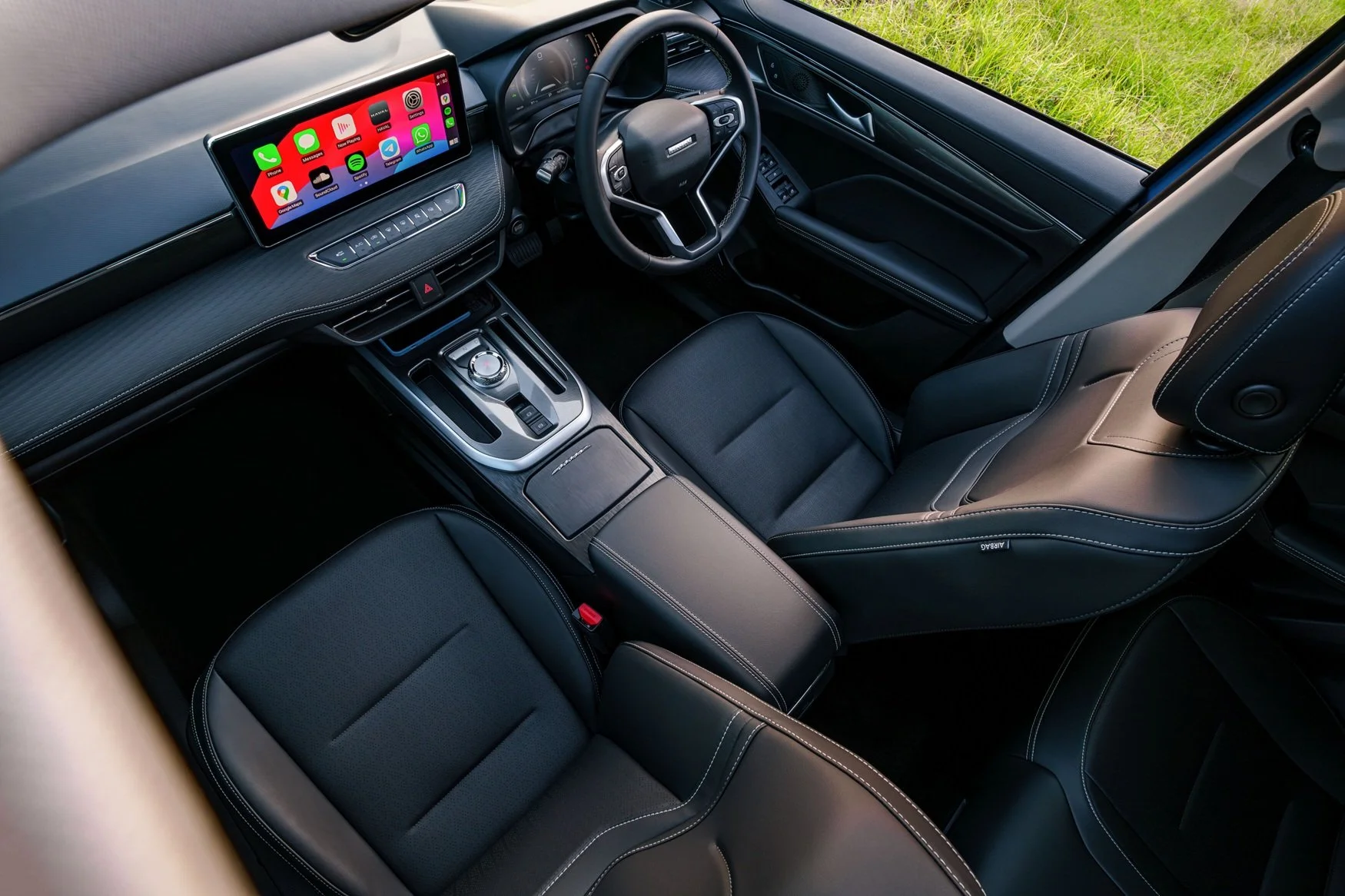
But that’s kind of it. There’s not a whole lot to get excited about in here.
The seats are comfy enough, without being ultra-supportive, the ergonomics are reasonably good enough, the back seats are functional, and even the top tethers on the back of the seats are within reach.
There’s actually very little to be offensive about in here. If at all.
But that’s the cruz of the Jolion’s interior. There might be little to hate, but it’s also hard to find designs and ideas that warranty complimentary feedback. It’s adequate.
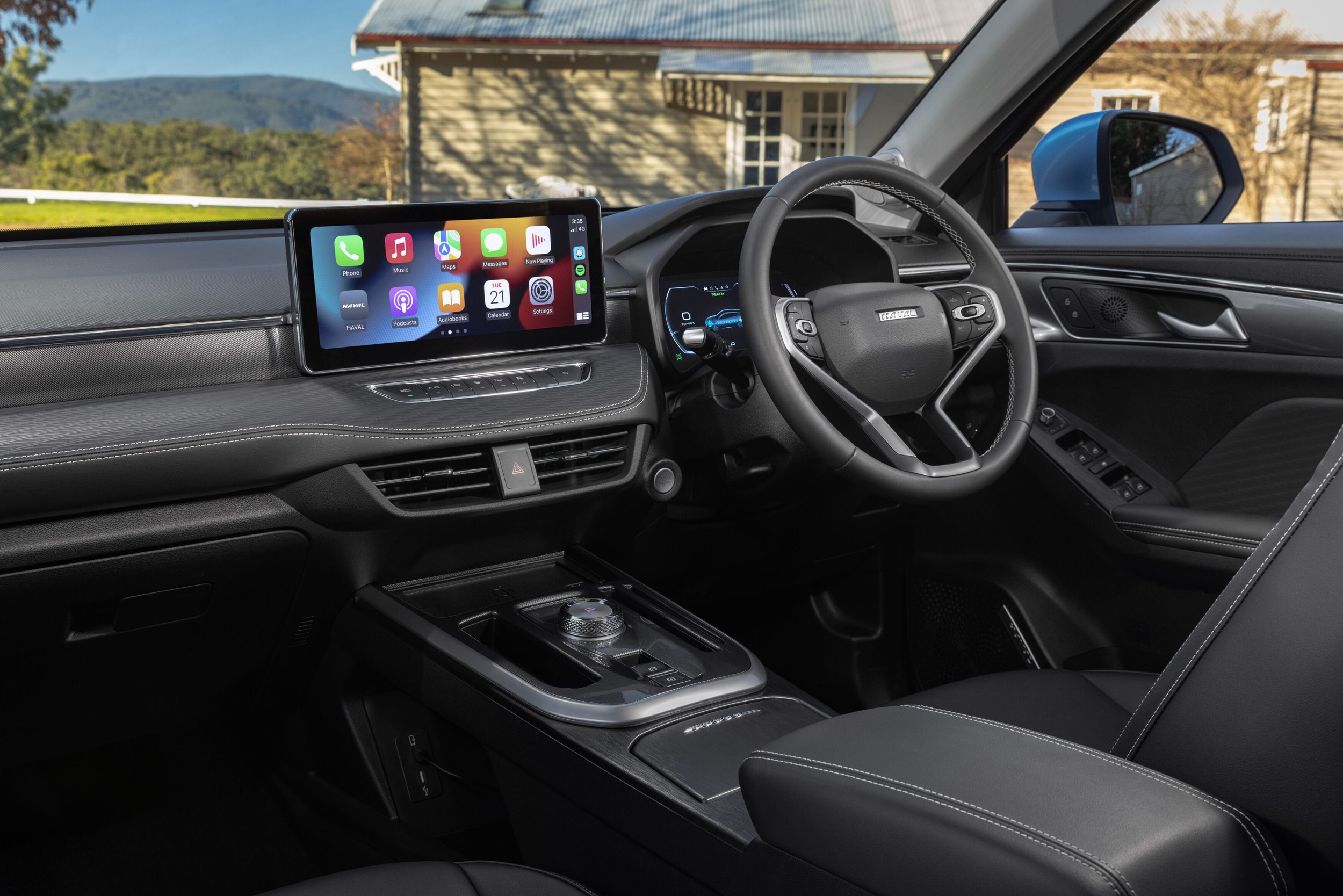
There are some clever points to note here about the layout, including the use of cubby holes in the centre console either side of the rotary transmission dial. The idea being that you can slot your phone in there so it doesn’t slide around when cornering. This is particularly useful if you want your phone contained during flight but not triggering the light on the wireless charging pad.
USB ports can be located in the panel and stowage cubby under the transmission dial if you have multiple devices to charge while in transit.
The infotainment screen is decent in terms of its responsiveness and connecting your phone isn’t unacceptably difficult. SPeaking of the screen, it’s nice to see the ‘Home’ icon and the shortcut panel is located on the right-hand side, nearest the driver.
You might also appreciate that they’ve stuck a row of buttons for basic HVAC functions on the dash right below the touschreen for quick access to things like recirculation, front/rear demisting, and also to turn off the parking sensors for whatever reason.
The Jolion’s back seats have legroom to suit most families, space for a couple of restraints and an assortment of pockets and holes that would feel typical of any medium SUV. It’s not going to inspire, but it will work, and that’s the general goal for most people.
I'll help you save thousands on a Haval Jolion
Just fill in this form.
No more car dealership rip-offs.
Greater transparency.
Less stress.
ENGINE
Powering the Jolion are two powertrain options: a conventional turbo-charged petrol 4-cylinder with a dual-clutch transmission, and a hybrid version of that same 1.5-litre turbo-petrol unit with a two-speed ‘hybrid’ transmission.
The combustion-only powertrain produces just 105kW in the Premium and the Lux, which ramps up to 130kW in the Vanta. This 23 per cent increase in power has to be nothing more than a straight engine mapping job, because the capacity doesn’t change, the fuel it’s taking is still 91 RON and only the compression ratio changes from 9.3 to 11:1.
Fuel economy and emissions are also marginally better in the Vanta variant with 130kW (at 7.5L per 100km) than the lower tiers with 105kW (at 8.1L per 100km). They improve again with the hybrid, going from 7.5 to 5.1L per 100km. This is, of course, the claimed figure produced from standardised laboratory bench testing and should not be used to guage how much fuel you will use; it’s to compare variant to variant of Jolion, as well as to compare other models of similar size, weight and cost.
The hybrid version of Jolion has a total power output of 140 kilowatts, with an electric motor output of 115kW, and the 1.5 petrol engine is only making 70kW. So which powertrain offers you the best performance becomes a matter of power-to-weight ratio.
By adding the 1.6 kilowatt-hour battery pack (the same size as a Toyota RAV4 hybrid, by the way) and the AC electric motor, the top-spec Vanta variant gains 100kg in kerb weight over the petrol-only version. But it’s only gaining 10kW, meaning the power-to-weight ratio only improves from 85kW per tonne to 86kW per tonne. It’s negligible.
You’re effectively paying an additional $5000 for a 1kW advantage in the real world and a claimed fuel economy advantage of 32 per cent. If you averaged 15,000km per year, and fuel was $1.80/L, it would take you over 7 years to break even on the $5000 price premium you paid for the hybrid.
The maths goes like this:
15,000km/yr ÷ 100 × 7.5(L/100km) = 1125 litres per year [VS] 15,000km/yr ÷ 100 × 5.1 (L/100km) =765 litres per year | 360 litre saving (approx.)
360 (litres saved × $1.80 (per litre, approx.) = $648 saved per year
$5000 (price premium) ÷ $648 (saved annually) ≈ 7.7 years approx.
This might disappoint you, especially if you had your heart set on the hybrid, but this is the same economically irrational argument we can and have used regarding the Toyota RAV4 hybrid in the past.
It’s an inconvenient truth, certainly, but at least it means you can make an informed choice. It’s also perfectly okay if you prefer the way the hybrid drives and are happy to pay the premium to derive that tangible benefit - because it is true.
Jolion’s combustion-only powertrain lacks the smooth, linear acceleration from the lights that the hybrid offers. Just wait until they get around to offering the unique Australian ride and handling tune in 2026 and beyond.
FUNCTIONALITY
What the Jolion gets right is very similar to what Toyota has gotten so-right for the last 10-20 years, making ordinary cars that the masses want, at an affordable price. Although, the Big T has pushed that envelope lately on its bigger vehicles, it’s still realtively applicable today to its smaller vehicles like Corolla. For now.
The Jolion isn’t overly innovative in the functionality sweepstakes. The combustion-only versions’ boot offers 1133 litres of claimed luggage capacity with the back seats dropped, or 337 litres with them up. That’s in the ‘Premium’ and ‘Lux’ variants, which becomes 952 litres and 291 litres respectively in the Vanta.
And in the hybrids, you get 916L with row 2 down, or 255L with it deployed. This makes the hybrid about even with the Subaru Crosstrek on both counts, but it needs to be said, the Crosstrek and Jolion have the two smallest boots among competirors listed below with regard to row 2 being up.
So if you need to max your stowage potential in the Jolion, consider again, getting the combustion version.

Having said that, the towing aspect for the Jolion is a similar story, although it’s not overly bad news either. You do actually get a decent braked towing capacity at 1500kg for the combustion version and even on the hybrid, it’s 1300kg. A midsize Mitsubishi Outlander is limited to 1650kg braked - so this is quite good for such an affordable little SUV.
But when it comes to getting a flat tyre, you’re out of luck with the hybrid, because there is no spare tyre. Not even a space saver like you get on the combustion variants.
If you rarely venture outside of your local metropolitan city or large provoncial town, then the notion of getting a flat and needing a puncture repair or straight-up tyre replacement is probably not going to be an issue for you.
But if you do take occassional extended roadtrips for school holidays or long weekends, perhaps you’re planning to use the Jolion for work with regional clients etc. then you might need to consider purchasing a matching spare with a cargo barrier in the boot for stowing the wheel where it’s easily accessible in a pinch.
The dealership is usually jumping at the opportunity to upsell you on this kind of stuff (which is the premium we all pay for that convenience), or alternatively you would be able to source a cargo barrier from most auto retailers. And the spare wheel is something your local tyre shop can organise with their eyes closed.
DRAWBACKS
Aside from having quirks typical of a first-generation model, such as rather light steering feel, a slightly choppy ride over harsh bumps and a minutely over-bearing lane-keeping system typical of most new cars these days, there aren’t any major issues with the Jolion - aside from one.
With such a razor-sharp pricing range from just $24,000 to $39,000, there isn’t much room for holding residual value over the next five to 10 years. Resale value will tend to hit the Jolion pretty hard, in the exact way it will retain value in something like a Toyota Corolla Cross, Hyundai Kona or Kia Seltos.
But it’s also important to keep in mind here that resale value and depreciation can easily become unintended guilt or hesitation in buying the most affordable new car you can find, especially if you are in the position of actually needing a new car.
Fact is, it’s okay to simply buy the best-value small SUV you can afford, especially these days with tight economic restraints, even if it won’t be worth much in some unknown point in time in the future. So don’t let depreciation stop you from find the right tool and the right price to get you to and from work and take your kids to school in safety and comfort.
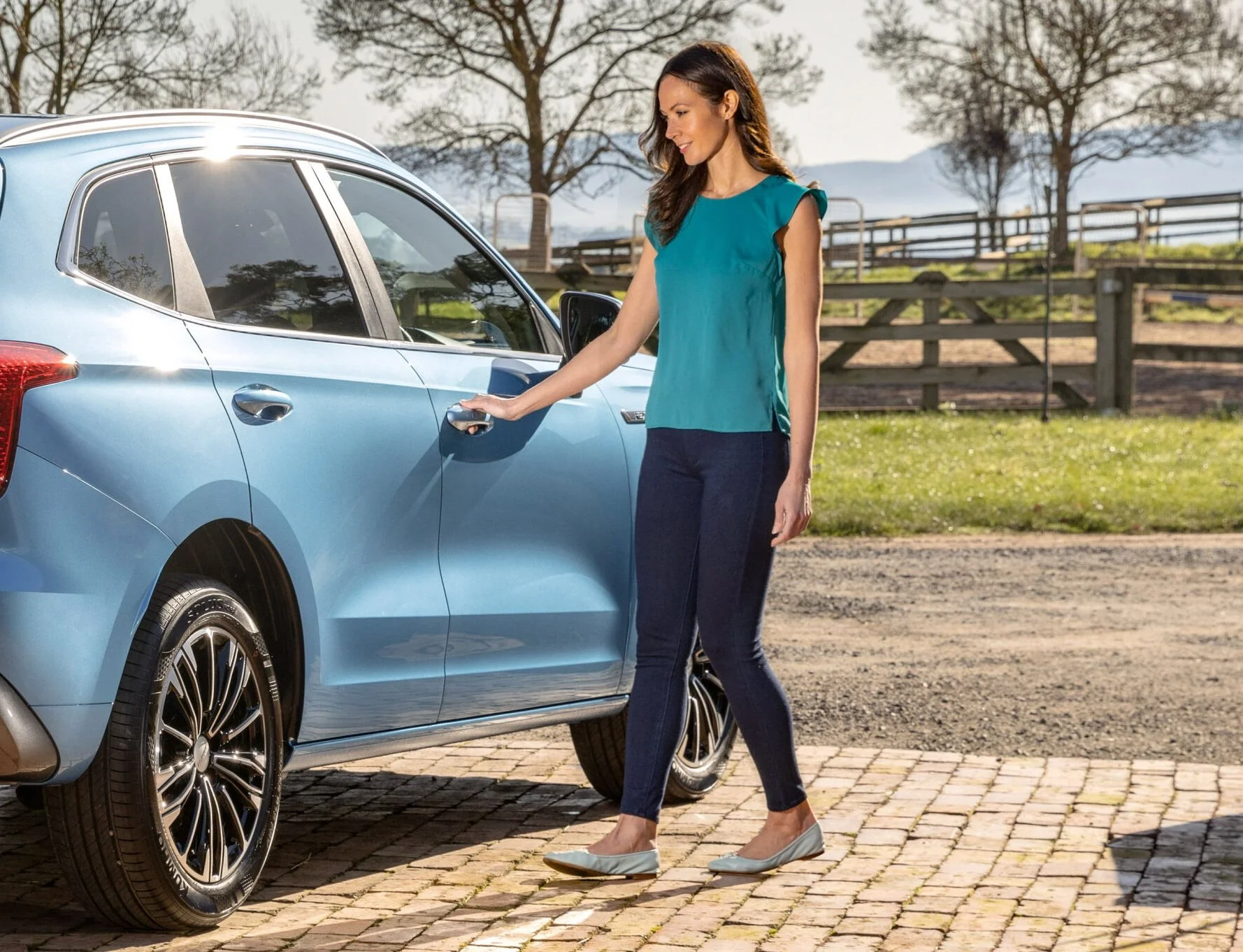
Buying yourself a new car shouldn’t mean potentially being stranded on some backroad due to a sidewall puncture on a $39,000 hybrid…
The other big drawback to the Jolion is, as mentioned previously, the complete lack of spare wheel on the hybrid. In Australia, where it can be 45 degrees in most major cities for 6 months of the year, and with possibly two kids in the car, and with often long distances between you and civilisation, it’s just not good enough.
You need to be mobile, and certainly if you’re planning to give this shiny new ride to your late-teen/early-20s drivers, who are still your children no matter how old they get, then being stuck on the side of the busy freeway in the pouring rain or scorching heat waiting for a tow truck is unacceptable.
It’s simply not okay for one little screw in the sidewall to render a $39,000 vehicle useless at the roadside en route to university or coming home late after birthday celebrations. And the can of compressed tyre goop usually offered on hybrids and EVs won’t work on any puncture that affects the shoulder or sidewall of a tyre. So there’s that.
Unfortunately, it’s up to parents to make the right choice here and go for the combustion-only version for the sake of having a space-saver spare to at least get you or your kids home in one piece.
MAIN COMPETITORS
HYUNDAI KONA
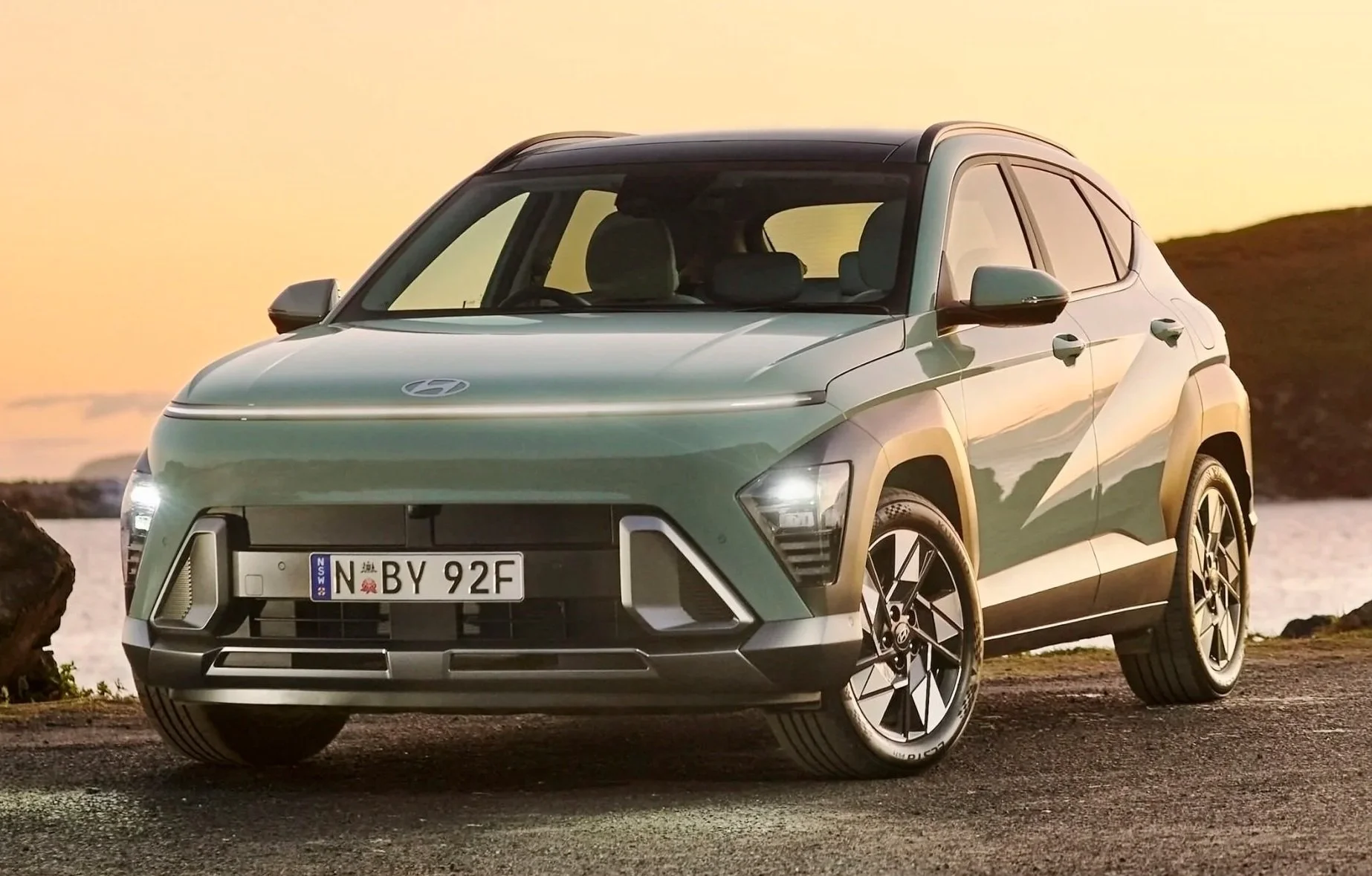
The Hyundai Kona is a funky, modernised hatchback SUV. Useful ground clearance makes tall kerbs and shoddy suburban driveways less scary than they would be in a low-slung conventional car.
Hyundai is up there with the best customer service operations in Australia, and the Kona is a compelling value proposition for a small family or those about to start one. The previous generation of Kona enjoyed a solid six years of in-service reliability, across all powertrains and variants. The new version (pictured, yet to arrive in dealerships) should continue this trend.
You’ll appreciate excellent build quality, a stylish but functional interior, generous luggage space, plus a wide model range including a performance version and the all-electric Kona.
Click here for more on Hyundai Kona ›
MAZDA CX-30
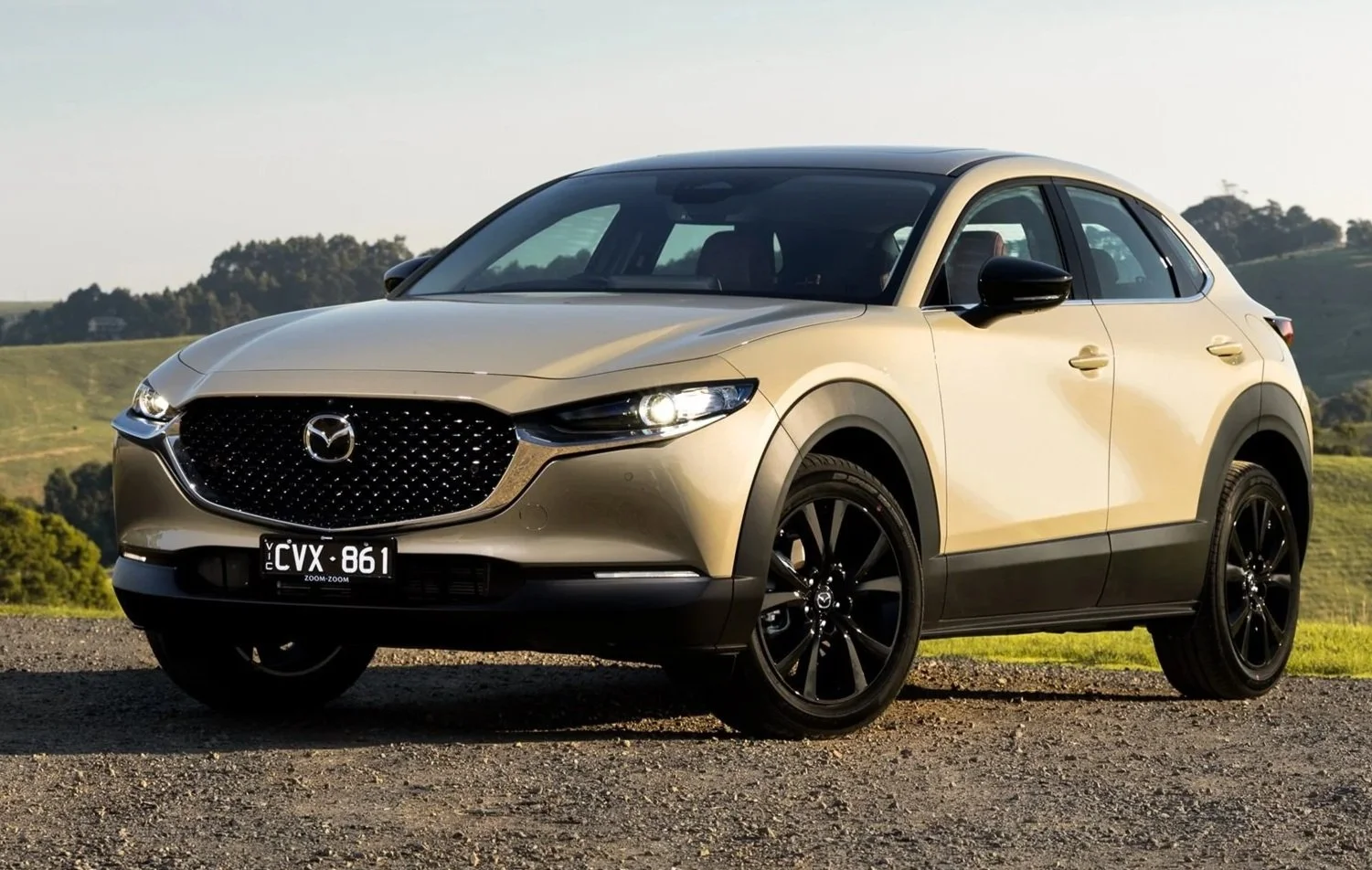
The CX-30 might look like a Mazda3 hatchback with raised suspension (because it is) but that doesn’t entirely diminish what is a more practical family SUV with loads of features and a very nice interior - the kind you might enjoy commuting to work in every day.
What you lack in the CX-3 due to its Mazda2-based platform you gain back with the CX-30, with slightly better ground clearance, better legroom and the broad appeal of an SUV - even if it does have the same 5-seat capacity and engines.
Thanks to the Mazda3 underpinnings, we also know the CX-30 is reliable, fairly frugal on fuel and safe. It’s also comfortable for longer drives than its hatchback derivative, helped in part by very comfy seats, better forward vision and good general driving dynamics.
Click here for more on Mazda CX-30 ›
SUBARU CROSSTREK

The Subaru Crosstrek is essentially a raised Subaru Impreza hatch, including the robust AWD system Subaru is renowned for.
It has a compact profile ideal for a suburban runabout, plus the light-duty soft-roading abilities young drivers, small families and regionally-based elderly drivers would appreciate.
Crosstrek features Subaru’s flat-configuration Boxer engine that offers a reduced centre of gravity compared with its rivals. It offers a mild-hybrid powertrain option, plus software-based terrain response called X-Mode that makes it good in soggy or loose terrain like campgrounds, dirt roads and heavy rain.
It’s this combination plus its high level of standard safety equipment that makes Crosstrek a very capable small SUV.
Click here for more on Subaru Crosstrek ›
KIA SELTOS

Kia Seltos shares its platform with the Hyundai Kona, but the model range is more streamlined, comprising just two powertrains. Which one you choose is really just about performance, equipment level and budget.
There’s a fuel-efficient 2.0-litre Atkinson cycle four-cylinder driving the front wheels only via a CVT, or a hotter 1.6 turbo engine with AWD.
Another bonus is generous luggage space, despite the city-friendly overall dimensions. It’s good for parking in tight spots without being too small to take a young family on a driving holiday.
There’s a well equipped interior, the latest tech, and a strong suite of standard safety features.
Click here for more on Kia Seltos ›

MG ZS
A similarly priced, similarly high-value small SUV that has broken the mould of affordable slightly-raised family runabouts.
Like the Jolion, the ZS is remarkably popular against the notionally bigger brands fighting to hold onto market share.
THe ZS is also available in hybrid and offers a compelling, smooth inner-city partly electric take-off at the lights.
And like the Haval brand, the MG is also wholly factory-run, meaning you’re not dealing with some middleman importer if you have issues down the track. You’re dealing with the company’s authorised dealer and its local head office. And the warranty is as competitive as any other brand.
Click here for more on MG ZS >
MITSUBISHI ASX
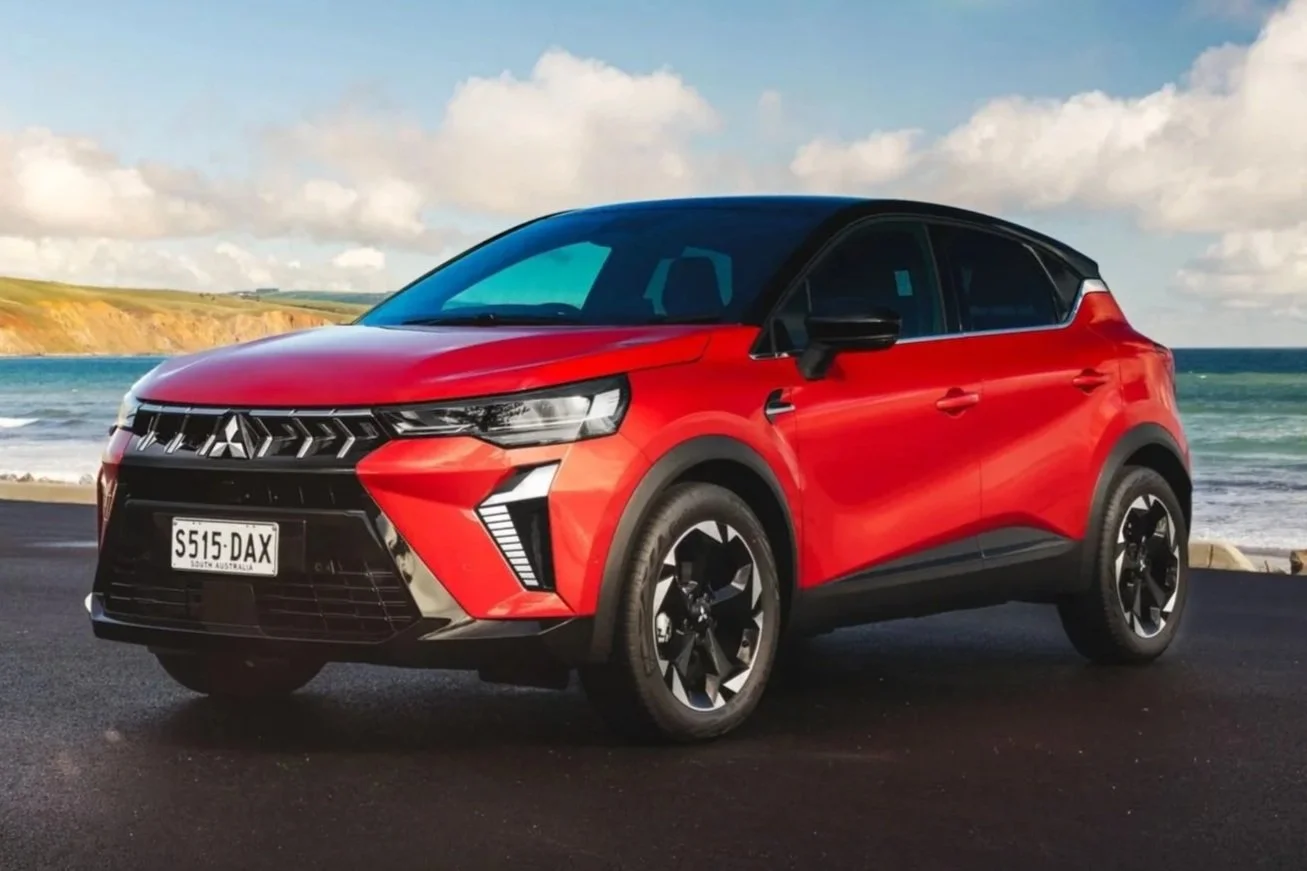
If you need an affordable, decent quality suburban SUV that’s affordable to run and service, then the Mitsubishi ASX is a great option for you.
While the ASX is certainly not the most innovative in terms of styling, layout or functionality, it’s right up there on value, and that’s backed by solid customer support and a strong 5 + 5 year warranty proposition (the latter five being dependent on servicing at a Mitsubishi dealer).
Equipment levels are acceptable, without being excessive or opulent. Luggage space might be a bit tight, but the ASX is still family-friendly while managing also to be compact and manoeuvrable - that’s a plus in multi-storey carparks and inner-city laneways.
Click here for more on Mitsubishi ASX ›
CONCLUSION
The Haval Jolion is a very appealing small SUV in the Australian car market, and the sales suggest it’s growing in popularity.
This is due to several factors, but most likely it’s the outrageously good value it represents to middle-class Australians who need to replace their aging Japanese or Korean (or even Australian-made) cars of yesteryear.
The styling is appealing on the outside, with a very inoffensive interior for the majority of people who want something clean and new without being striking or quirky, and two powertrains that offers good performance.
Jolion isn’t the greatest of the small SUVs for ride and handling thanks to its international steering and suspension tune suited to smooth Chinese freeways, but with GWM Australia’s new tuning program set to be unleashed in future model updates (including Havals), this is one crinkle destined for the iron.
Don’t buy the first Haval Jolion you test drive, and make sure you try a bunch of its rivals like Kona and Seltos if you want great driving dynamics, the Subaru Crosstrek if you want good soft-roading qualities in rural areas, and especially the Mazda CX-30 if you want luxury cabin feel with effortless, smooth powertrain delivery.