
Subaru Crosstrek review and buyer's guide
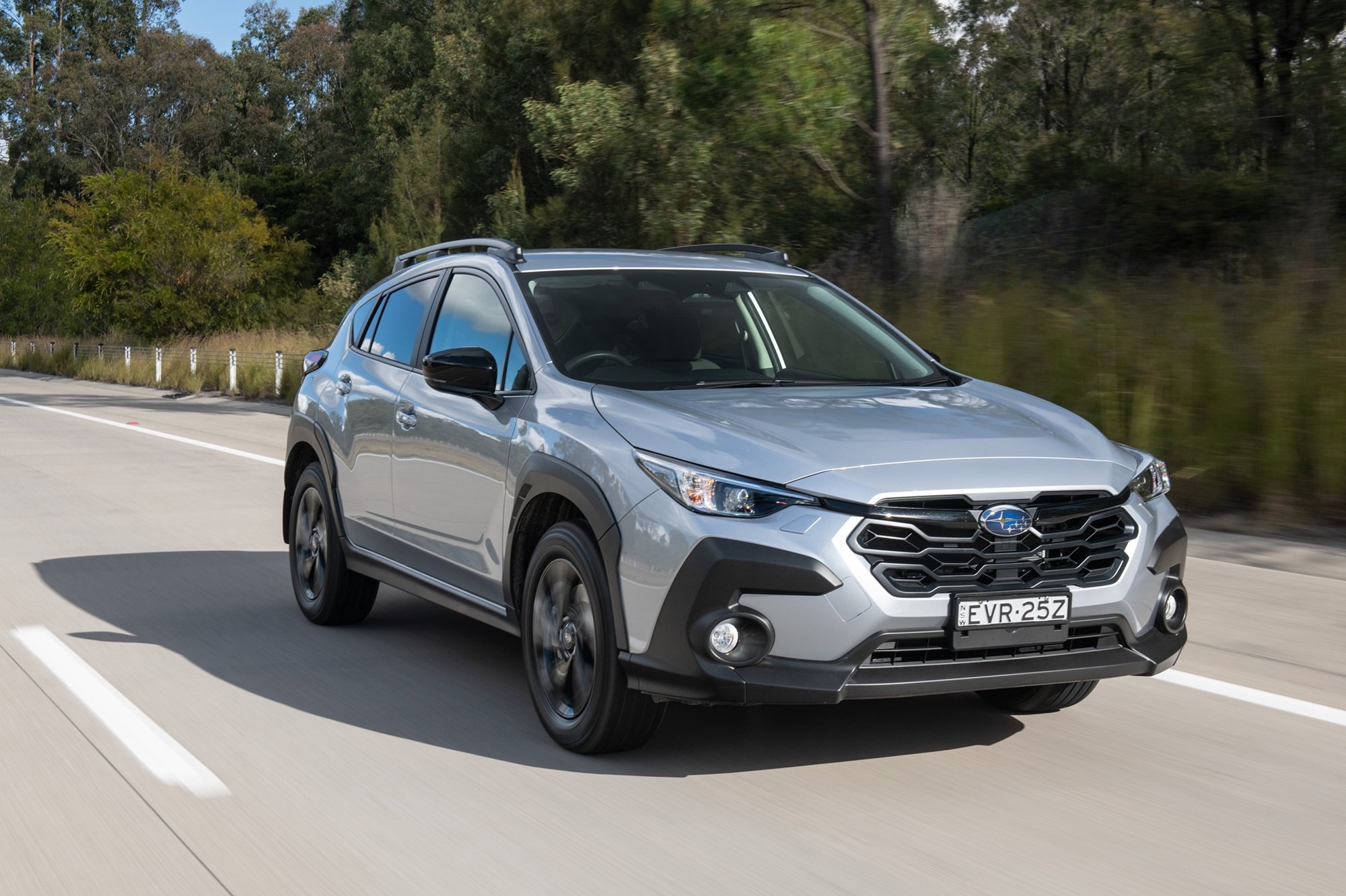
The Subaru Crosstrek offers great value and good build quality, with its all-wheel drive system making it a uniquely capable small-family SUV. If you like to leave the bitumen for sand, dirt or gravel, here’s why you need a Crosstrek.

Save thousands on a new Crosstrek
Fill in the form - we’ll get you a great price without the stress
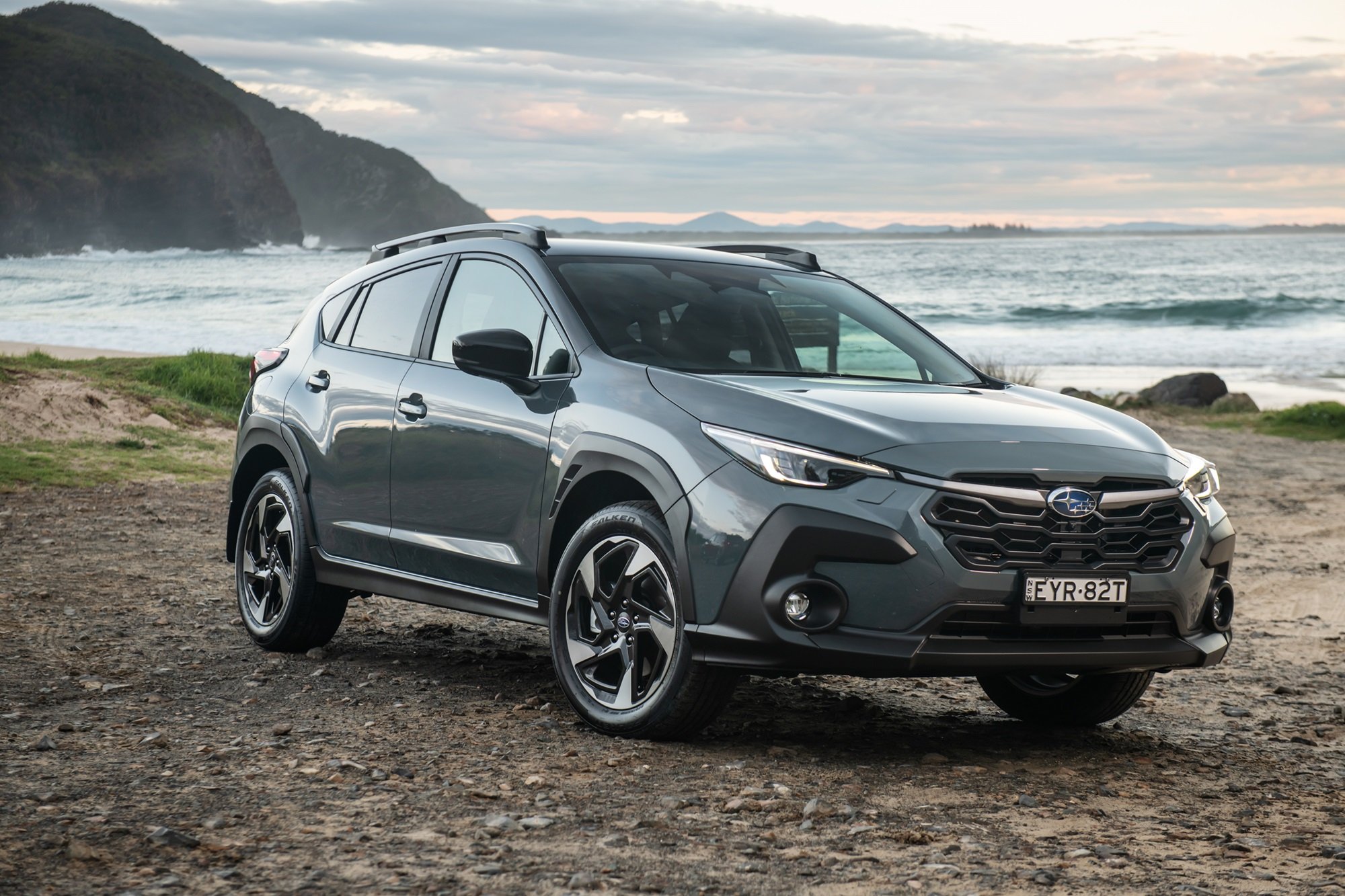
Subaru Crosstrek is a notionally ‘small’ SUV that has become what Forester used to be some 20-odd years ago. It may have grown in size but so has its capability, not just when the sealed roads run out, but also in functioning as a daily runabout.
Crosstrek is a pumped-up Impreza and that makes perfectly good sense for consumers who need it to do a little bit of everything well - without being a master at one particular area.
But it does hold the upper hand in one key aspect - its drivetrain. Let’s help you figure out exactly what those ownership prospects are so you can get the biggest bang for buck.
Download the official Subaru Crosstrek brochure here >> to get started.
Today's Crosstrek has essentially the same Impreza footprint. They’re both 2670mm in wheelbase (which is the same as the outgoing Mazda CX-5 midsize SUV, by the way), they’re both over 4.4 metres long, and they’re both over 1.7 metres wide. Impreza is about 13cm off the deck, while Crosstrek is 22cm.'
In fact, with the new Subaru Global Platform, it means the Crosstrek has exactly the same wheelbase as the current Forester at 2670mm. This means you’re no longer sacrificing crucial legroom if you downsize from the medium Forester to the notionally small Crosstrek.
Crosstrek weighs at its heaviest, about 1540kg with a full 61-litre tank of 91 RON petrol. We say ‘about’ because Subaru Australia continues to publish the tare weight (vehicle + 10L fuel) which is not the same at kerb weight (incl. full tank) and is more relevant. So we have to multiply 61 litres by 0.75 (kg, the approx. weight of gasoline), giving us 47kg + 1493kg (tare) = 1540kg. Thanks a lot, Subaru.
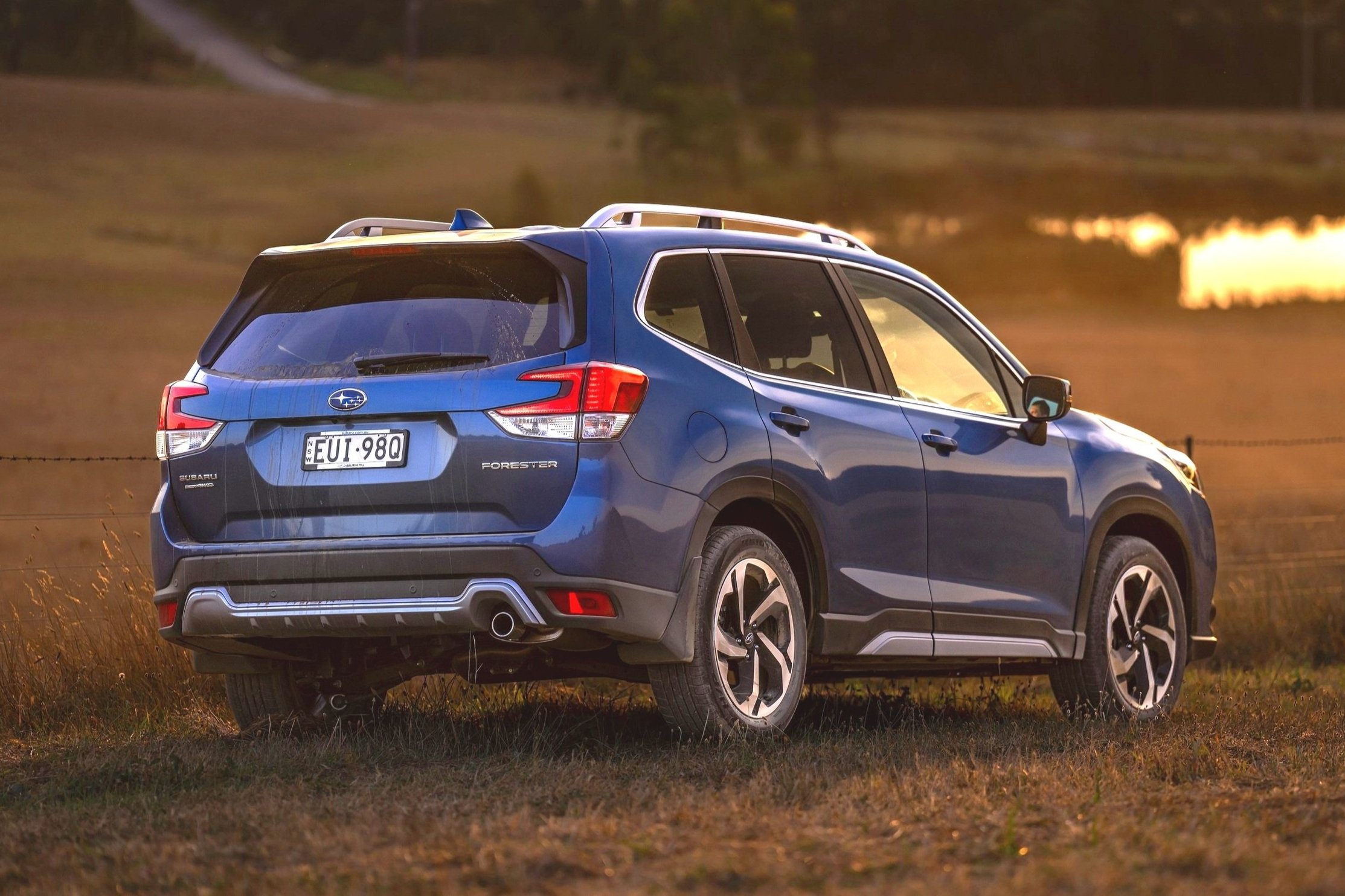
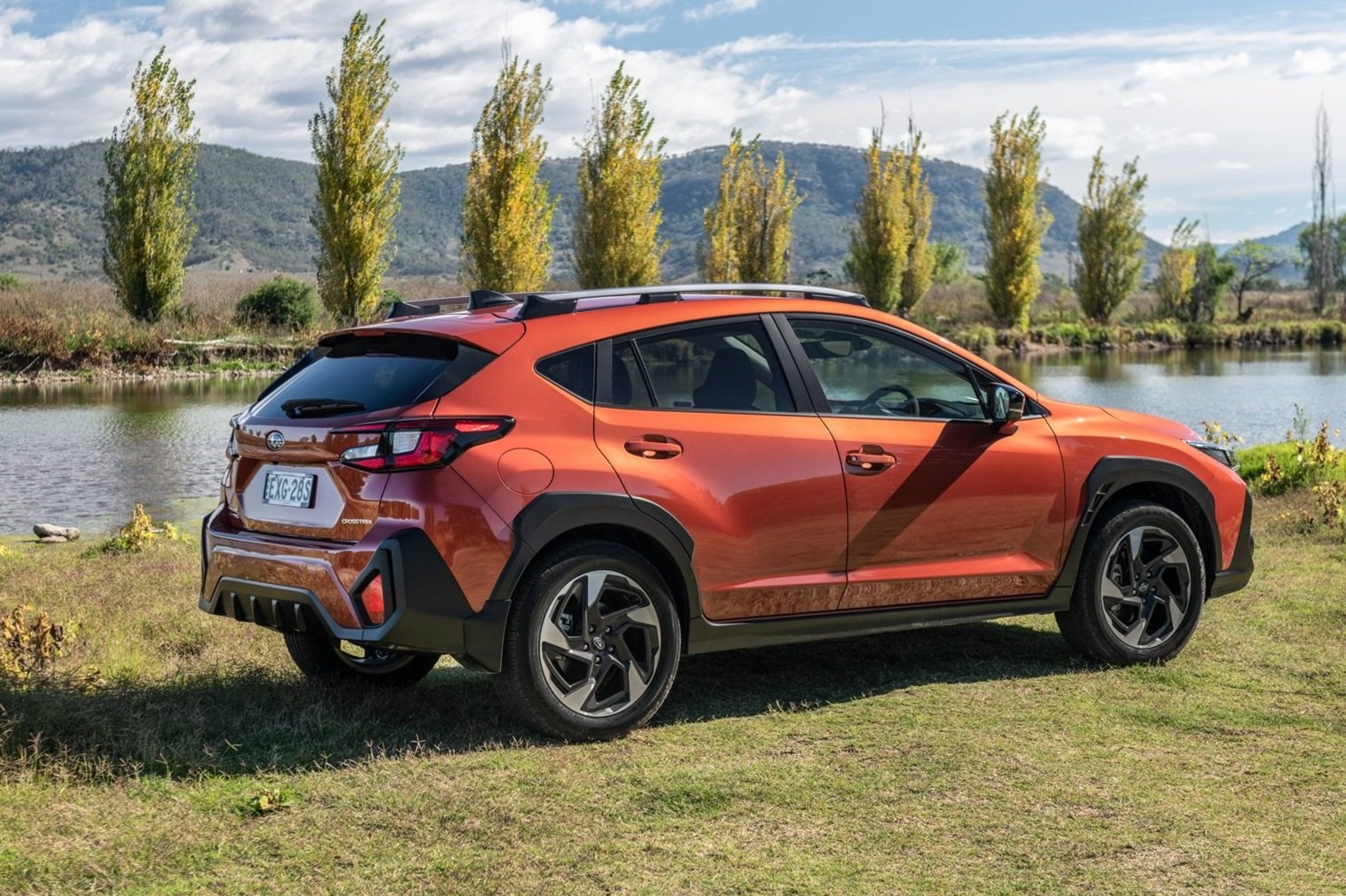
So anyway, Crosstrek weighs about 83kg less, but has the same size fuel tank as Forester (63L). Thanks to it being lighter and using a smaller engine (the 2.0 over the 2.5 in Forester), Crosstrek will return better real-world fuel economy, as supported by the official lab bench test using the combined cycle - 7.2 L/100km versus 7.4L.
But the compromise going Crosstrek over Forester is, of course, a 71 per cent loss in boot space. That’s a piddly 291 litres in the Crosstrek versus a whopping 498 litres in the Forester, but the same amount of seats and only a difference in price of about $5000 (excluding on-road costs). Do you see the value proposition problem with small SUVs? For a fraction more money, you get a significant boost in operational capability.
So has the Crosstrek improved enough to make it worthwhile? We’ll get to that in the ‘Drawbacks’ section below.
But what it lacks in sparkle and space is overshadowed by its ability in soft-road conditions. Here are two photos, one taken at the original XV launch in mid-2017, the second by a photographer for Subaru in the US.
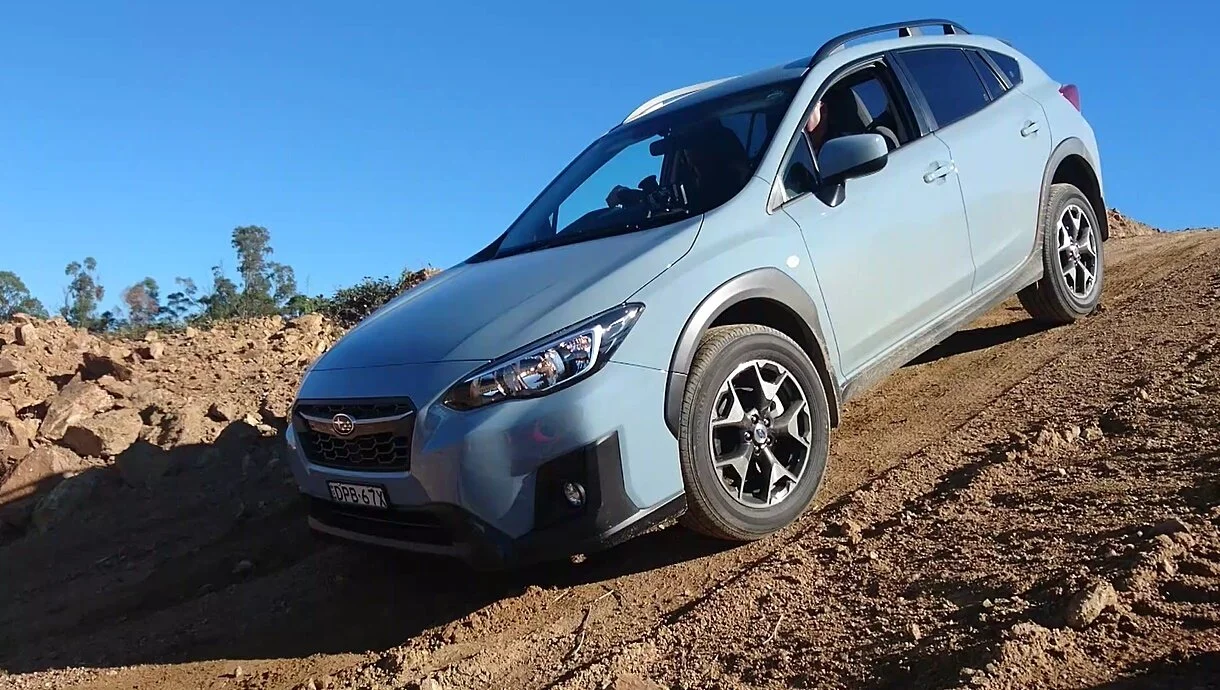
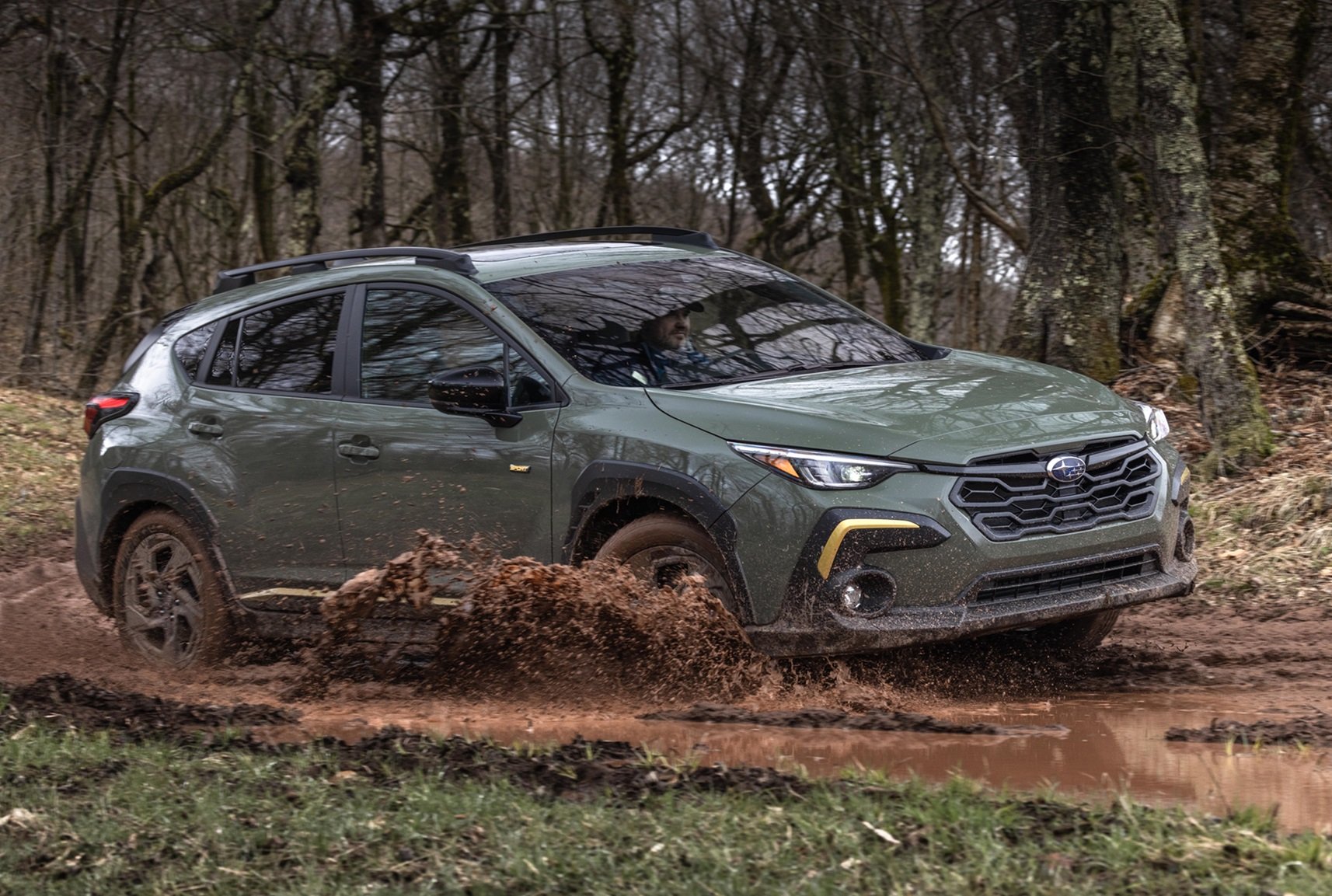
Most other small SUVs will struggle in these conditions owing to their more primitive drivetrains that favour front-wheel drive or the more delayed on-demand AWD which can be slow to respond when wheelspin is detected. More on this below.
So let’s see how much better the new Crosstrek is while also investigating if it does enough to justify itself over a standard Impreza, the new version of which is due here in January 2024.
Crosstrek is ideal for a range of consumers from young adults who’ve not been driving very long, to young couples starting a family, as a second car to run around in on daily commutes, or as a slightly more capable and practical option for older drivers with potential mobility issues where an ordinary sedan or hatch incurs hip, back or leg pain.
It’s good for active lifestyle adventuring without the proper blue-singlet off-roading thing and should be considered when shopping for a Hyundai Kona >>, the Mazda CX-3 >>, the Kia Seltos >>, a Mitsubishi ASX or Eclipse Cross, or the Toyota C-HR.
In 2024, sales for Crosstrek were average, but consistent, making it the sixth most popular small SUV in Australia with over 11,500 sales. It was beaten by the MG ZS on 22,600, the Hyundai Kona on 17,300 sales, the Haval Jolion on 14,000, and the Mazda CX-30 and Mitsubishi ASX on over 12,000 each respectively.
For the Crosstrek itself, that’s a 28 per cent increase over the 8900 sold in 2023 and shows not only that the model is popular, but also that in the small SUV segment which grew 3 per cent, the Crosstrek is keeping up and making significant gains.
The reason this is good news for you is because it means good onshore parts availability, greater investment in the brand at its dealers, greater technical support and a much stronger resale value in a few years time if you decide you’re ready to trade in and/or sell - especially if you want to go again on another Crosstrek in future.


FEATURES AND PRICING
There are only three model grades in regular combustion Crosstrek, and thankfully Subaru has kind-of simplified the naming convention by removing the ‘i’. So now we have the 2.0L, the 2.0R and the range-topping 2.0S. All with the same powertrain.
The hybrid is simply ‘Hybrid L’ or ‘Hybrid S’.
You can download the Crosstrek range specifications here >>
Crosstrek 2.0L - $39,000 driveaway (approx)
The base model is about $35K before about $4000 of on-road costs, depending on where you live. It offers:
Apple CarPlay and Android Auto phone integration,
dual-zone climate, auto wipers
LED headlights and taillights, (halogen) daytime running lights
electric folding mirrors, rear parking sensors
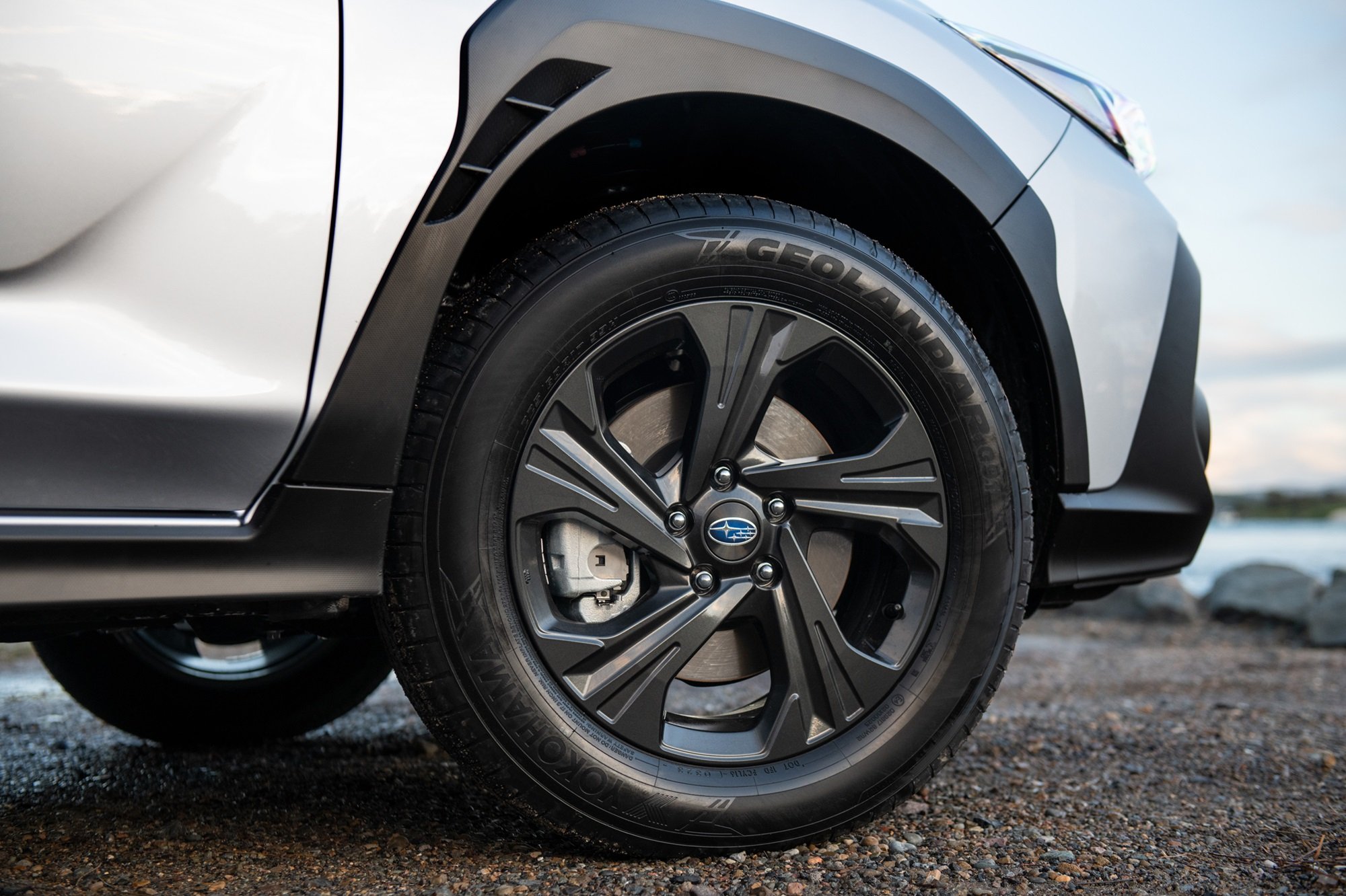
17-inch alloys, tyre pressure monitoring, temporary spare tyre
push-button start with proxy key, and engine stop-start
range-wide towing of 1400kg braked (excludes hybrids)
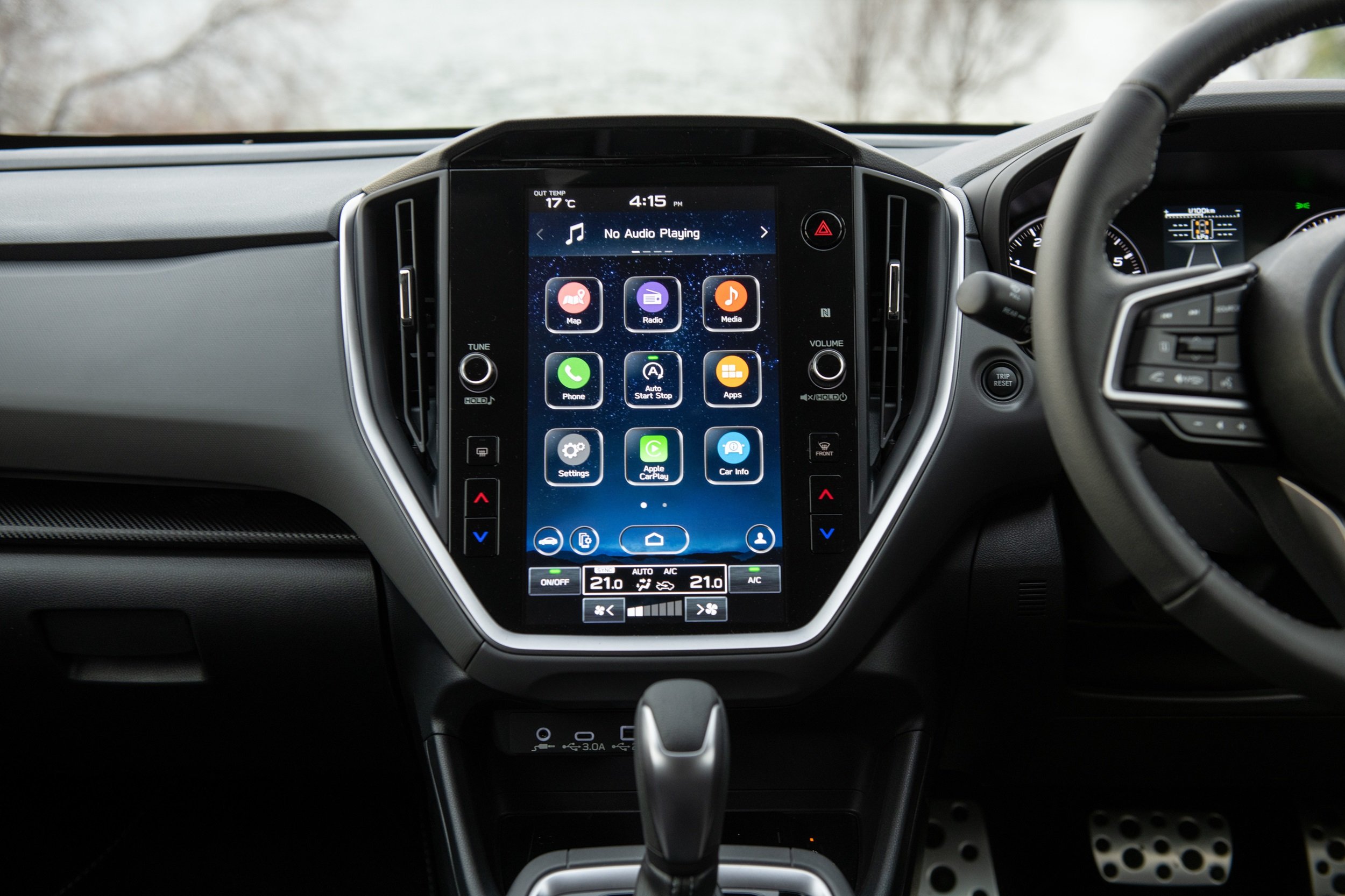
11.6-inch infotainment screen (portrait)
USB type A and USB type C ports (power supply and communication) plus auxiliary input jack
Wireless smartphone charging
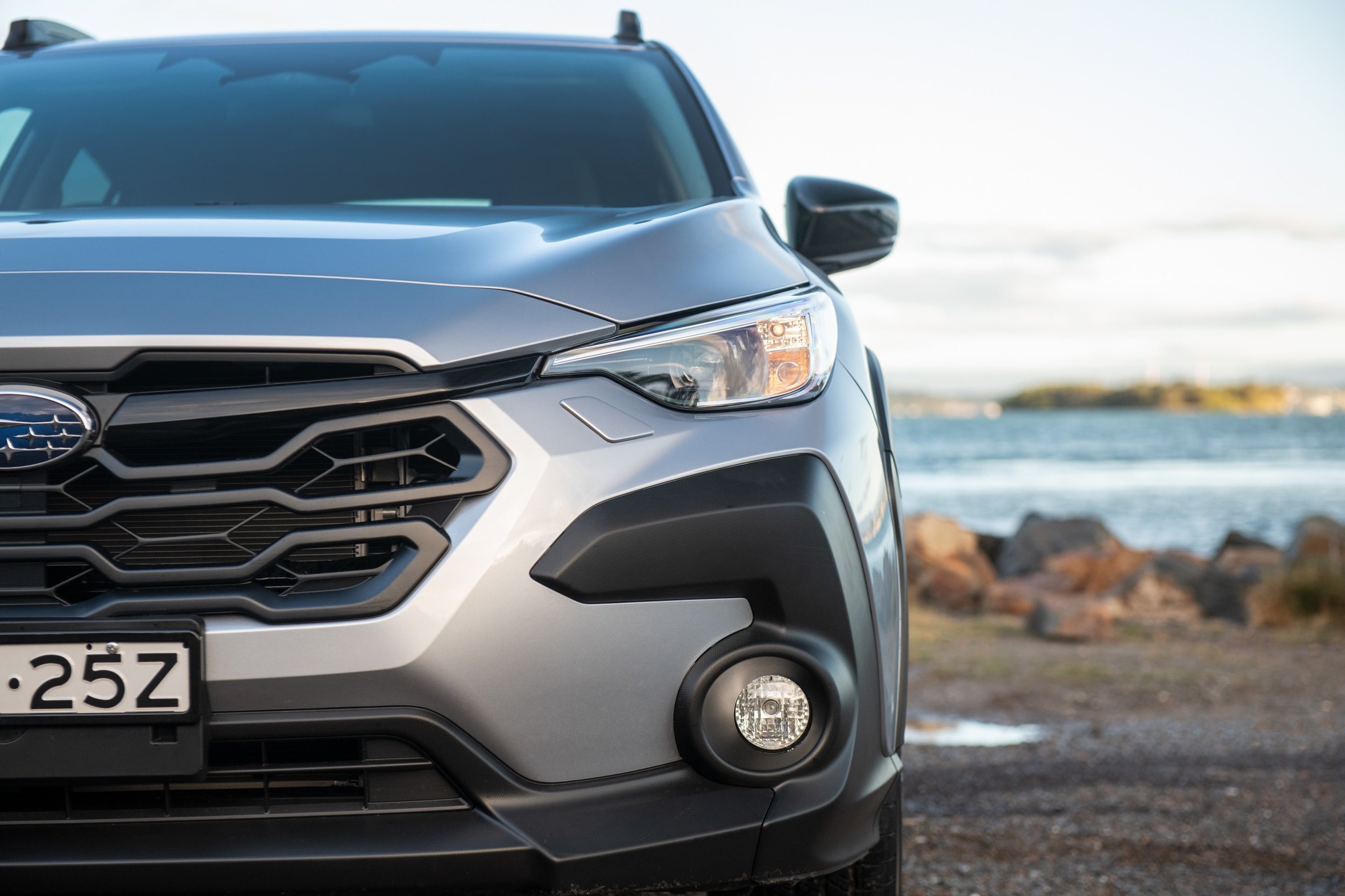
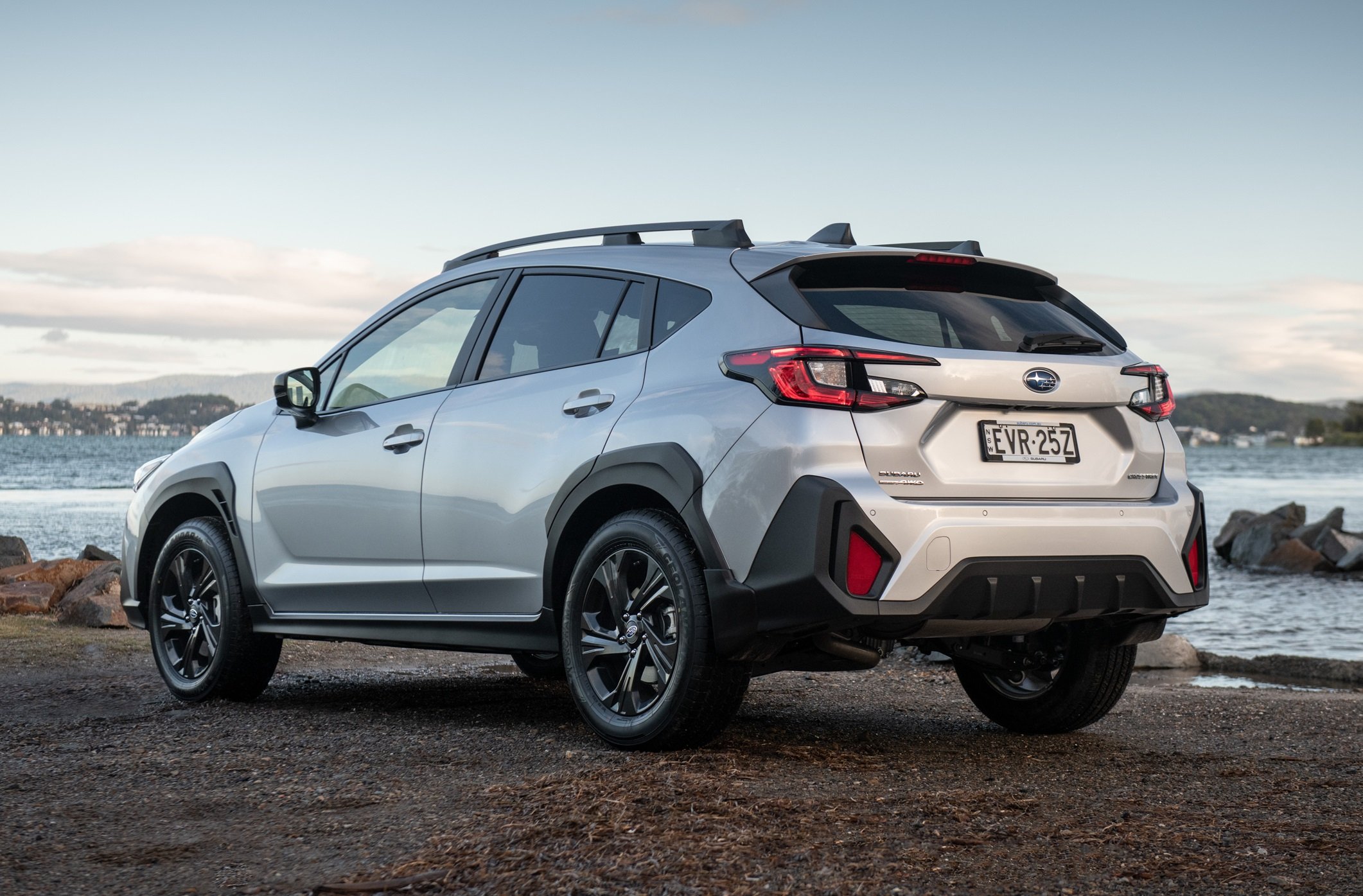
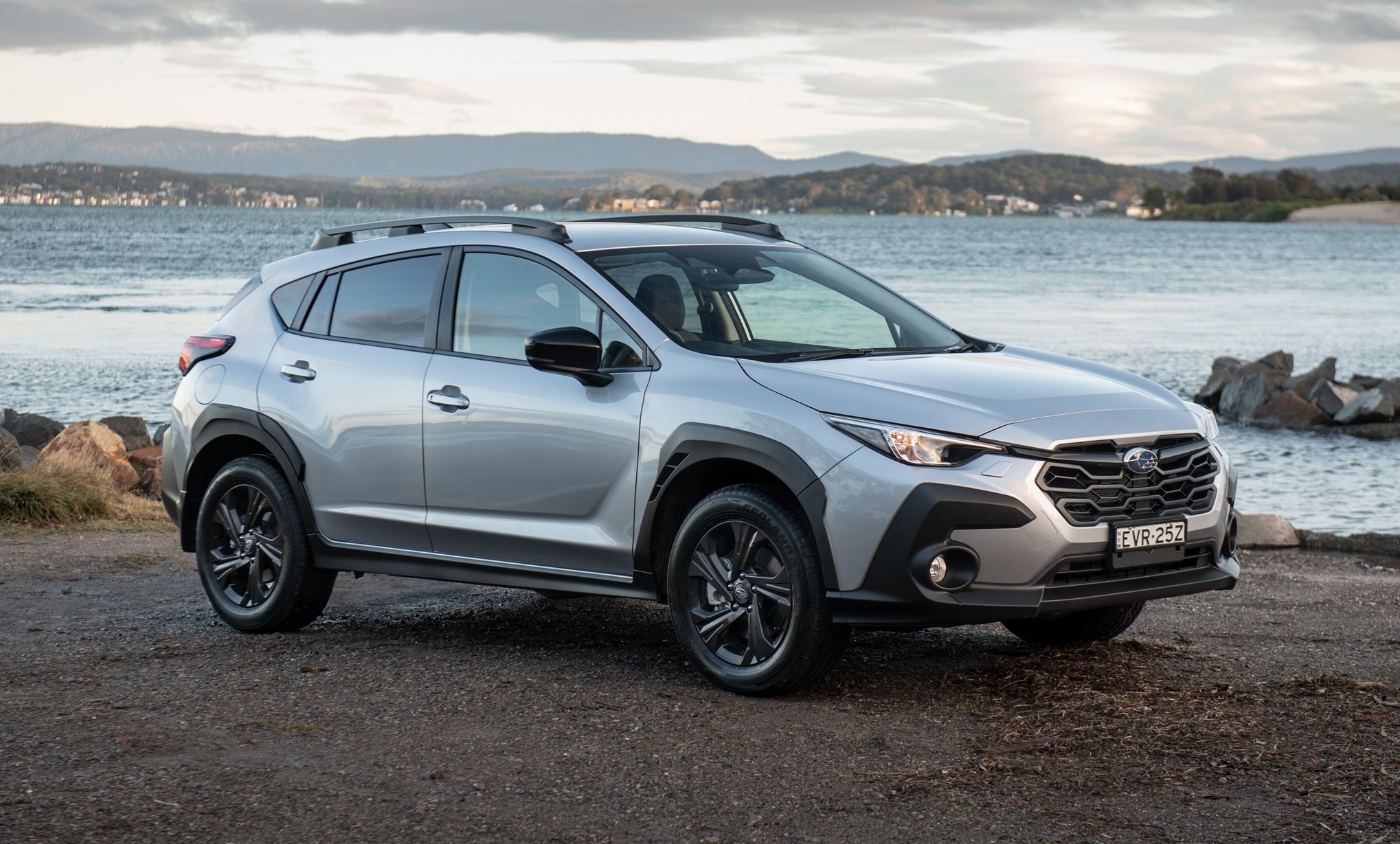
Despite the cool charcoal alloys, the base model actually looks quite premium; tyres are Yokohama. Being stuffed full of interior niceties like wireless charging and both USB charger types is one of those sigh-of-relief aspects to this vehicle.
You’ll notice smart additions like front-wheelarch ventiliation to draw hot air away from the brakes and allow for better aerodynamic flow at speed.
Within the EyeSight safety suite across the range you get of note:
Speed sign recognition
Lane Centring function
Driver distraction monitoring, drowsiness warning & fatigue detection
Reverse auto braking
Crosstrek 2.0R - $44,200 driveaway (approx)
Another $3500 (approximately) gets you the 2.0R for about $38,500 before on-road costs, and the extra kit here is:
18-inch alloys
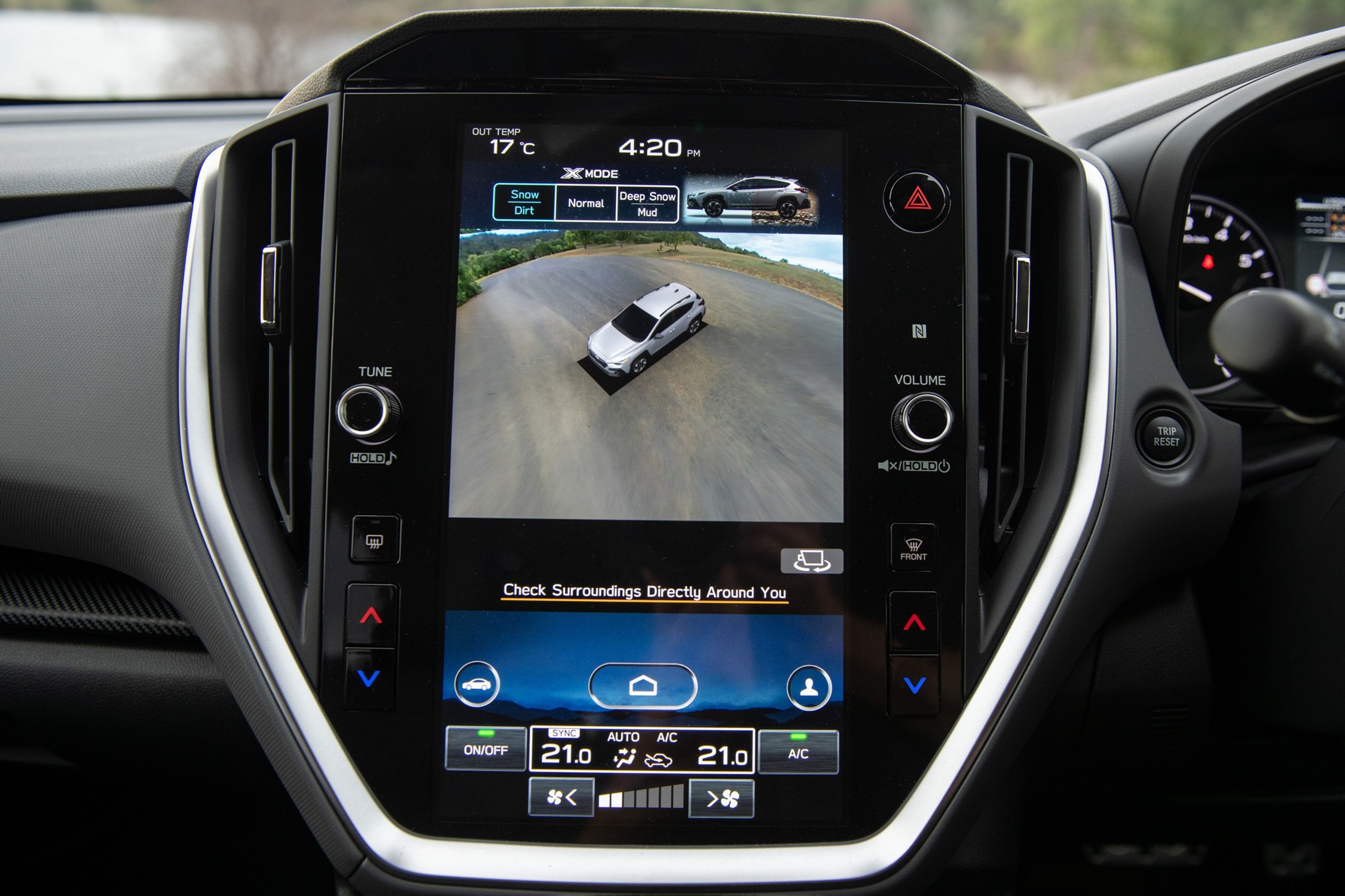
Panoramic 360 degree camera (incl. side-view monitors)
auto-levelling & steering-responsive headlights, LED foglamps & daytime running lamps
auto-dimming rearview mirror, leather steering wheel & transmission shifter
Rear USB-A and -C charging ports
8-way electric seats for driver
Crosstrek 2.0S - $47,300
And then the range tops out at around $41,500 - another $3000 - and for that you add:
Sunroof
Satnav
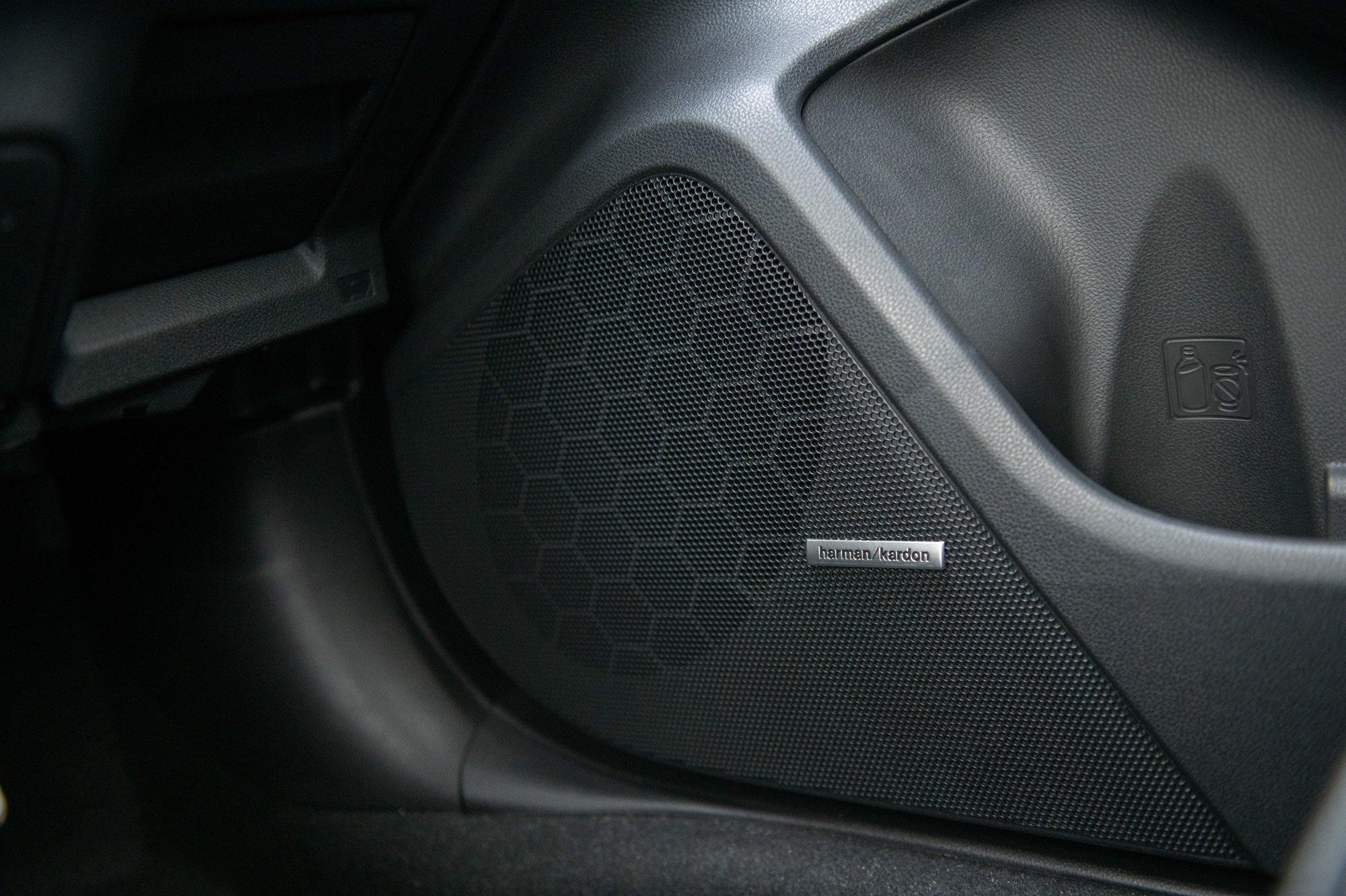
10-speaker Harmon Kardon stereo system, includes amplifier
So pretty much the works burger of safety, and a decent but not opulent level of plushness, drive-away for under $46K if you negotiate like you mean it. That’s pretty good value, too.
Specifications and price may change at any time: always check before signing any contract or paying a deposit.
For a such a smart-looking, broadly capable SUV that feels better to drive than the old XV ever did, powered by an engine that is raucous but smooth and refined, turning a driveline that is so good in adverse conditions, Cross trek really does do a bit of everything quite well.
The best value in the range is either the R because you can live without the boom-box and the sunroof in melanoma central (AKA Australia) - or it has to be the base model with all the safety fruit you actually need, the go-far powertrain, and the strong level of premium-like features that usually aren’t standard in this market segment.
Where midsize SUVs are a chunk of additional cash to simply entre midway in their model ranges, if that’s what you can afford, It’s probably worth considering the smaller Crosstrek (lower running costs henceforth) but in the top-spec S with all the trimmings.
Example: if you’re not going to have the car full of six-foot teenagers on a daily basis, at elast for the next three or five years, then save the extra cash and stick with the smaller SUV. How often are you actually going to fill the boot, and the back seat with people and stuff?
If the answer is, like most big SUVs stuck in the daily commute, a big fat ‘no’, then there’s absolutely no need to pony up the additional cash just for more outright volume in a bigger vehicle you’re objectively never going to use.
TRANSMISSION
There are two things that make a Subaru Crosstrek better than its competitors, generally speaking. The first is it uses a CVT transmission which, admittedly, isn’t that uncommon or particularly advantageous above al others, and the second unique aspect is, of course, the all-wheel driveline.
A CVT is a continuously variable transmission, which is essentially two pulleys with a steel chain or belt that is constantly being adjusted to provide the required gearing based on your throttle inputs and road speed. The aim of the CVT is to provide you with peak power at virtually all times - prioritising high demands like heavy throttle applications.

The CVT in Crosstrek is pretty smooth, rather intuitive and rarely misses a beat. It’ll even provide a good kickdown effect for moments of overtaking when you need it to perform.
Otherwise, it’s generally a well designed and quite reliable transmission which Subaru has stuck with for the last 15-20 years quite successfully. You can also select the ‘S’ drive mode which makes the engine and CVT (controlled by the car’s ECU) respond quicker and hold revs for longer.
But the main driveline uniqueness to the Crosstrek is symmetrical AWD - and this is basically what the company has built its future brand on.
While most SUVs are only 2WD favouring the front wheels, and the AWD variants on offer are typically 'on demand' AWD, the Subaru system is always working to feed identical amounts of tractive effort to each wheel in ordinary driving.
The on-demand AWD you’ll find on a Mazda, Toyota or Mitsubishi is by default a front-wheel-drive until the rare moment a loss of traction is detected, at which point the computer directs the drive to the rear wheels to assist. Or in more technical terms, it splits the drive to minimise wheelspin while hoping the rear wheels have something to offer. You can absolutely still get stuck in an on-demand AWD system.
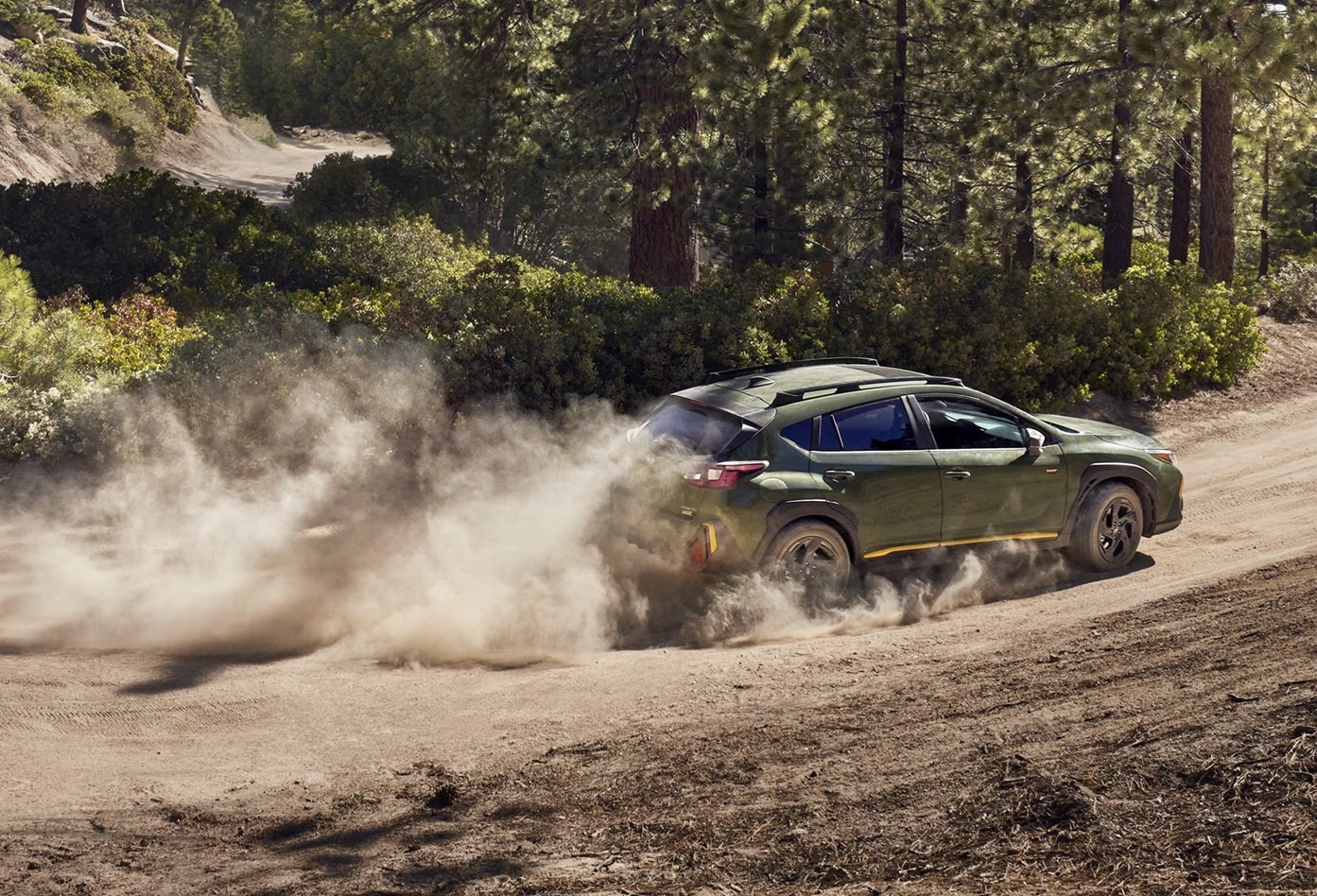
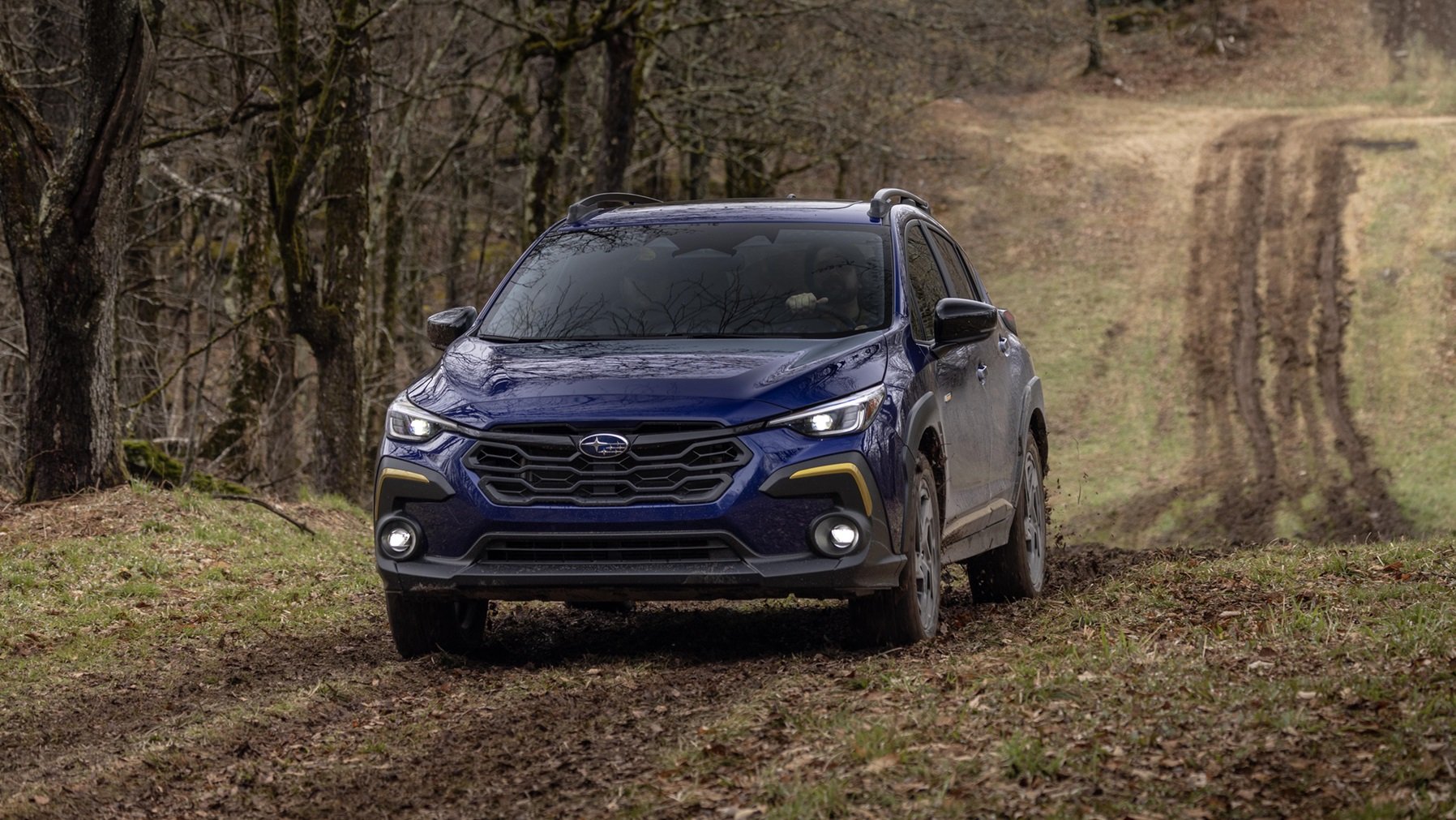
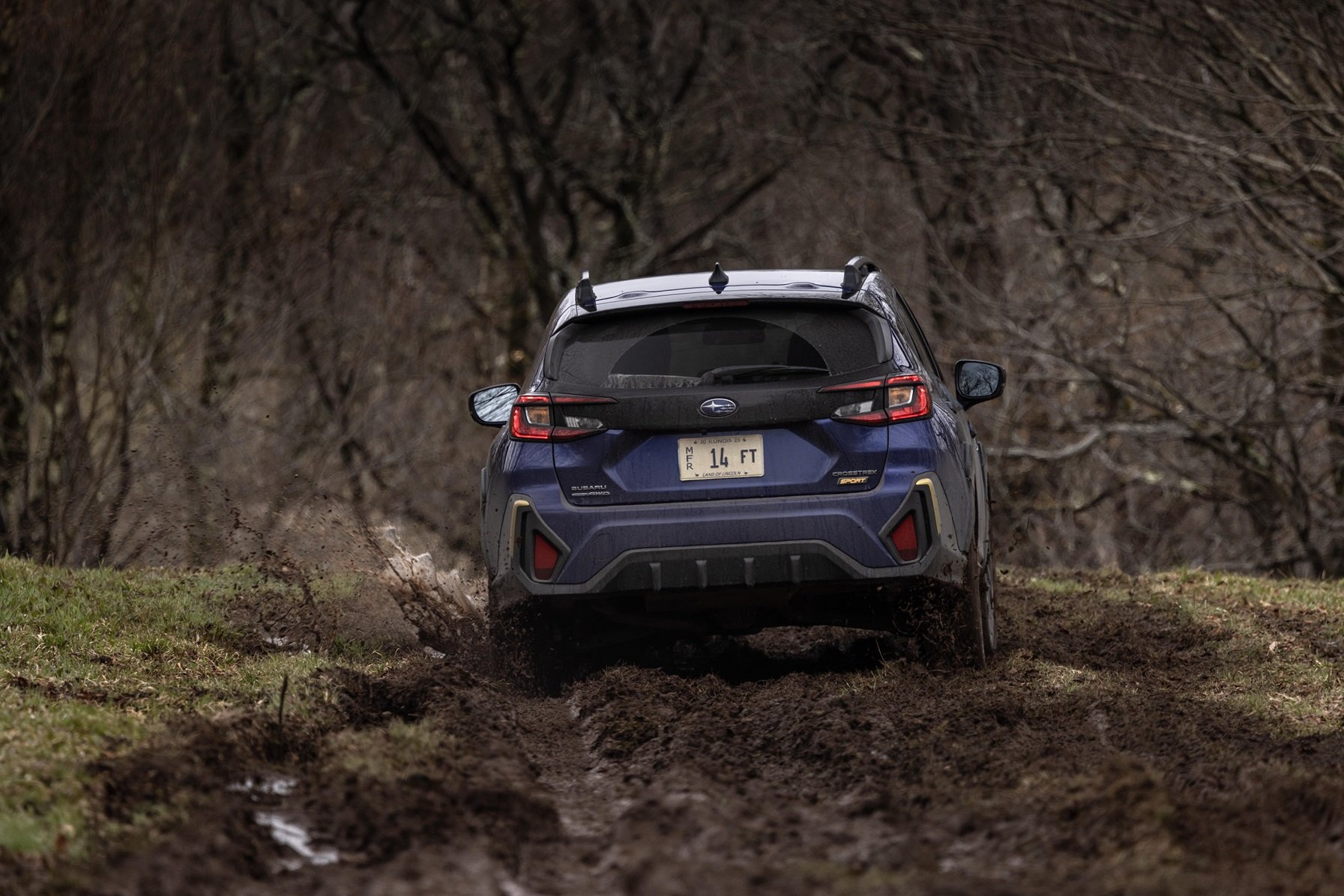
Subarus generally drive all four wheels all the time, so the vehicle doesn’t lose forward momentum the way an on-demand AWD does.
Subaru has a system called X-Mode - on all its SUVs - to extend the all-terrain envelope. It dulls down the throttle response at low speed to minimise the chance of you provoking traction-sapping wheelspin. It hardens up the limited-slip diff and also sharpens up brake response.
This is all for the slippery stuff, both uphill and downhill, under 40km/h. Under 20km/h it’s hill descent control allowing you to take your feet off the pedals and let the computer manage that, you just have to steer. It’s a real plus when traction is low - if you want to avoid becoming a toboggan - which, trust me, you do want to avoid.
Ground clearance for this kind of uncivil, reckless, non-bitumen driving is an impressive 220mm.
SAFETY
When buying a Crosstrek, safety is a big priority, especially if you’re allowing your young adult kids to drive, or if you’re ferrying your small children around.
In the United States, Subaru has earned more ‘Top Safety Pick+’ awards than any other brand, as rated by the Insurance Institute for Highway Safety (IIHS). And the Crosstrek was one of the latest vehicles to be given this accolade that is rather difficult to earn.
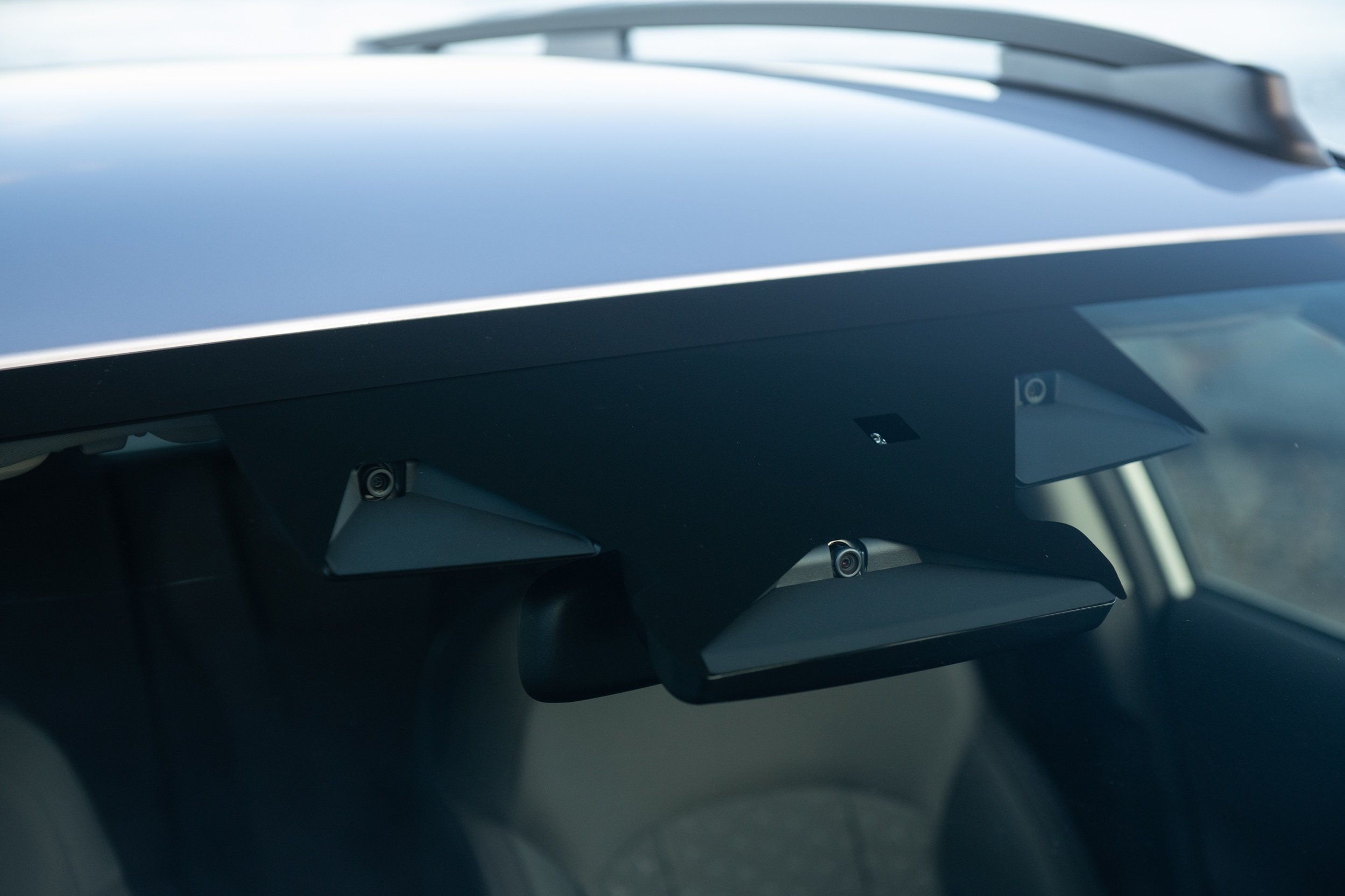


If you’ve ever visited intensive care, favouring EyeSight is a worthwhile investment in not returning. In my view, buying the base model is false economy.
EyeSight also adds adaptive cruise control, which is awesome. So good on the freeway - the car automatically adapts to congestion, slows down and maintains a safe following distance, then speeds back up. You’d never go back.
Adaptive cruise is available on Kona, Seltos, ASX, CX-3, and others, but Subaru is proud to say it was one of the first carmakers to introduce it and autonomous emergency braking years before anybody else - and they have been refining the software and hardware ever since. Hence it’s one of the best, most user-friendly systems on the market - still.
Other brands may have caught up by simply offering their version, but to be fair, they all have flaws, most notably in their lane-keeping features which are often overzealous or counter-productive even sometimes to the point of being a hinderance or a distraction when they overstep.
Having made the concession, Subaru’s lane-keeping is improved and doesn’t get as stringent on keeping the absolute dead-centre of the lane, unlike some rivals. Often, if you’re hoping to gently navigate an object on the road by using the available space in your lane - without going over the white lines (obviously) - the cameras typically try to tug the steering wheel to centre the vehicle.
Fortunately, Crosstek’s servos in the steering aren’t so aggressive and will let you continue the manoeuvre without making things worse. It doesn’t take over and give you that unnerving feeling that you’re not in control. This is a noticeable improvement Subaru has made in these systems over the years. Early versions were too dictatorial, but now they’re much more subdued without being completely useless.

Left: fun stuff; Right: serious stuff - Subaru has maintained its button-fest steering wheel, which is actually a good thing…
What’s also noteworthy is Subaru’s steering wheel layout of its buttons. It’s really good how they’ve kept the right formula for what functions go on the right-hand side and what stays on the left side. Anything related to infotainment, calls, volume, voice activation, skipping songs/stations - it’s all strictly on the left, closest to those features - where they belong; out of the way.
All cruise control, speed adjustment, driving mode, distance adjustment et al. are specifically on the right. Australians are predominantly right-handed, and we mostly drive during the day, so even the indicator stalks are on the right, so literally everything relative to operating the vehicle is on the preferential side.
And adjusting each feature has its own button. In a world where even Subaru has been going (too) hard toward touchscreens, the fact Subaru has maintained these haptic-feedback systems, is wonderfully ergonomic. If you want to increase the distance to the car ahead, push that specific button. Wat to reduce that gap? Push a separate but logically co-located button to do that.
As for its performance in crash testing, here’s how it performed in the notorious small overlap frontal crash test, which is one of the key areas needed to earn that safety pick award:
When it comes to destructive crash tests, the small overlap is an especially nasty one and quite difficult, in physics terms, to design a vehicle for. This is because, generally, you’re concentrating all the kinetic energy of the vehicle on one small area of the vehicle. So more load of the impact is absorbed by less of the vehicle’s structure than, say, a full-width or side-impact, whereby the impact is spread across a wider area.
It’s the concentration that is so destructive, meaning engineers have to pay particular attention to the forward passenger cell to make sure injuries to legs, feet and hips are kept to the absolute minimum. And they do this test for both driver and passenger sides. In the case of Crosstrek, the IIHS says:
the passenger's survival space was maintained very well…[meaning] risk of injuries to the dummy's legs and feet was low.
Crosstrek also has 9 SRS airbags standard, including above the driver’s knee and front-centre airbags.
But annoyingly, you don’t get the “pedestrian alert system” on the combustion models - only on the hybrid versions.
When it comes to operating a small SUV in the real throws of normal life, it’s far more relevant for consumers like yourself to have the safest, most practical vehicle around you at all times. You don’t get to choose the worst possible moment for a crash.
The fact a Crosstrek has arguably the best handling small SUV driveline among its competitors, one that is inherently designed to provide you with optimum grip between the four wheels, an excellent crash performance, a lower centre of gravity, and one of the best crash avoidance suites among mainstream brands - all means you’re naturally in the best position in the event something does go wrong. Touch wood.
It has taken ANCAP two full years to get around to rating the Crosstrek, apparently due to a safety update issued for MY25 vehicles. This is despite the actual testing having taken place in 2024, as shown on the vehicle in the images below when tested by EuroNCAP.
The summary of the ANCAP testing regime is thus: it passes with flying colours, in typical Subaru fashion.
One out of two points of contention for the Crosstrek is in what’s called the ‘Far Side Impact’ tests, which assess how well the vehicle’s seatbelts and centre airbag systems work at protecting the neck and spine from sideways travel, and the front occupants’ heads from collision, during the crash.
Now, the Crosstrek lost a point for what appears to be head-to-head contact through the front-centre airbag, which doesn’t actually happen as it appears in the little graphic beside the score (pictured right).


What actually happens in a side-related impact is the driver will initially move towards the curtain airbag while simultaneously the passenger moves toward the front-centre airbag. It’s the secondary recoil-type movements where the front-centre will protect the front occupants from these reactionary impacts. This is when the majority of the kinetic energy obtained by the occupants has reduced after their first deceleration experienced by the curtain and front-centre airbags.
In the footage provided by EuroNCAP, you can’t actually see the two heads colliding directly into each other through the airbag. Instead the brush the airbag at slightly different moments. It’s very unlikely two heads are ever going to directly impact an airbag in this pictured manner by the graphic; it just looks bad because, as a society, we’re acutely aware of head trauma, and the graphic uses red which makes us think: bad. But it’s not actually that bad; you’ll walk away from such a crash.
The second point of contention is regarding the ‘AEB Backover’ score which is poor. But for context, it was never tested on the Hyundai Kona, nor was the Kia Seltos tested for it back in 2019, the Mitsubishi ASX is so ancient it doesn’t have it, the Mazda CX-3 is of the same vintage a doesn’t even get it as an option on top-spec versions, and the new Toyota C-HR didn’t have it available on its vehicles for testing, so it wasn’t assessed. How convenient.
As least Subaru had the integrity to have their system scrutinised. And the ‘poor’ result doesn’t mean that it doesn’t work, nor that it wouldn’t actually stop or brake. But it does confirm that it functions and has some level of intervention.
And the Chinese brands aren’t much better: the new Jaecoo J7 got a ‘poor’ score, as did the Haval Jolion, and the Chery Omoda C5 did poorly on the ‘adult standing’ AEB Backover test, but did good on the ‘adult walking’ test.
Overall, the Crosstrek is a very safe vehicle not just in its ability to protect you in a crash, but to help you avoid having one in the first place, both from a collision-prevention technology perspective, but also from a vehicle dynamics and performance perspective. More on the latter below.


I'll help you save thousands on a new Subaru Crosstrek here
Just fill in this form.
No more car dealership rip-offs.
Greater transparency.
Less stress.
ENGINE
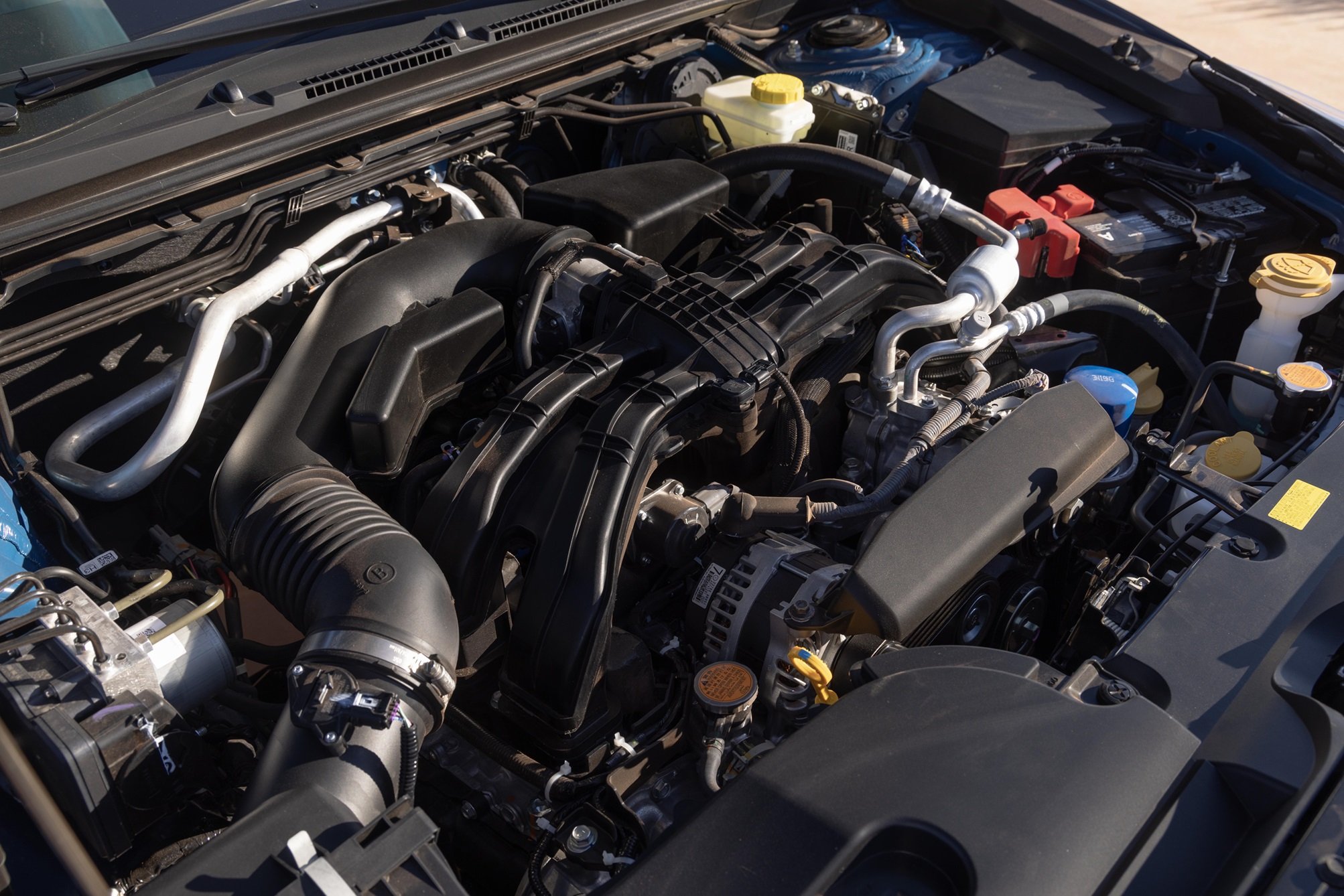
The second big part of Subaru’s deviance from the mundane is its Boxer engine. The pistons are aligned flat and move horizontally, instead of up and down. This means the engine is very compact in a vertical sense, meaning it sits flat and low in the engine bay, lowering its centre of gravity and reducing its longitudinal and latitudinal rocking motions, particularly in spirited driving in mountainous roads.
By comparison, other vehicle using a conventional vertically arranged four-cylinder engine will be subjected to vibrations inherent in the operation of its pistons going up and down. The engine (which is the heaviest component of the entire vehicle, has a tendency to wriggle side-to-side, and sits naturally higher in the engine bay and therefore handling in corners is either not as composed, or has to be resolved using engineering trickery.
Having said all this, the typical small SUV buyer is never going to fully appreciate or even necessarily notice these differences. But it’s nice to know.
Interestingly, the Crosstrek gets Subaru’s 2-litre engine from Impreza, and not the 2.5-litre in Forester. It only has a 115kW with a power-to-weight ratio of 77kW per tonne, and because the Impreza hatch has the same engine and output, the Crosstrek is slower because it’s heavier than the hatch.
It makes a bunch of noise under acceleration, but it’s only naturally aspirated, so there’s certainly nothing particularly exciting about its performance. But unfortunately, that’s because Subaru doesn’t really go in for that stuff anymore.
Check out Boring Boxer: Why Subaru needs to turbocharge the Forester >> for more on that.
This new Crosstrek is typically Subaru - meaning well built, with good ergonomics, and an easy to understand range. There are four variants with one combustion-only powertrain, and two variants with a hybrid powertrain.
It's built on the 'Global' platform - that’s the fundamental architecture for Subaru's future products. You get a 2.0-litre boxer four cylinder petrol engine mated to a CVT (transmission) and the trademark Symmetrical AWD.
Performance
Many Subaru Crosstrek reviews will claim it is a bit sluggish and the CVT drones on, but I’d suggest this is a load of steaming incorrectness.
Here’s why: the weight is within 100kg of Impreza. It’s the same powertrain. Therefore: Very similar performance. Basically, it’s line-ball with other strong two-litre petrol SUVs like Kia Seltos, Hyundai Kona and Mazda CX-3.
These uninformed critics are demonstrating both confirmation bias and CVT aversion syndrome. Compared with other vehicles at the same price, the performance is on par. The 0-100km/h sprint takes a tedious 10.5 seconds according to data provided by Redbook.com,au - and certainly the Crosstrek makes plenty of growling noises while doing it. But it’s increasingly rare that you’ll ever need to go from a standstill to 100 flat out.
Where Crosstrek shows quite good performance is taking off up to about 60km/h. It’s less of a sprint and more of an enthusiastic canter, which is exactly what you want from a small SUV. The differentiator for this vehicle over its rivals is it actually sounds okay when it does.
Sure - Crosstrek is not as fast as a turbo 2.5-litre CX-5 or a 1.6 turbo Tucson, but it’s a helluva lot cheaper for how spritely it is. Thankfully you don’t need a specially calibrated accelerometer in your arse, because it’s all about the mass and the power. Crosstrek keeps up in traffic and on the highway. It’s reasonably quiet and it goes where you tell it to go. And besides, you’re not exactly setting lap records in a small family SUV, are you?
A Hyundai Kona N-Line is going to murder a Crosstrek in a straight line, but in the wet on a mountain road at night, you’ll be tip-toeing in the Kona where you’ll be carving smooth, clean, reassuring lines in the Subie. Add frost, snow or mud? Same deal. Grassy concert carpark - Subaru for the win.
What makes the difference is how it performs in its element, which is out on the open road, even beyond it. If your family, or possibly your elderly parents, or even your teenage kids need to frequent somewhere beyond the sealed blacktop of security, Crosstrek is ideal.
Anywhere like a camping site, some rural in-road, maybe a gin distillery or winery, a farm or some remote getaway accommodation - if the roads become loose, broken, damp, or even downright torrential, you’re going to have a driveline operating that is quite capable of pulling you through these situations where a front-drive or on-demand all-wheel drive small SUV is going to struggle.
Unfortunately, towing is limited to 1400kg (braked) on all combustion model grades, and just 1270kg on the hybrids. But to be fair, 1400kg on a small SUV is better than Kona, Seltos, CX-3 and ASX.
INTERIOR
Crosstrek is all good in the dynamics domain. But there are a couple of somewhat less copacetic anomalies down the back.
Perversely, the Crosstrek’s luggage space is phenomenally smaller than the new 2024 Impreza at 291 litres versus 577 litres on Impreza. That’s 98 per cent less boot in the more expensive Crosstrek. This is the inherent compromise you make, but a lot of people think SUVs are bigger because … SUV. The truth is in quite stark contrast.
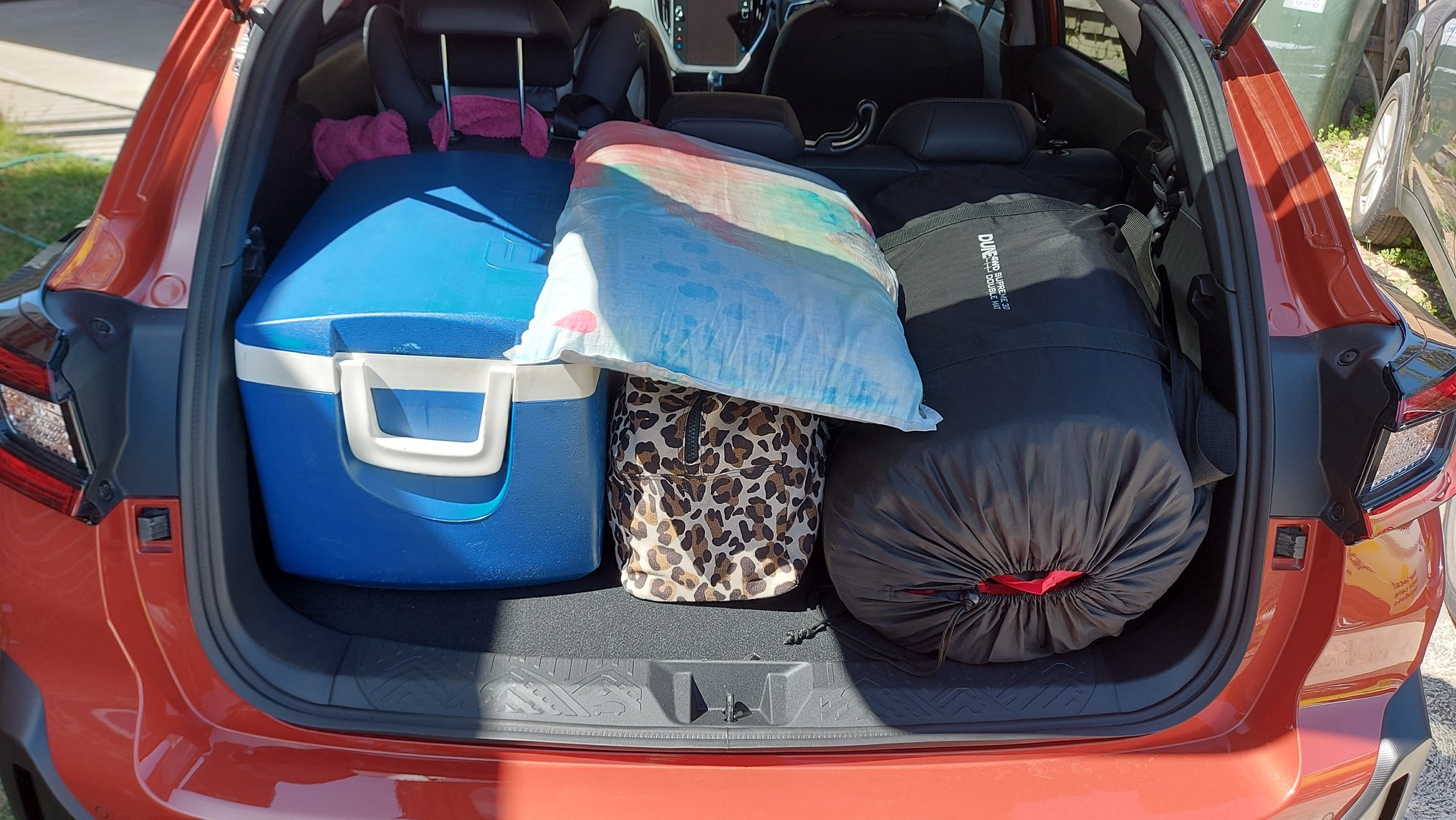
No powered tailgate on Crosstrek, but that means you can squash as much in as you can… Roof racks are necessary.
So exactly how practical or pathetic is Crosstrek’s boot then? Well, despite being significantly smaller than its cheaper Impreza brethren, it’s still a relatively useful space. A moderate size eski, a couple of small-to-medium luggage bags and a double inflatable mattress are happily consumed by the void.
However, you’ll note how close these items come to not only the edge of the boot floor, but also the limit of the aperture where the boot hatch needs to close.
Small, young families will of course be able to utilise the footwells of row 2 and there’s always the cost-saving option of some roof racks and a luggage pod to drastically improve the stowage capability of your Crosstrek.
If you’re buying an Crosstrek instead of an Impreza to accommodate more stuff, you really are barking up the wrong tree. Having said that, CX-3 offers only 264 litres (rear seats up), but beats Crosstrek with 1174 litres (seats down).
And despite this high floor, Subaru only provides a space-saver spare, which is kinda at odds with the wild adventuring this vehicle is otherwise so well set up to accommodate. And I don’t know why they do that - the other SUVs (Forester and Outback) see fit to run full-sized spares). It seems an odd choice, but the good news is the spare in Crosstrek is not some skinny little pool donut. It does actually have some profile that makes it much safer to use and will continue allowing the AWD system to function properly.
Similar to what was done on the performance hero WRX and Sportwagon >> the temporary spare is a 185/65/R18 which is only 20 per cent narrower than the standard 225mm tyres; still 80 per cent of the normal tread face:
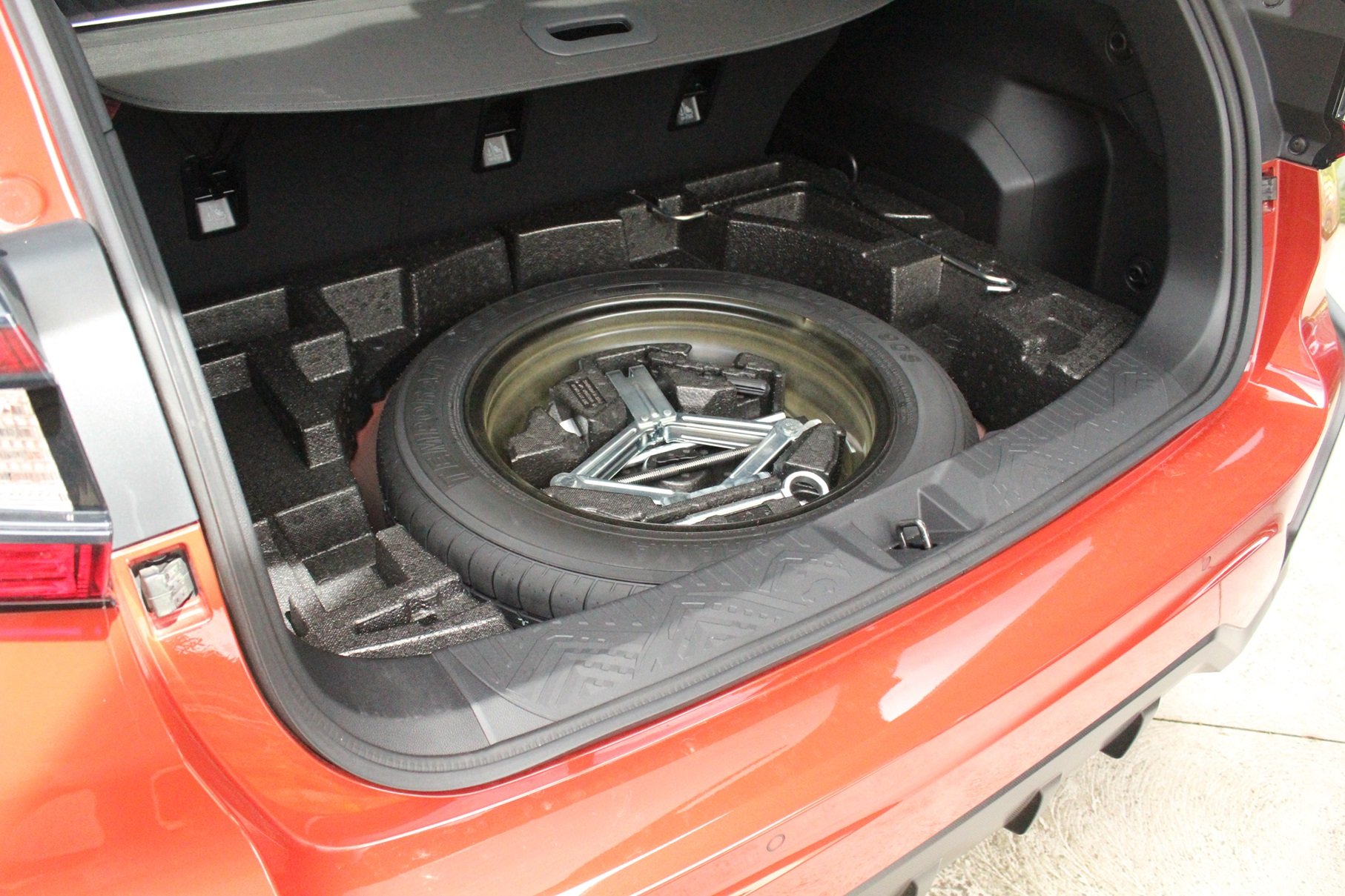
Not all space savers are created equal, apparently…
While you don’t get the built-in roof crossbars available on a $48,000 Outback (only $3K more than the Hybrid S Crosstrek, mind you), the rails you do get here do actually sit at a practical height above the roofline, meaning as you’re fitting your Rhino Racks or whatever, you’re less likely to scratch and scuff the roof paint as you do it.
Inside, the infotainment screen is 11 inches long, and you can customise the home screen to decide which features’ tile you want in what order. For example, you can have the ignition auto stop-start deactivation and the Driver Monitoring System deactivation right next to the round ‘Vehicle Settings’ icon so that as you do you start-up procedures in the morning, turning off all the irritating so-called driver-assistance systems is a slick process.
HINT: Do this before you drive off the dealership forecourt to take ownership.

You can judge for yourself, but the interior remains functional at a simplistic level - not to excess, but not lacking…
Crosstrek’s interior is nicely executed without being the full ‘wannabe Mercedes’ experience you get inside a Mazda CX-3 >>, or the funkytown design exercise of the Kia Seltos >> or the futuristic-Robocop inspired Hyundai Kona >>
It’s a simple layout, nothing is in a weird spot, every switch and button feels robust and light to operate, the seats are good for moderate journeys out on the road (before you’ll need a stretch after 90 minutes), and the centre console is not bombarded with stuff. This later aspect is mostly because Subaru has put a lot of emphasis on the tablet screen - which dominates the dashboard, aesehtically.
But having said that, it doesn’t mean you’re always using it. It’s not some wanky Tesla experience; you don’t have to trudge through endless menus to do basic stuff. Heater and A/C controls are fixed in place, and there’s even proper temperate adjustment buttons either side for each respective passenger for quick changes.
Yet, in contradiction to the screen we have seat-heating switches on the central transmission console, which are the same switches used by Mitsubishi.

Almost as much legroom as a Forester, but only about 13cm less headroom
No rear air vents are a bit disappointing on a circa-$40,000 SUV aimed at young families, particularly as there’s a sunroof on the mid-spec 2.0i-R letting in more sunlight to further heat up the cabin. You do get pockets on the front seatbacks, but they’re pathetically shallow, while at the same time up front, the sunvisors still don’t extend out to cover that irritating patch of UV searing your neck on a sunny afternoon back from the beach.
At least you get wireless Apple CarPlay and Android Auto as standard across the whole range, so no more aggravating cables strewn across the centre console. So that’s nice.
DRAWBACKS
The boot
Arguably the biggest problem with the old XV, ironically enough, was that it wasn’t big enough to be as spacious as a family might’ve liked, but not small enough that it was the antithesis of economical rationality.
It was in a weird middle-ground between being too compact to be practical for a 2+2 family going away for the weekend (without roof racks and a luggage pod), nor was it as tightly packaged as a standard Impreza - but cost an extra $10K more.
The boot was too small, there wasn’t enough legroom for anybody over 6-foot-tall, and fitting a child restraint was hard work if you forgot to duck your head.
But just to be clear, most small SUVs are like this. They’re typically too small to be as well-heeled in the space domain, but you’re paying more than the ordinary hatch car they were derived from. And in some cases, you actually lost boot space in the process as well. Mazda CX-3 is a good example.
The main concern here is that Crosstrek’s 291 litres of luggage space is 6 per cent smaller than before, but the whole vehicle is 10mm longer. Subaru has missed an opportunity to improve on its predecessor’s primary issue, which is disappointing.
However, keep in mind that if they’d found a compromise to give you a bigger boot, it probably would’ve meant you got a space-saver spare and not the chunkier half-size spare that’s there now. You can solve the boot space issue with roof racks and a basket or platform very easily at any auto retail store. They’ll even show you how to fit/install it - they can even do it for you.

The hybrid
There are two hybrid model grades, the L at roughly $43,700 driveaway, and the S at $51,000. There’s a roughly $4000 premium for the hybrids over the equivalent combustion-only variant. That’s worth about 2000 litres of unleaded at $2 per litre.
If we look at the Hybrid S and compared it with the petrol-only ‘S’ to see how the onboard battery assists the engine. We need to do this because there are some changes made to the combustion version that alter how you might use it.
Firstly, the fuel tank on the Hybrid S is 15 litres smaller than the S. But it weighs 1622kg, a full 5 per cent heavier than the top-spec S at 1540kg - with a 63-litre fuel tank. The result of this increase in weight means that because it only makes 110 kilowatts, it has a worse power-to-weight ratio at 69kw per tonne. The combustion-only S has 77kW-per-tonne. The performance is better in the top-spec Crosstrek S which is thousands cheaper.
The performance is going to be exactly the same between the hybrid or the combustion-only Crosstrek. If you’re expecting it to go better, you’re going to be disappointed. This is not where the advantage of choosing the hybrid lies.
The reason performance is mediocre is because the battery has to produce 12.3 kw to power the electric motor to capacity, but the battery is only about 0.6kwh. So it’s being discharged rapidly - and it can only do it for as long as 3 minutes until it’s completely depleted. And you can’t even drive on battery-assistance only; the combustion engine kicks in at somewhere between 25-40km/h.
This is a 1.6 tonne vehicle being moved by, essentially, four lawn mowers worth of battery and motor assistance. It’s such a small battery, Subaru doesn’t even quote its output specifically on the spec sheet. It’s the equivalent of six 36-volt power tool batteries.
Just for comparison, the Toyota Yaris Cross hybrid has an electrical motor that produces 59kW, which is 4.7 times the output of the Crosstrek. And it’s $9000 cheaper.

So, why would you want the hybrid?
‘Hybrid’ is a form of energy capture. It relates to harvesting energy otherwise lost by braking. The hybrid system in Crosstrek captures kinetic energy when you lift your foot off the throttle. It stores it as electrical potential in a battery, which you can use to get going again when you stop.
In practice, only a small amount of energy gets captured. But it makes a big difference to fuel economy. There are two types of hybrid: there’s plug-in hybrid, or parallel or series hybrid. Crosstrek is the latter: you cannot plug it in, and it can only capture kinetic energy from braking or decelerating (letting off the gas).
If you’re on the highway, you’re not going to be recharging the battery (capturing energy) to use when you get going again, unless you’re coasting down hills or braking intermittently. But it wont add much because you’re sitting at a constant speed, relatively speaking. That level of effort is going to be more than the tiny battery alone can handle. So you’re going to be relying on the combustion engine solely, primarily, which is why the official highway fuel economy is the same between combustion-only and hybrid Crosstrek.
What the hybrid means for consumers is a reduced emissions footprint in urban driving.
So how’s the fuel economy then? We’ll if you’re a city driver commuting regularly in stop-start traffic, you’ll appreciate that the hybrid is minutely better at saving fuel. This is because it has lots of braking opportunity to recharge the tiny battery onboard. So it returns a 6.5-litre per 100km combined cycle. The combustion-only S returns 7.2 litres - so about 10 per cent. That’s 0.7 litres (700ml) every 100km.
If you drive the average 15,000km travelled in Australia annually, that’s 105 litres you’re going to save. If fuel is $2 per litre, that’s $200 a year saved, making it 20 years before you break even on the $4000 premium you paid. So in 2043 you’ll be back in black on your Crosstrek hybrid.
Honestly, just by the combustion-only ‘S’.
MAIN COMPETITORS
Here in Australia, the top-selling small SUVs are the CX-3, ASX, Kona and Seltos. Here’s a synopsis for comparison with Subaru Crosstrek.
Mazda CX-3
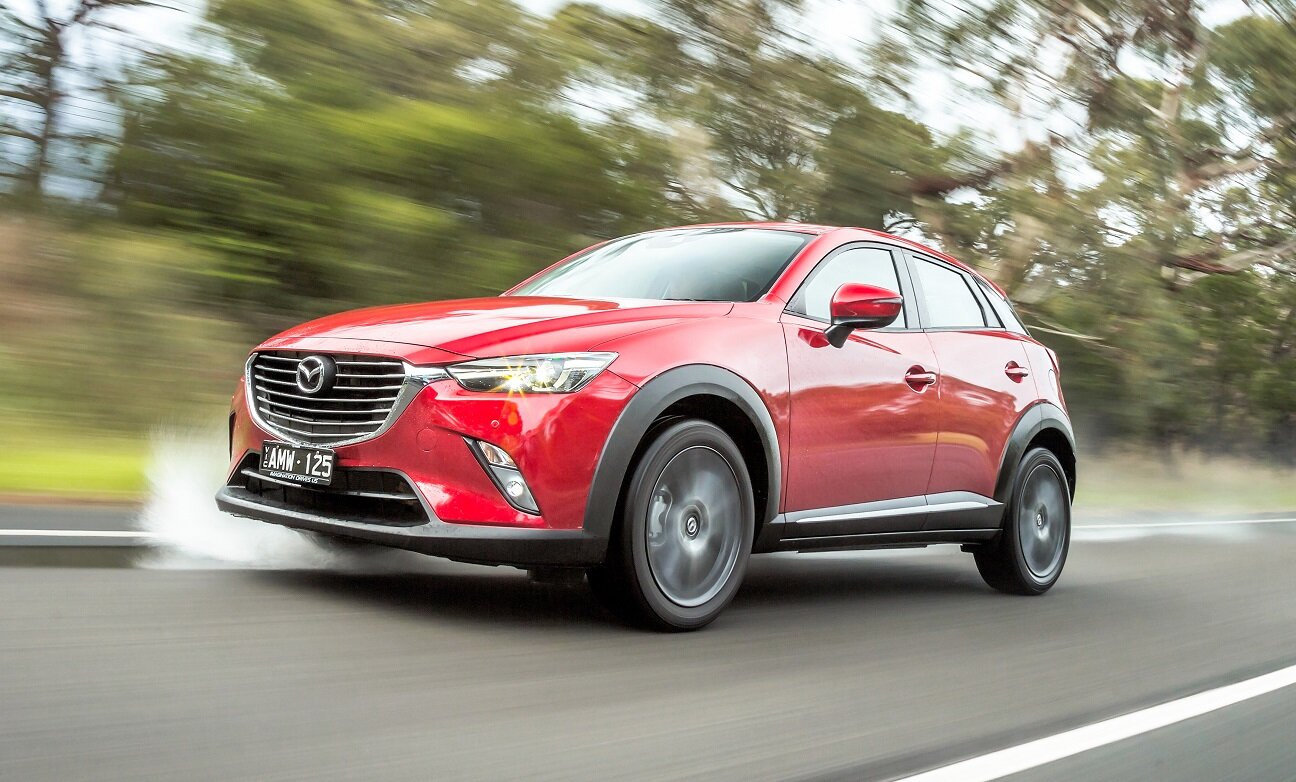
Combines elegant styling with smooth powertrains and quality interiors… but it’s old.
CX-3 is, however, very compact, at just 4.2 metres long and there are plenty of buttons thanks to the age of this platform (CX-3 shares its platform with the Mazda2, by the way).
This compact SUV is perhaps the perfect of its kind for getting around town in comfort and style.
The CX-3 is a conservative all-rounder, being more subtle than the more outlandish South Korean offerings. There’s just a little more prestige and polish all round.
Your teenage kids might think other cars are cooler, but they’re not the ones spending the cash, frankly. The CX-3 presents itself dressed ‘smart-casual’ in a segment where ‘torn jeans’ are the norm.
Click here for Mazda CX-3 review >>
Mitsubishi ASX
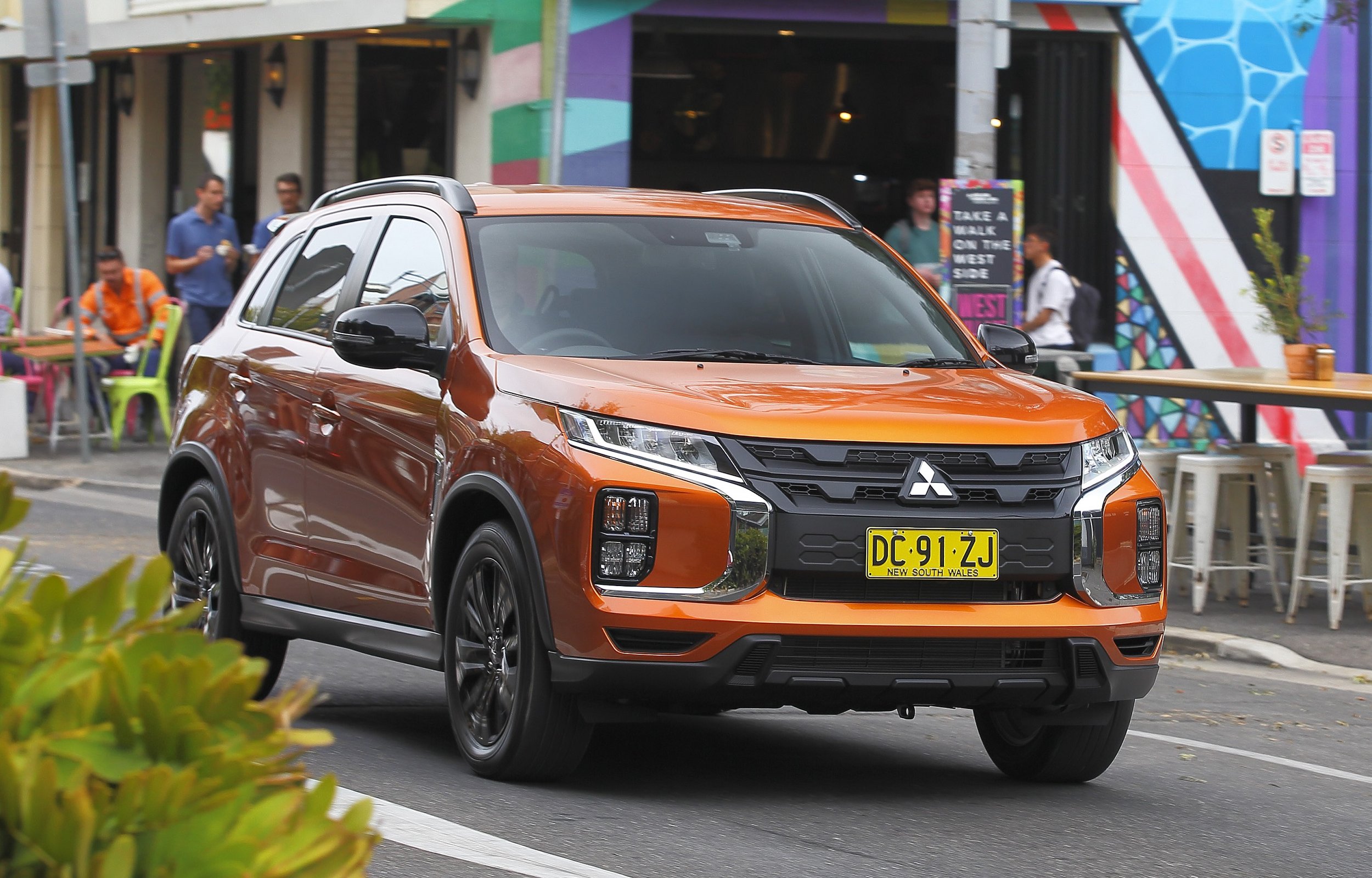
If you need an affordable, decent quality suburban SUV that’s affordable to run and service, then this is a good option for you.
While the ASX is certainly not the most innovative in terms of styling, layout or functionality, it’s right up there on value, and that’s backed by solid customer support and a strong 5 + 5 year warranty proposition (the latter five being dependent on servicing at a Mitsubishi dealer).
Equipment levels are acceptable, without being excessive or opulent. Luggage space might be a bit tight, but the ASX is still family-friendly while managing also to be compact and manoeuvrable - that’s a plus in multi-storey carparks and inner-city laneways.
ASX is a budget option for putting your kids in a modern safe SUV, to compete with the Hyundai Venue and Kia Stonic.
Click here for Mitsubishi ASX review >>
Hyundai Kona
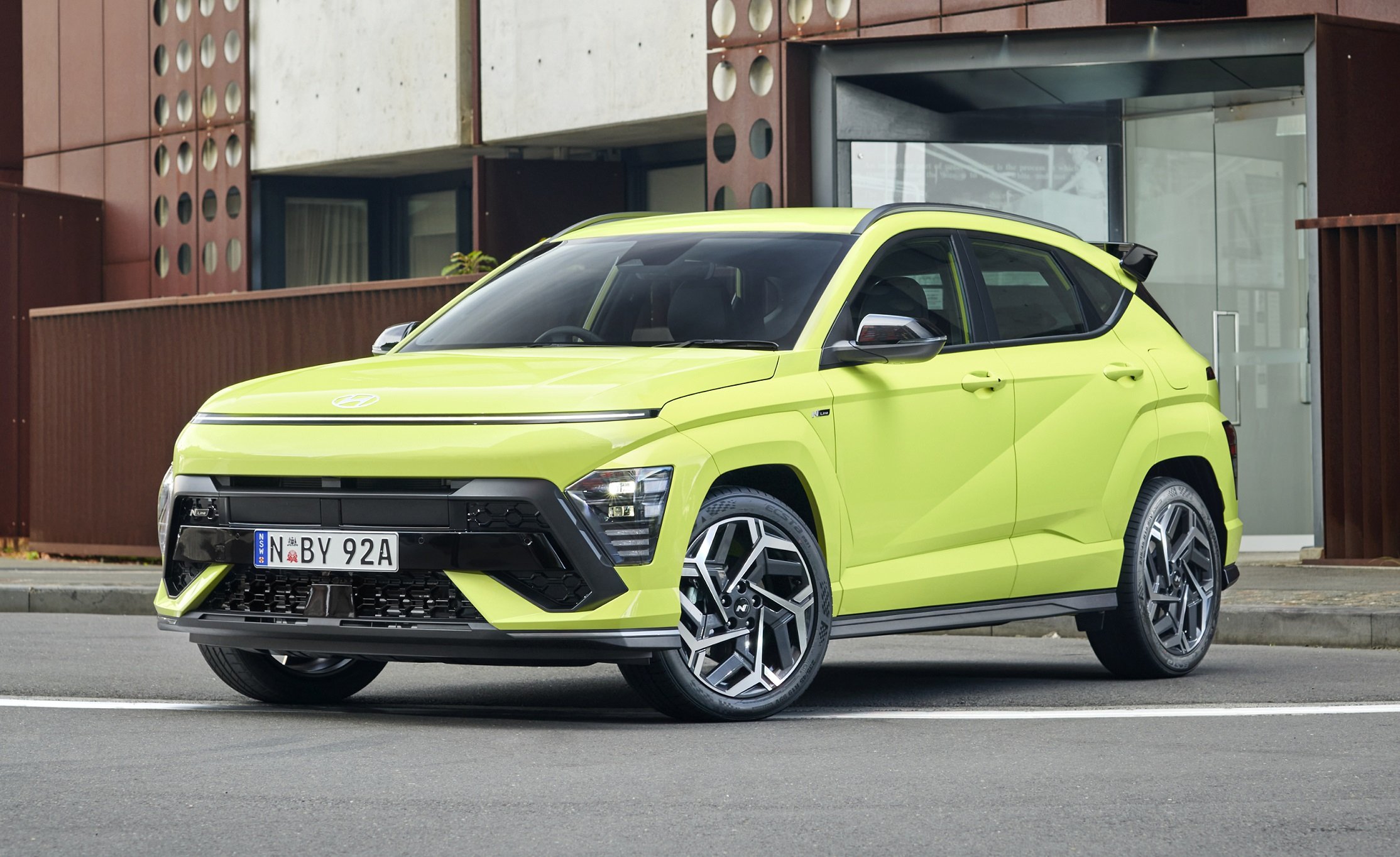
A funky, modernised hatchback SUV - with a proper performance option if you’re that way inclined.
Useful ground clearance makes tall kerbs and shoddy suburban driveways less scary than they would be in a low-slung conventional car.
Hyundai is up there with the best customer service operations in Australia, and the Kona is a compelling value proposition for a small family or those about to start one. The previous generation of Kona enjoyed a solid six years of in-service reliability, across all powertrains and variants. The new version (pictured, yet to arrive in dealerships) should continue this trend.
You’ll appreciate excellent build quality, a stylish but functional interior, generous luggage space, plus a wide model range including a performance version and the all-electric Kona.
Click here for Hyundai Kona review >>
Kia Seltos
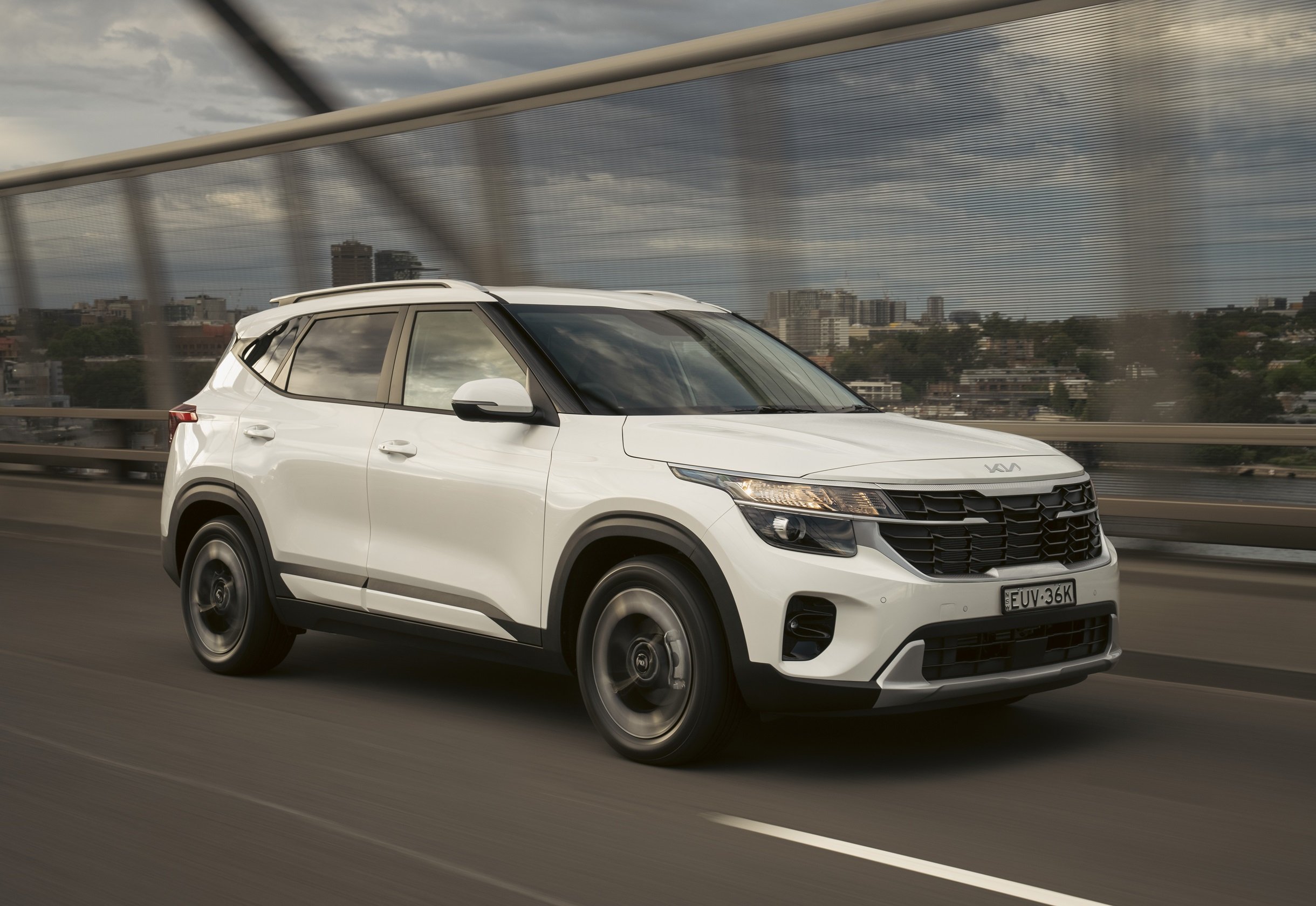
Seltos shares its platform with the Hyundai Kona, but the model range is more streamlined, comprising just two powertrains. Which one you choose is really just about performance, equipment level and budget.
There’s a fuel-efficient 2.0-litre Atkinson cycle four-cylinder driving the front wheels only via a CVT, or a hotter 1.6 turbo engine with AWD.
Another bonus is generous luggage space, despite the city-friendly overall dimensions. It’s good for parking in tight spots without being too small to take a young family on a driving holiday.
There’s a well equipped interior, the latest tech, and a strong suite of standard safety features.
Click here for Kia Seltos review >>
CONCLUSION
The Subaru Crosstrek does lack a big enough luggage space in the boot for growing families - there’s no doubt about that. But consider that if a large part of your family is already grown-up but their either need help with their first car, or perhaps you need a smaller one to keep up with them - Crosstrek is a compelling idea.
It’s also a great choice for small families just getting started.
It can happily do soft-roading type camping adventures, you can dramatically expand its carrying envelope with a few aftermarket mods like some roof racks and a luggage pod, or a towbar a light trailer, and even if none of that appeals to you, simply having a regional property can mean you deal with muddy driveways and inclement unsealed backroad conditions.
But Subaru’s unique AWD also benefits in terms of general driving in the suburbs on sealed roads that are particularly steep, where their driveways can be used multiple times per day and it only takes one sudden downpour to render most front-wheel drives fighting for grip.
Crosstrek thanks to its relatively small size makes it nimble and efficient for moving up to four people in reasonable comfort, in close quarters driving, while also offering that window of capability in times of uncertainty - and that adds to your peace of mind, especially if it’s your most precious people driving.




There’s plenty to like about the 7-seat Ford Everest for hardcore off-roading and heavy towing thanks to its big V6 diesel. But is it wise dropping up to $80K on Ford these days?