
Hyundai Santa Fe review and buyer's guide
The Santa Fe adds a hybrid powertrain to what has been one of Australia’s best-selling seven-seat SUVs. It offers premium European-style refinement and equipment you’d expect from prestige brands, keeping its value proposition and family appeal.

Save thousands on a new Santa Fe
Fill in the form - we’ll get you a great price without the stress
The all-new Hyundai Santa Fe is a perfectly rational argument against buying a luxury 7-seat SUV from Mercedes or Audi, because it offers such breathtaking value it puts supposedly premium brands in the naughty corner.
The Hyundai Santa Fe is a three-row large SUV that offers a long list of equipment you won’t find on its rivals like Sorento, Kluger, Mazda CX-9 or Outlander.
Hyundai has dropped the 2.2-litre turbo-diesel engine in this generation of Santa Fe, which is a fundamental change, especially because they’ve gone to a hybrid powertrain instead. This is a product planning decision that previously has sacrificed that surge of predictable, tractable low-RPM power that made moderate towing and long-haul family touring a breeze.
The reason for this relinquishing of diesel is to use a hybrid powertrain we’ve seen used in the rest of Hyundai’s range: the 1.6-litre turbocharged petrol engine with a moderately powerful 44kW electric motor driven by electrical supply from a battery roughly the same size as the one in a Toyota RAV4. Except in the Santa Fe, that battery is doing a lot of work (which is a good thing, in this case). More on this below.
The Santa Fe is also a distinctly modern-looking vehicle with some out-there aesthetic design which manages to not entirely override the vehicle’s ultimate practicality and purposefulness as a three-row, seven-seat family vehicle with decent soft-roading abilities baked in.
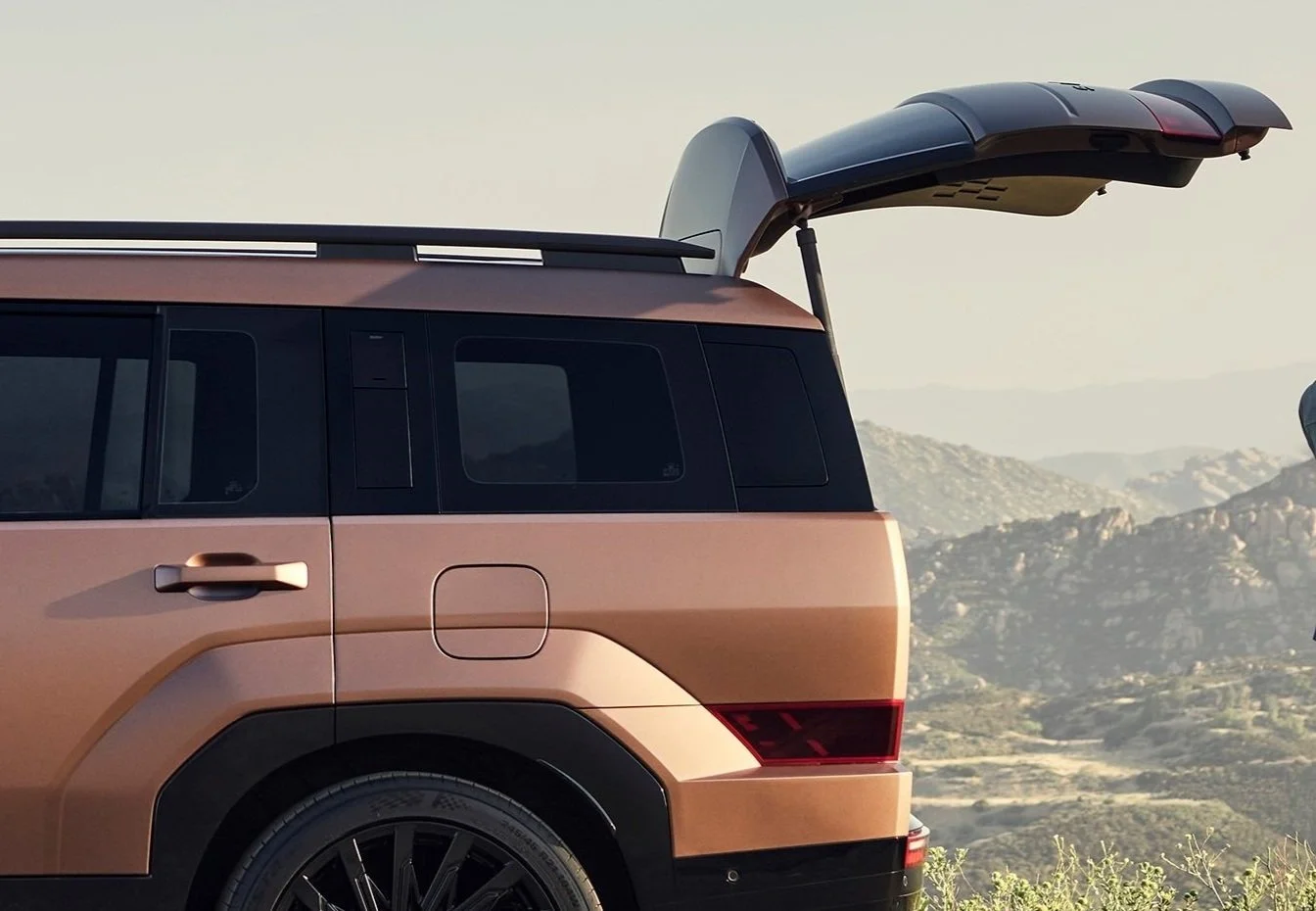
You’d be forgiven for thinking it looks like a contemporary homage to the Land Rover Discovery 4 with its sharp, square front styling, it’s wide centre-split tailgate ideal for sitting on at some idyllic vista, and a rear window perfect for hunting ducks from (in season, obviously, if you’ve from Victoria).
Just because Santa Fe offers smart, modern and minimalist interior design, however, doesn’t mean it still ticks all the right boxes. Has the new, supposedly better version lost that X-factor which really did impress on the old model? We’ll discuss that soon enough.
Hyundai designed this new Santa Fe with the intention of making it more ‘adventurous’ than most SUVs by making it bigger, taller and more boxy - kinda like a 4X4 LandCruiser, only with decidedly more luxurious interior design, and without the beefy, hardcore off-road drivetrain underneath, obviously.


Santa Fe is a vehicle that continues to suit the modern school drop-off zone, but it’s hard to say if the Santa Fe will age well. Stranger things have happened.
There are also questions we need to answer regarding whether the Santa Fe is worth your money over something slightly older but still highly functional, and with that grunty 2.2 turbo-diesel engine - the Hyundai Palisade.
And considering the price of a Santa Fe is in the $70,000 region, would you be better off getting something equally as practical as a Palisade, or even go slightly more off-road biased with something like an outgoing Mitsubishi Pajero Sport GSR?
But there is also a question here regarding Hyundai cannibalising sales of the larger more LandCruiser-esque Palisade with its 8-seat appeal and supposed flagship super-sized design. It’s a question we need to address here because if the Palisade does everything a Santa Fe does, then what’s the point of either?
Current Palisade is 5 metres long (well, 4995mm if you want to be technical; based on the old Santa Fe’s platform), and the new Santa Fe is an additional 45mm longer than its predecessor, now 4830mm (4.83m). So it’s just 16.5cm shorter than a Palisade, and it’s now taller than it at 1.77 metres.
All of this growth means we have to ask: What’s the point of the Palisade anymore? Well, the short, simple answer is that the new version of Palisade, whenever that finally arrives, will be even bigger again. In the case of Santa Fe and Palisade, this growth also means increased in wheelbase, meaning more passenger legroom and general interior space.
Hyundai says new Santa Fe is 50mm longer in wheelbase (than the old one) meaning it’s now 2.83 metres between the front and rear axle centreline.
But there’s an important problem here with all this growth - it’s not free. Not just financially costly, it also has a direct increase in the vehicle’s weight. Find out more in the ‘Engine’ section of this review, below.
Also in this category, you’ll be comparing against the Kia Sorento >>, the Mazda CX-9 >> and/or Mazda CX-8 >>, there’s the medium-sized by 7-seater Mitsubishi Outlander >>, the Toyota Kluger >> or potentially, if 7-seats is not a strict requirement, the 5-seat (but fairly large) Subaru Outback >>
You might also find interesting the Hyundai Palisade 8-seater >> or the Kia Carnival: a SUV-style people mover >>

FEATURES & PRICING
Specifications and price may change at any time: always check before signing any contract or paying a deposit.
There are now three model grades, all with the 2.5 turbo-petrol which arrived in late 2024 and is now the default powertrain. But on the base model Santa Fe, it is front-wheel drive by default with the option of upgrading it to all-wheel drive, keeping that 2.5 engine.
The base model is still just called ‘Santa Fe’ (with no individual, discernible naming convention, which makes the Santa Fe just that little bit more ambiguous for consumers to decipher). Starting at about $58,300 driveaway, that’s in front-wheel drive with the 2.5 petrol engine, or you can pay another $3100 to make it proper all-wheel drive for $61,400 driveaway.
Next model grade up is the ‘Elite’, which asks just under $68,200 and it can only be had in all-wheel drive.
And finally there’s the top-of-the-range, the ‘Calligraphy’ at an eye-watering $78,600 for the 7-seat version, with a 2-3-2 seating configuration front to rear. Or you could opt for the 6-seater version which deletes the centre position in row 2 and allows for walk-through access to the two seats in row 3.
The only problem here is the Calligraphy 6-seater is $79,100. You’re probably thinking you’re paying another $500 for less seating capacity, but it’s actually for the ease-of-access to row 3 which is traditionally quite poor in 3-row vehicles.
If you at $2500 to each model variant, you can have the 1.6 turbo-petrol hybrid powertrain.
Santa Fe soft-roading packs now available…


Hyundai Australia has given the new Santa Fe a dealer-fitted version called the ‘XRT’ to make it an even better soft-roading all-wheel drive option.
The XRT is available exclusively with the 2.5-litre turbocharged petrol engine which arrives in
Both the ‘XRT Adventure’ and ‘XRT Peak’ packs include black 17-inch alloys with Pirelli all-terrain tyres, some light underbody guards, mudflaps behind all four wheels, black roof rails, black/charcoal trims and highlights. Sadly, the embossed XRT logo leather seats are only available (for now) on the US-model Santa Fes.
With both XRT variants, approach, breakover and departure angles increase from the standard base model or Calligraphy, thanks to new suspension components. These include uprated springs and dampers to give better wheelarch clearance and better performance over rougher roads than the standard on-road set.
The uprated suspension increases ground clearance by 33mm to 210mm, an increase of 18 per cent over the 177mm available in the standard Calligraphy. This is carried over from Hyundai in North America which indicates 8.3 inches of ground clearance over 7 inches in the standard Santa Fe variants.
Unfortunately the Australian-spec XRT does not get a full-size spare up under the rear (it’s a space-saver only), but you could simply take the donut-spare out and get yourself a correct-profile wheel and tyre from any tyre shop and mount that on the roof.
On XRT Peak, you do get side steps (maximum 200kg load rating) and roof racks with an 80kg load limit, provided you ‘distribute the load evenly across two bars’ and not concentrate it all in one spot. Although, it’s hard to do that with a full-size spare, gas bottle or an Eski. You would centralise the load as best as possible, in most cases, which is good practice for stowing anything on the roof anyway.
The XRT Adventure is a $6990 pack and the XRT Peak is $9990.


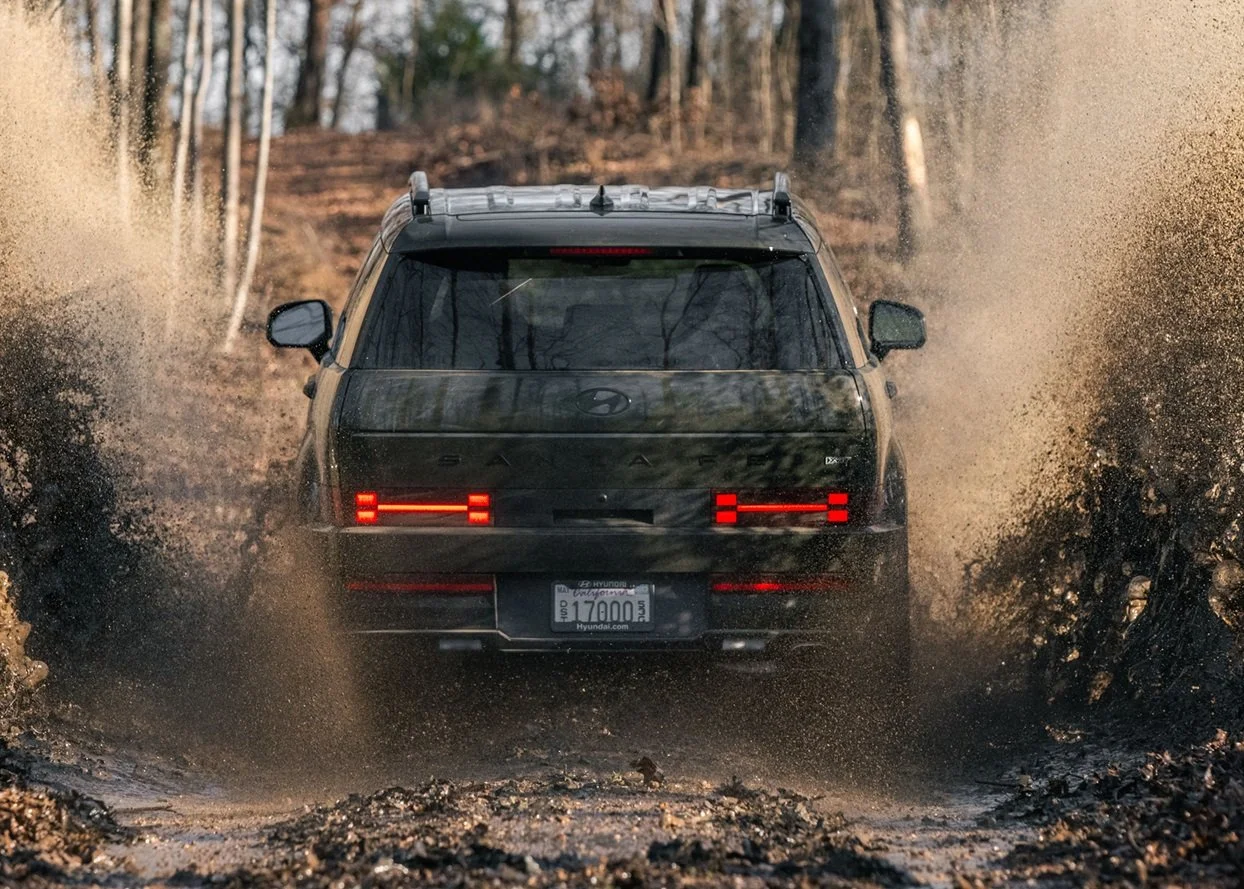

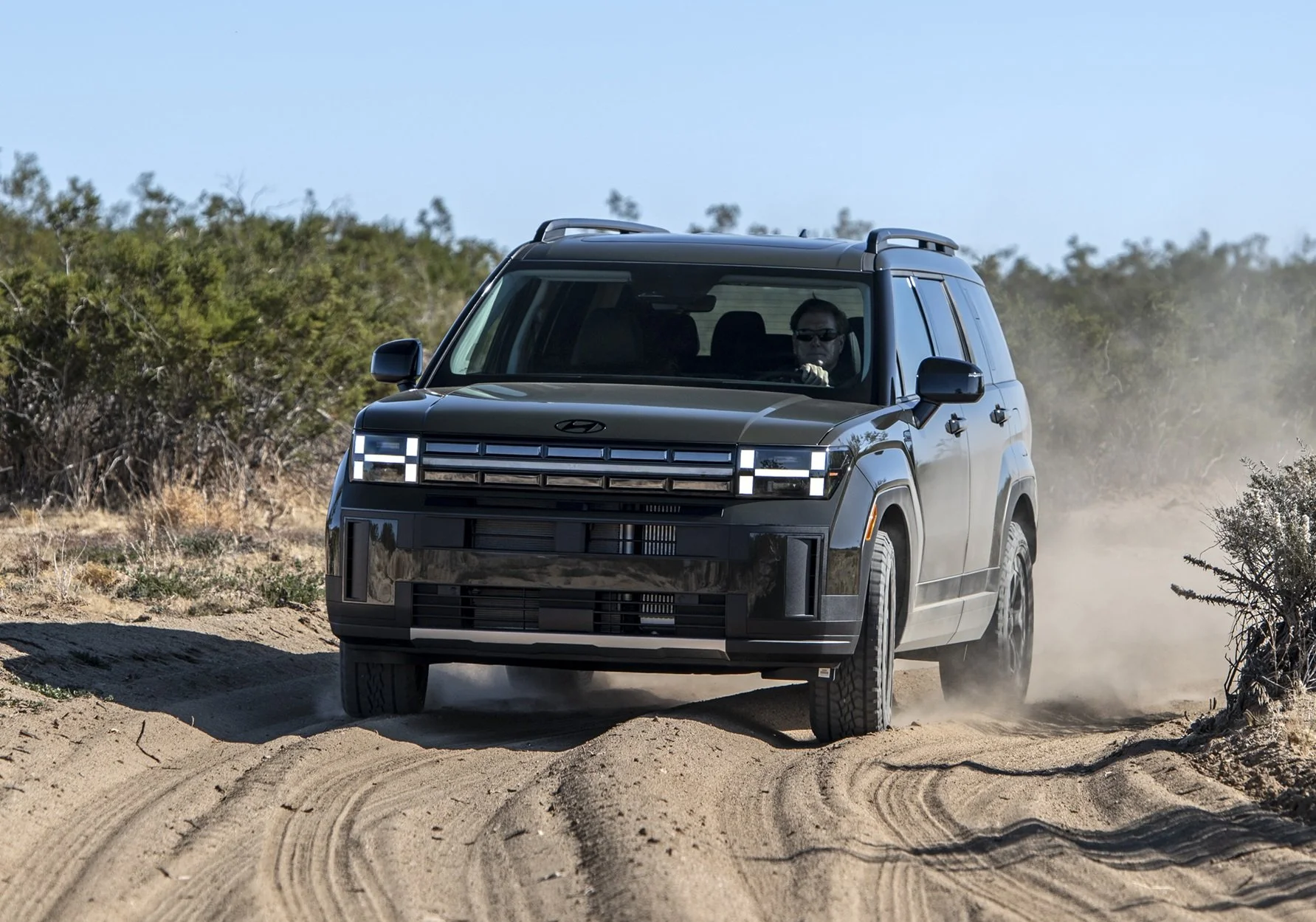

While it’s not a true return of the Terracan 4X4 wagon with a dedicated low-range transfer gearbox, this certainly puts Santa Fe in hot competition for that large-SUV soft-roading vehicle, of which you would compare it with Subaru Outback XT and Mitsubishi Outlander Exceed or Aspire with Super All-Wheel Control.
What makes this such a good-value and compelling choice for Santa Fe is that the HTRAC all-wheel drive system has proven itself quite clever and profoundly good at low- to medium-intensity soft-roading conditions. The addition of all-terrain tyres can massively improve the unsealed road performance of any AWD vehicle, which is a good product decision for Hyundai.
But to include more fundamental components such as the uprated suspension - that’s a significant step. In concert with the tyres, the highly active AWD system and the various alternative-terrain mode selections you can set to replicate 4X4 vehicle behaviour, this XRT edition is going to be quite comfortable leaving the bitumen.
Here’s a basic summary of the varying equipment levels on the relative model grades.
Santa Fe (base model)
2.5-litre turbo-petrol | $58,300 d/away approx. (7-seat)
1.6 turbo-petrol hybrid | $60,800 d/away approx. (7-seat)
starts with:
Optional front-wheel drive or all-wheel drive with either 2.5 turbo-petrol or 1.6 hybrid powertrains, standard transmission with drive mode selection,
Tyre pressure monitoring, rear parking sensors and reversing camera, electronic park brake, auto high beam, auto rain-sensing wipers
Full LED lighting in headlamps and daytime running lights
auto dual-zone climate control, 2nd and 3rd row ventilation ducts with air-con, heated door mirrors, electric lumbar support (front seats)
Adaptive cruise control, forward collision avoidance, junction collision avoidance, rear blind spot collision avoidance, rear cross-traffic collision avoidance, lane keeping, multi-collision braking
20-inch alloys, full-size spare tyre, front, rear and side parking sensors, rain-sensing wipers, power folding mirrors
Wireless Apple CarPlay and Android Auto, single wireless phone charging, 12.3-inch infotainment touchscreen standard on all variants, 360-degree camera system
Cloth seats, bi-directional centre console, proximity key & push-button start, paddle-shift, electric child locks, safety exit assist, leather steering wheel



Something new and curious added to the adaptive/“smart” cruise control system is what they’re calling “Machine Learning function” which Hyundai says is “based on driving style”. The question this raises is: If humans are so bad at driving, why are we teaching the machine how to drive like us? Isn’t that the blind leading the blind?

Tall, thick matte-black lower door, rear bumper and wheelarch trims ‘distinguish’ Santa Fe poverty pack
An entry-level Santa Fe, which doesn’t even get a proper name like the ‘Elite’ or ‘Calligraphy’, might look a little bit plain-Jane on the outside, but it comes with a very long list of standard features.
So don’t be fooled by the Westinghouse fridge white paint scheme and blocky alloy wheel designs.
Elite
2.5-litre turbo-petrol | $68,200 d/away approx. (7-seat)
1.6 turbo-petrol hybrid | $70,700 d/away approx. (7-seat)
adds:
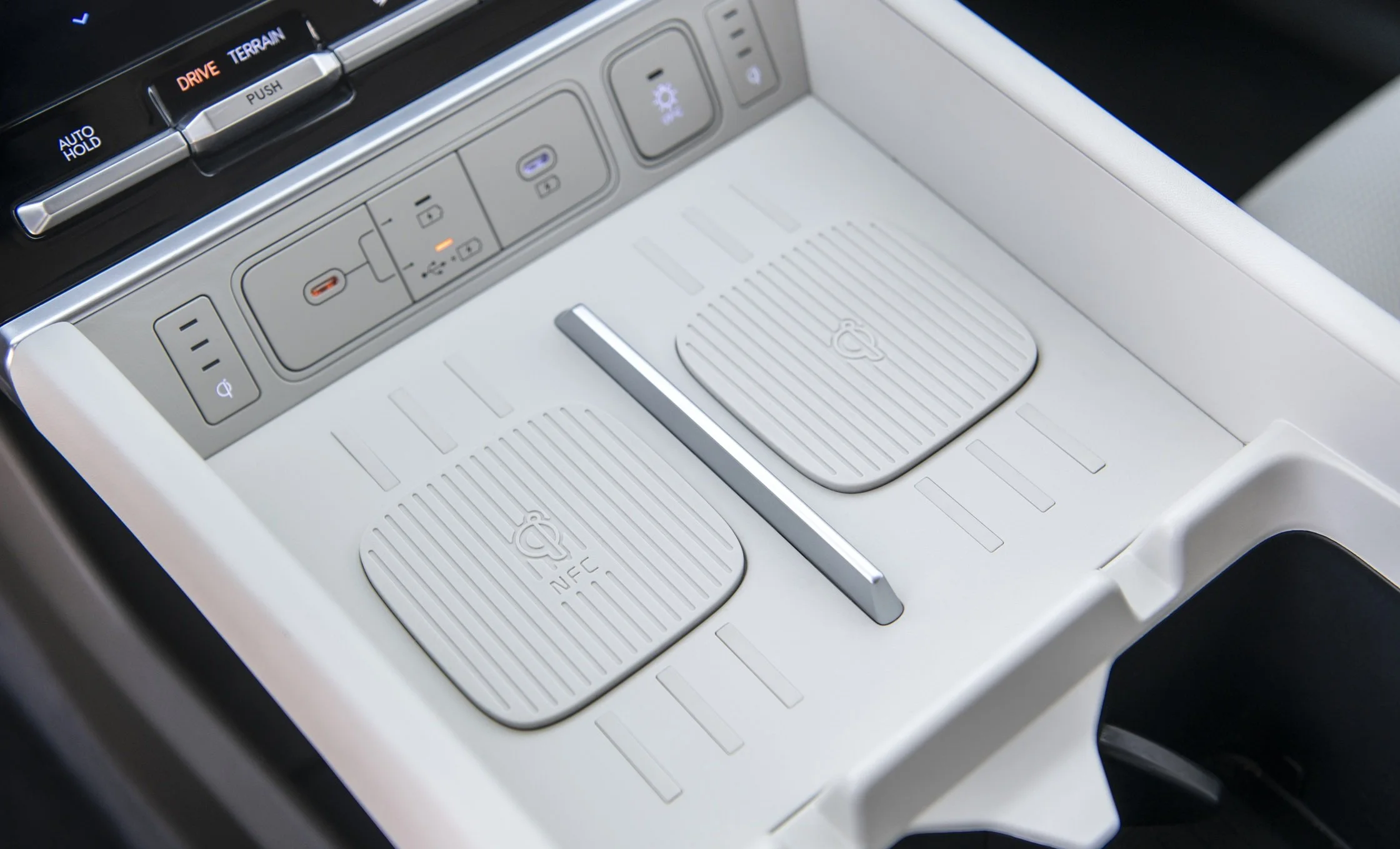
Advanced rear occupant alert, satnav, Bose premium 12-speaker sound system, dual wireless phone charging
electro-chromatic rearview mirror, 10-way electric driver’s seat adjustment, power tailgate, boot cargo net
still gets 20-inch alloys but with a different design
High beam assist
Highway Driving Assist (HDA) including:
Distance control, Lane Following Control, and Lane Change Assist Control
Navigation-based Smart Cruise Control (NSCC)
Remote smart parking assist (via smart key: forward/reverse)



*Unique design specific to Australian market
Hyundai will probably be quite okay if you spend-up to the top-spec Calligraphy in order to have the sunroof and pumping Bose sound system, but A) Australia is the melanoma capital of the world, so you don’t need ‘more sun’; and the Bose stereo is available on the Elite anyway.
Not to mention, is leaving a USB-C cord in your Santa Fe really that hard? Elite gives you the dual wireless charging pads, you get leather seats, and you already have the third-row AC ventilation from the base model. Plus, the tailgate is electric as well. Why would you actually need the top-spc?



Answer: Because your backside is cold and you want it warmed up en route to school drop-off, or your back gets sweaty on summer roadtrips and you want the cooled seats.
It would also be nice to have the retractable window shades for the little ones back there.
Calligraphy
2.5-litre turbo-petrol | $78,600 d/away approx. | 7-seater
1.6 turbo-petrol hybrid | $81,100 d/away approx. | 7-seater
2.5-litre turbo-petrol | $79,100 d/away approx. | 6-seater
1.6 turbo-petrol hybrid | $81,650 d/away approx. | 6-seater
tops it off with:
Even snazzier 20-inch wheels, premium Nappa leather, 12.3-inch digital driver’s dash cluster, dual glass sunroof, UV-C sanitising tray
Head-up display, blind-spot view camera system, remote smart parking assist, reverse parking collision-avoidance, LED projector headlights
Powered front passenger seat w/ driver’s seat memory, “Relaxation” driver and passenger seat, heated front seats and row 2 outboard seats, ventilated (cooled) front seats, heated steering wheel, LED interior lighting, fully digital camera-based rearview mirror, retractable row 2 window shades
6-seater: Powered row 2 seats, row 2 ‘relaxation’ function


Additional costs:
Premium paints: $695 (black, silver, ‘ocado green’, ‘pebble blue’ (even though it’s actually a silver) and ‘Magnetic Force’ grey); Matte paint: $1000

Specifications and price may change at any time: always check before signing any contract or paying a deposit.
ENGINES
Australian Santa Fe sales have for years been predominantly the grunty 2.2 diesel engine for its smooth, efficient low-RPM power. It was a great engine for taking a bunch of kids to school, carrying their sports gear to weekend practice, and it was ideal for light to moderate towing assignments.
You could load up for a big regional trip and it had plenty of poke for overtaking, keeping up with traffic and even towing a small camper etc. AutoExpert proved how good Hyundai’s diesel-AWD system was by torturing it >> and towing with it >>
But the diesel is dead now, replaced by two petrol engines. They are:
a turbocharged 2.5-litre 4-cylinder producing 206 kilowatts with an 8-speed dual-clutch transmission (with a wet clutch) sending drive to either the front wheels entirely (in base model Santa Fe only), or to all four wheels in either the base model, Elite or Calligraphy;

OR
the other being a 1.6-litre turbocharged petrol-hybrid making 174 kilowatts in total, storing kinetic energy from braking and coasting in a 1.49 kWh lithium-ion polymer battery which powers a 44kW AC electric motor. The combined power output of the combustion and engine and the battery-motor combination is 172kW - that’s 24 per cent more power. It’s no wonder the power-to-weight ratio has increased despite being about 150kg heavier than the diesel
A conventional 6-speed epicyclic transmission sends drive to the front wheels only in the base model, or to all four wheels in all three variants in a front-biased system that is almost always sending tractive effort to the rears to assist on aggressive overtakes, long steep hills or when heavily laden, for example.
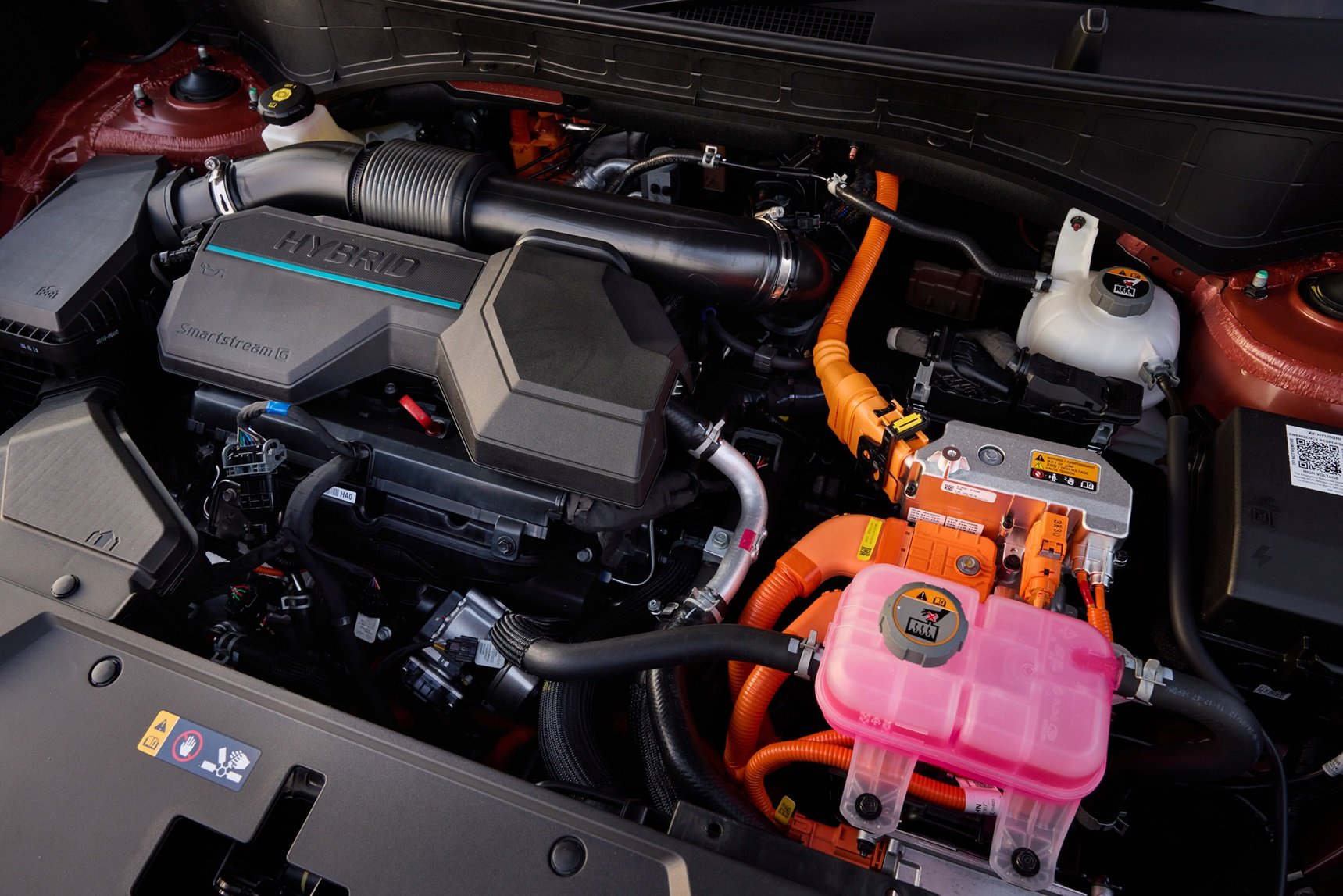
And yes, it’s the familiar turbo 1.6 we’ve seen in Kona, i30, Tucson etc. So we know it’s reliable.
In Elite or Calligraphy, you cannot have front-wheel drive, but you can choose between the ‘performance’ petrol-only 2.5 turbo powertrain, or the hybrid. Now in this generation of Santa Fe, treat the hybrid as the replacement for the diesel, and the 2.5 as the replacement for the old 3.5-litre V6.
Now, new Santa Fe at its heaviest (in hybrid AWD form) weighs 2075kg - that’s a 6 per cent increase in kerb weight over the old diesel Highlander which had a power-to-weight ratio of 78kw per tonne.
But the new hybrid Santa Fe makes 170kW of combined power, which is 17 per cent more power, so it should have better performance. Right? Well, hypothetically, it should.
See diesel fuel has about 20 per cent better energy density than gasoline, so it offers great low-rev power just above idle, making it ideal for trucks, big vehicles, utes and various applications where weight-carrying is the job description.
But Hyundai has ditched its diesel for a hybrid, claiming the battery and motor offer their famously zero-rev torque at equally low RPM in this new Santa Fe. They’re saying 44 kilowatts from the AC electric motor is available from 1600-2100 revs. For all intents and purposes, that’s pretty much the exact rev range where the 2.2 diesel offered most of its torque. (‘Torque’ is just low-RPM power, FYI.)
Hyundai also says the hybrid’s full dose of 397Nm of torque comes in from 1500 to 4500 revs, which is even lower down than the old diesel. That’s helped by the combination of turbocharging and the battery powering the AC motor.
So in practice, the new hybrid should be just as grunty as the old 2.2 diesel, but it probably won’t be because the lithium-ion battery is pretty tiny at just 1.49kWh of capacity. This means it’s going to be able to get the vehicle moving up to about 30km/h (depending on driver demand and the gradient of the road), but after that, it’s primarily going to be the turbo-petrol 1.6 doing the majority of the work.
Once you load up the kids, all your holiday luggage and stick a light trailer on the back, or some sporting equipment on the roof, that little 1.6 petrol is going to be working harder than the old 2.2 turbo-diesel would’ve had to.
Happily, the 3.5-litre petrol V6 is dead and buried from the Santa Fe in 2024 onwards. That’s a good thing.
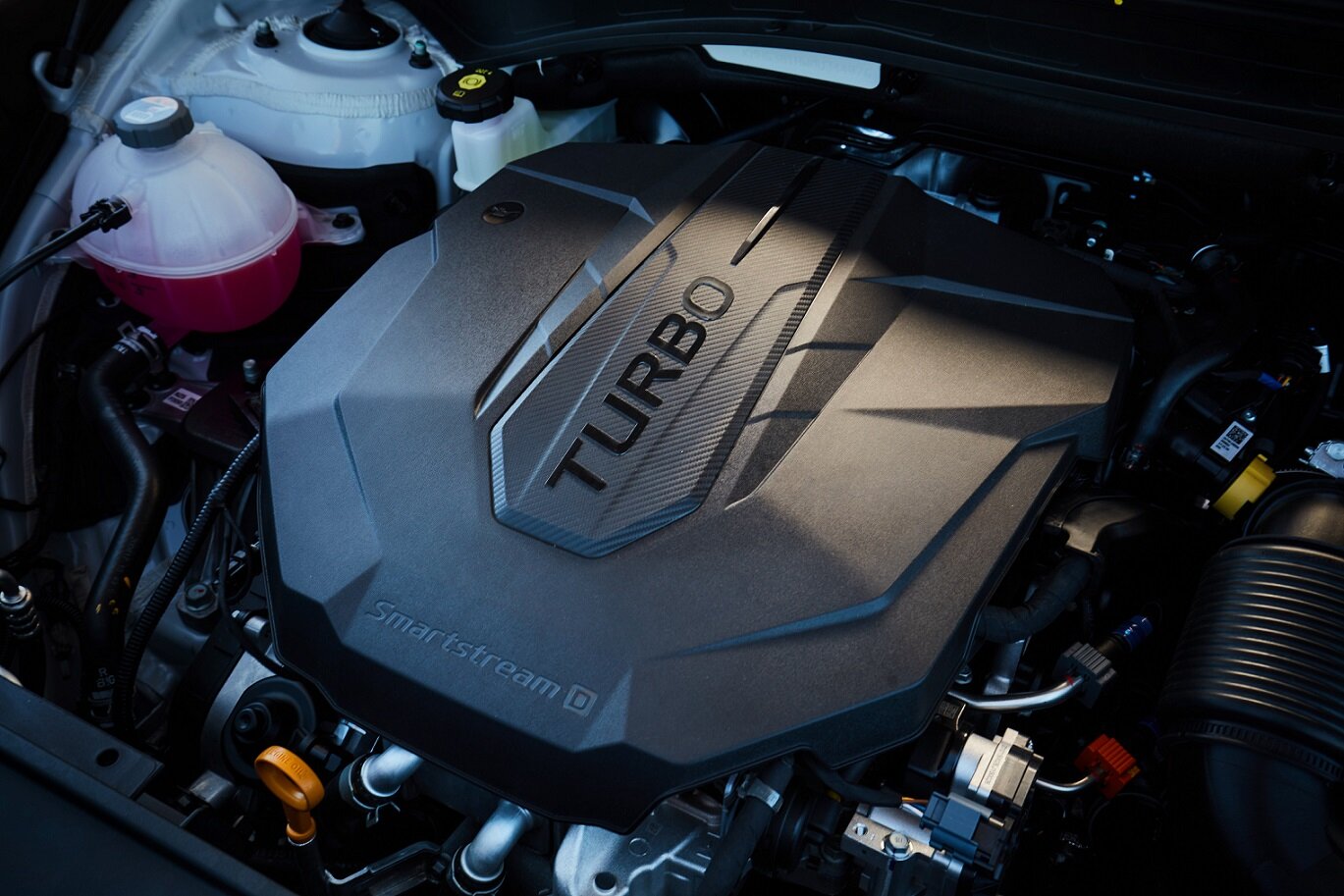

The other engine is Hyundai’s 2.5 turbo-petrol unit which is an interesting, if not weird, powertrain choice. It comes back to the energy density of diesel versus gasoline, but also in this assessment we have to factor in the North American problem, because they are they dominating market, and the Americans are obsessed with gasoline over diesel.
The 206 kilowatts of peak power of the 2.5 is arriving at 5800 RPM, which is quite high, as is the torque not arriving until 4000 revs. Given that this engine is also using multipoint injection, which is tuned for fuel economy and not performance, it’s not going to be as efficient to drive as the old 2.2 diesel.
The unique relationship between Hyundai and Kia means you do have options when it comes to how and where you can access the distinct advantages of its trusty powertrains.
Hypothetically, the hybrid should offer decent performance despite moving a heavier vehicle than its predecessor, we just need to learn how hard the electric part of the system works. Given that this is the same powertrain from the Sportage hybrid, Sorento hybrid and the previous-generation Santa Fe hybrid, it’s hard to see how
But if you still want that outgoing diesel engine, you can still get it, but likely not for very long.
The 2.2-litre turbo-diesel engine, which gets the eight-speed DCT, is still available with all-wheel drive in the Hyundai Palisade if you still want that grunty powertrain with hefty payload potential to rival a LandCruiser. But you can get the benefits of the diesel without the need for AWD by also considering a Kia Carnival, depending on the size and demands of your fridge-emptying teenagers.
There is a new Carnival in 2024 as well, so that’s worth looking into as well.

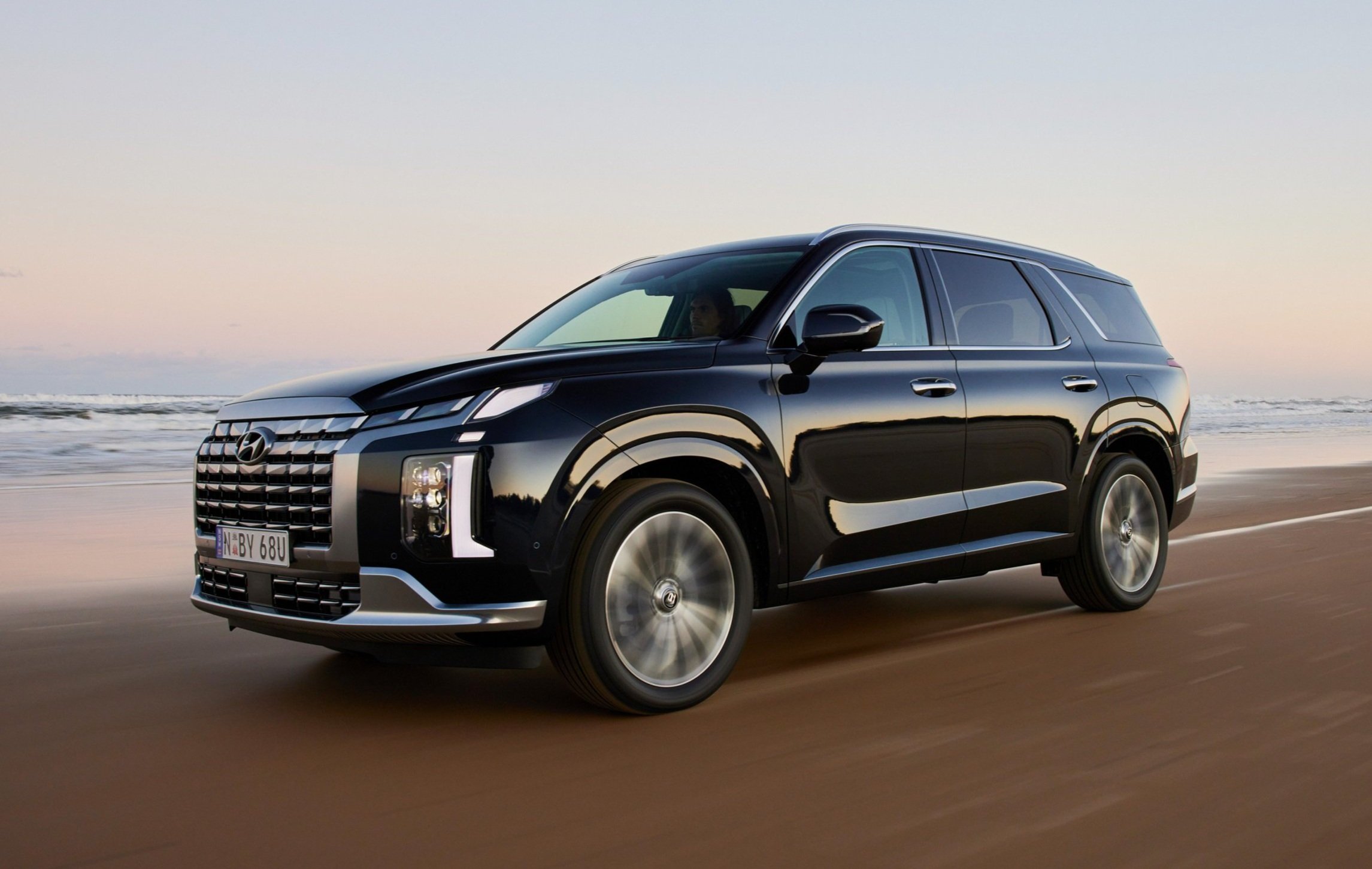
On the other hand, if you want that same 2.2-diesel powertrain but need it in a strong towing platform, again with the big family practicality element taken care of, there’s also the Kia Carnival. Having said that, Carnival is front-wheel drive only, in which case you could also consider the big less aesthetically pleasing by still remarkably practical Hyundai Staria, which gets all-wheel drive.
It’s certainly a game of powertrain tennis, but this does at least mean you still have options when it comes to long-distance cruising, holiday trailer towing of light to medium loads.
The Carnival is good for towing 2000kg (braked) with 200kg of towball download, with seven seats including four ISOFix points and full-length side curtain airbags.
Read my full Carnival Love/Hate Guide here >> or my Hyundai Palisade practicality analysis here >>
HYBRID
How the hybrid works is relatively straightforward. Instead of braking like a convention combustion-only vehicle where the kinetic energy (call it the ‘momentum’) is wiped off by the brakes, the hybrid captures that energy via the wheels. It does this by spinning the electric motor in reverse, which turns it into a generator which recharges the battery.
Don’t think of it as ‘free’ energy, but more like hoarding energy that would’ve been wasted in the form of heat when the brake pad clamp down on the brake discs. This process is called ‘regenerative braking’ and it is at its most effective being driven in suburban areas, in commuter traffic and stop-start city driving where the battery can be used often to get going (the most energy-intensive part of driving) and then get frequently recharged when the vehicle inevitably slows down again.
By the same token, conventional regenerative braking hybrids, for this reason, are less ideal for long-distance open-road driving where they don’t always get to capture that kinetic energy from braking and the batteries are quickly depleted when used to assist the petrol motor in high acceleration demands, such as overtaking.
The 1.5 kilowatt-hour battery capacity is about the same size as the one used in the current Sorento and Sportage, and Tucson. In the context of Santa Fe being a heavier vehicle and therefore requiring more energy to get it moving from stationary, either of two things are going to happen.
First, the battery won’t be able to provide as much tractive effort to get the vehicle up to speed compared with, for example, the much lighter Sportage hybrid. Meaning, Santa Fe hybrid will get going using the battery+motor up to about 20km/h before the petrol engine kicks in to get up to the ideal cruising speed.
Second, the battery will use as much tractive effort as the lighter vehicles it powers, like Sportage, or if it uses more, it means the battery will be depleted sooner. As a result of using more juice to get it up to speed from stationary, it will need to recharge sooner, drawing off the petrol engine more often.
The regenerative braking can be adjusted to three different states of aggression. The lighter setting will capture a small amount of energy but the benefit is that this provides less resistance, which slows the vehicle down less, and will therefore allow the vehicle to coast for longer.
The middle regen-braking setting will offer slightly more aggressive charging, but in the same driving scenario, will slow it down a bit quicker as a result of creating greater resistance (a bit like engine braking in a manual). And of course the most aggressive regen-braking will offer a greater recharge to the battery, but will also slow the vehicle up much quicker as a result of the greater resistance.
Unlike in a plug-in hybrid such as the Mitsubishi Outlander PHEV, you won’t be able to run the Santa Fe in pure battery-only mode. It simply doesn’t have the (literal) capacity to power the vehicle in that way.
TRANSMISSION
Hyundai’s robust and fairly sporty eight-speed dual-clutch transmission is paired up to the 2.5 turbo-petrol engine in a Palisade, providing the smooth (often uncanny) gear changes former Santa Fe owners might know from the previous generation.
Hyundai/Kia DCTs are especially good, considering what an engaging and efficient driving experience it provides for such a big vehicle. It does all the right things when you expect it to, such as changing up as you enter the freeway or changing back as you go downhill. (Sometimes before you’re even expecting it to.)
This transmission is also used because it plays the fuel economy game like an extreme sport. When their DCT was introduced it wasn’t a tiny, single-digit fuel economy improvement, it was a 19 per cent gain, which was substantial.
Simply by having two clutches, each with a hair trigger on constant duty, ready to change gear in an instant, fuel consumption has been a tangible engineering victory for Santa Fe over the years.
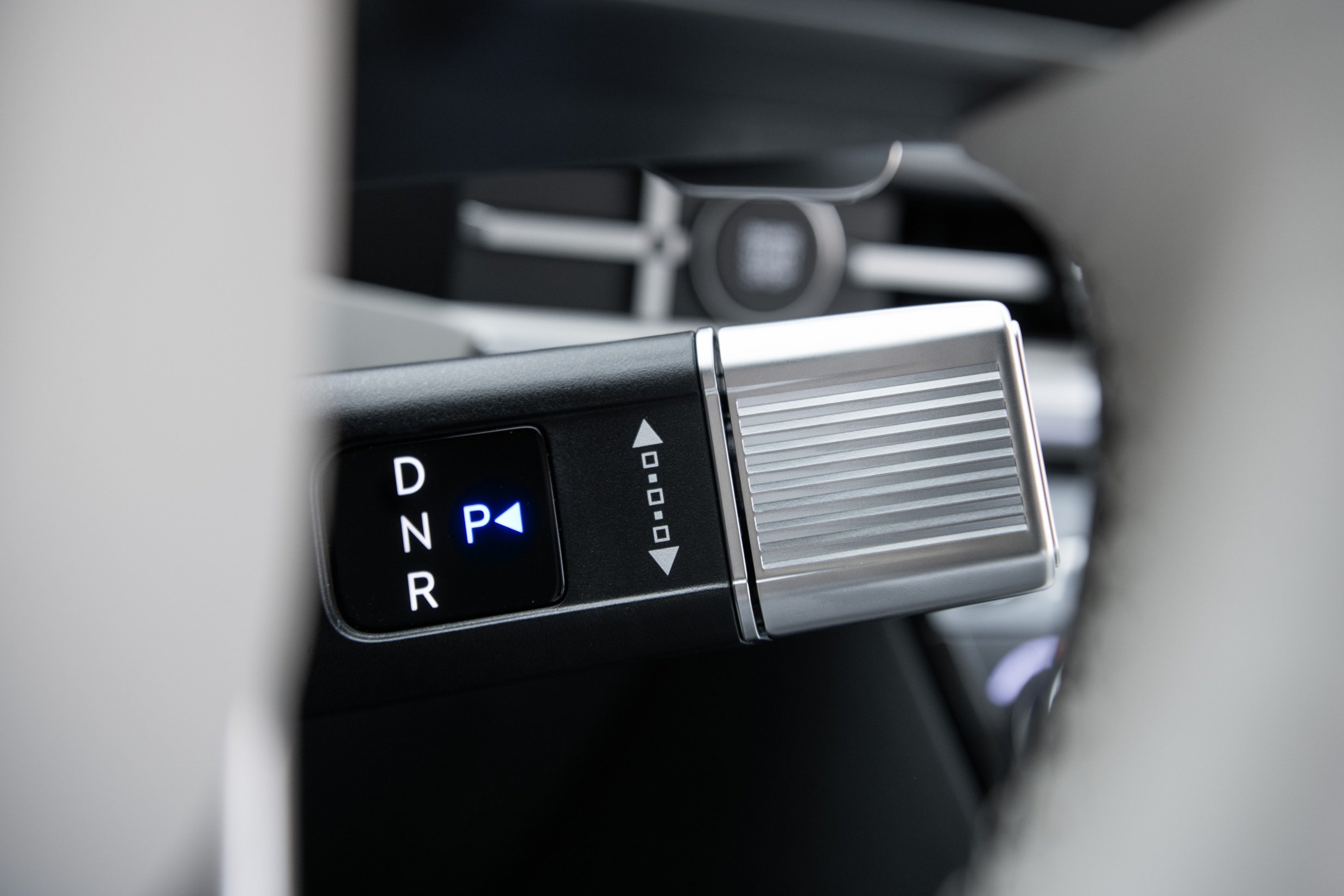
The push-button selector (previously found on the centre console structure to the left of the driver) has been replaced with the steering wheel located stalk with a rotating action to engage ‘drive’, ‘neutral’ or ‘reverse - and pushing the ‘P’ button on the end for ‘park’. The question here is whether this is a step forward or back.
The transmission stalk is a winner from a cabin layout and clutter perspective. It opens up acres of space for buttons and storage areas and just more bits and bobs to tinker with.
But from an ergonomics point of view, it needs to be said that this transmissions talk makes what is already a busy steering wheel and user interface, a bit overwhelming.
Any modern car already has a plethora of buttons and toggles and stalks to deal with, thanks to things like adaptive cruise control, voice commands, phone calls, volume and trip computer scrolling - and of course the indicator/headlights and wiper stalks we know and use every day.
Do we really need another stalk with four individual modes to sift through? The answer depends on you and how much you can deal with. There’s a good argument to suggest that we’ve all become much better adapted to cognitively demanding technologically and this will be yet another change to the convention we will incorporate.
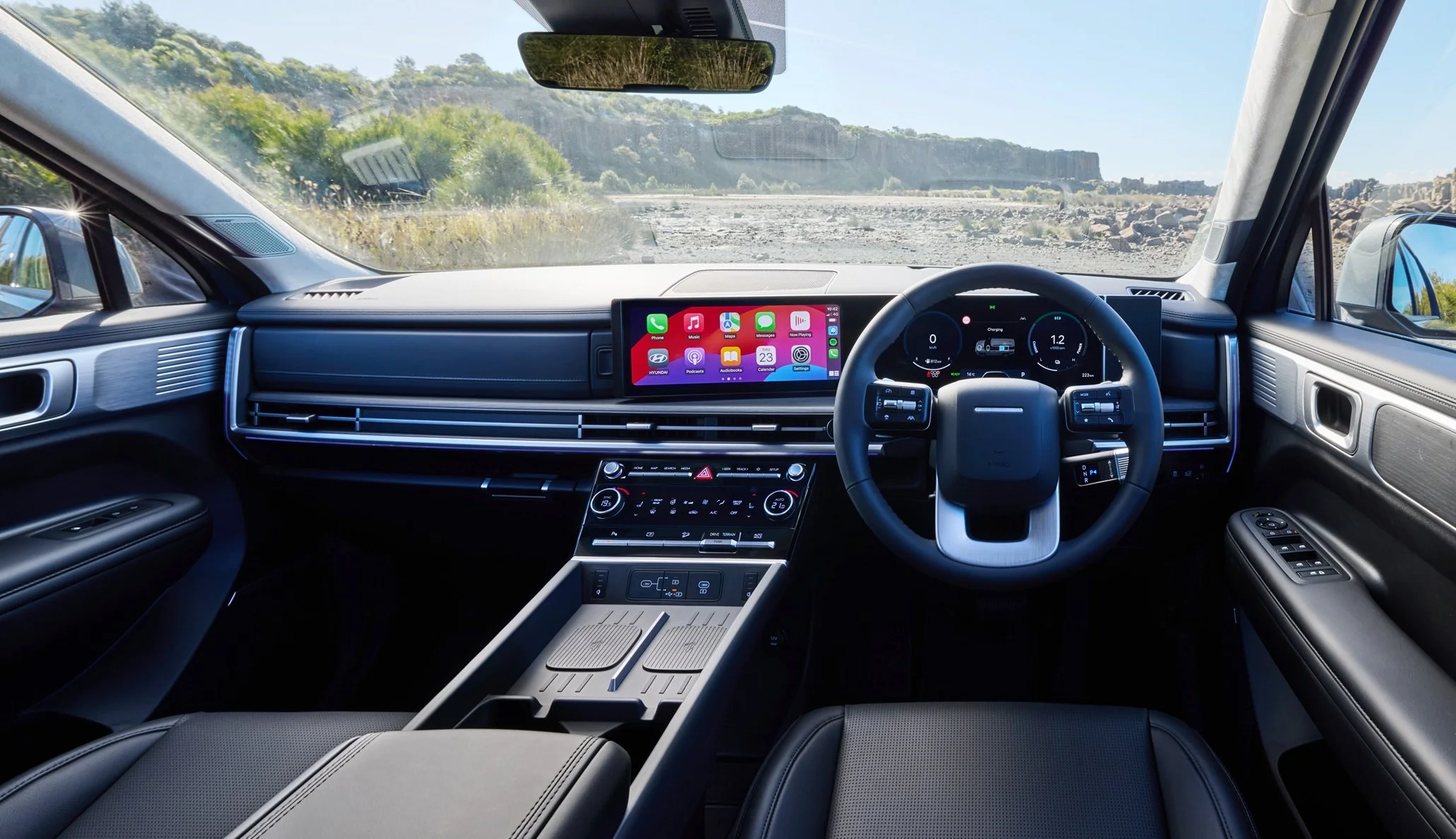
So every time you’re going to be operating the vehicle, you’re going to have to engage with 2 primary start-up procedures (A: the start button + B: park brake release in dark yellow below) and then operate the 4 control hubs on the steering wheel itself:
Transmission drive-mode selection: P, R, N, D
audio/comms
cruise control operation + speed adjustment
indicators + headlights
wipers front/rear

And to think Subaru copped it for many years having a ‘busy’ steering wheel…
At this point let’s be clear, this isn’t explicitly a criticism, more of an observation. Again, there’s a high likelihood you will be able to adapt and clearly there will be a period of familiarisation for yourself and your other half - it will be different too from your current daily driver.
Some credit is probably due to Hyundai for having the foresight to make the directional changes for the vehicle correlate to the twisting motion of the stalk. So to go into ‘drive’ you twist it forward, and to find ‘reverse’ you twist it backwards (or towards you), which is pretty intuitive. Then simply push the end-button for ‘park’. How hard can it be?
The twisting section of the transmission stalk is self-centring
So how good is the transmission on the Santa Fe going to be? Well, fortunately for you, Hyundai has runs on the board here.
The eight-speed dual-clutch transmission was launched with the 2020 Kia Sorento where the ultimate test for this gearbox was slowly creeping off the line on a slope. It passed with flying colours: Kia Sorento review and buyer's guide >>
Having also pitted the 8-speed DCT against the AutoExpert driveway from hell, you too might live on a replica of the North Face of the Eiger. If so, you have a steep driveway or perhaps live in hilly suburbs, meaning you’ll appreciate the fact Santa Fe’s transmission can handle a daily dose of mechanical hard work.
Check out: Hyundai Santa Fe dual clutch transmission extreme endurance test >> for more on that.
But what’s great about this Hyundai’s HTRAC AWD system historically and in this new Santa Fe is that with the smooth application of its the hybrid battery and motor combination, in heavy rain, dewy campsites and soggy winter footy grounds are not going to result in having to be towed out.
‘ACTIVE’ AWD & TERRAIN MODES
Arguably the biggest highlight of the Santa Fe platform is the fact you get to marry the plush comfort of a large SUV (and its subsequent seven seat capacity) with the adaptability of a driveline able to get you through tricky conditions - without resorting to the comfort-compromise of a full off-road 4X4 wagon or ute.
Santa Fe is not a proper 4X4 with a low-range transfer case: it cannot do the same extreme driving as a LandCruiser, Everest, Pajero Sport or Patrol - but it can handle a surprising array of soft-roading conditions where a front-wheel drive or on-demand AWD would certainly be needing help.
Do not conflate these two very different types of drivetrain: Santa Fe and Sorento will happily venture down loose gravel tracks and slippery-when-wet tarmac or lightly rutted terrain, but they are not hardcore 4-wheel drives. But they do offer more than the typical front-drive SUV.


Hyundai’s HTRAC AWD system is ‘active’, which means it is constantly calculating and sending some percentage of the drive/torque to the rear wheels. This is to maintain optimum grip and almost eliminate the likelihood of generating wheelspin. It is different from the ‘on-demand’ AWD system you’ll find in a Mazda CX-9 or Toyota Kluger, which waits until the computer detects wheelspin before splitting the torque to send some to the rear. CX-9 and Kluger default to front-wheel drive.
Both of these systems are different again to a Subaru Outback which is always dividing its drive/torque between the four wheels, at all times - it never adjusts or waits or limits the drive - which is why you’ll rarely ever get wheelspin in a Subaru, save for the slipperiest of situations.
If you like to take the kids camping, one light shower overnight can render the grassy campgrounds impassable in anything front-wheel drive, or on-demand AWD.


Santa Fe has a multi-mode system, which provides an electronic, variable torque-split between the front and rear axles, and has three selectable drive modes, ‘Normal’, ‘Sport’ and ‘Smart’. Smart mode acts as an on-demand system, but kicks into AWD virtually instantly.
‘Snow, ‘Mud’ and ‘Sand’ are varying calibrations of the traction control system and have respective settings for distributing drive for those driving conditions. In combination with the hybrid system in particular, the sensitivity of the throttle to deliver drive will be the primary method of avoiding wheelspin.
Hyundai’s system is as close as you could possibly get before the symmetrical all-wheel drive system on a Subaru Outback or Forester. But those vehicles don’t offer the seven-seat versatility of the Santa Fe. Hyundai is also confident it’ll do sand, snow and mud - but don’t get in over your head, obviously.
Similar electronic torque-splitting systems, which are able to be locked-on, are also currently in use on diesel-variants of Kia Sportage and Kia Sorento. So if you can’t get hold of the Santa Fe you want, you might find the equivalent Sorento an option - it should be on your shortlist, for this reason alone.
All this doesn’t endow Santa Fe with the hardcore off-road capability of low-range transmission and mechanically lockable centre and rear differentials, such as the Mitsubishi Pajero Sport or Nissan Patrol, or even a dual-cab ute like the Triton or Mazda BT-50.
But it will get you through light mud, moderate dirt roads and slippery sealed roads with inclines or declines that might otherwise make you require new underwear.
I'll help you save thousands on a new Hyundai Santa Fe here
Just fill in this form.
No more car dealership rip-offs.
Greater transparency.
Less stress.
DRIVING
This fifth-generation Santa Fe offers one of the best chassis dynamics and comfort tuning on a modern large SUV. A vehicle this big, this heavy and so capable, shouldn’t handle this well, convention tells us, especially when it’s so heavily derived for the American market. (Local Aussie tuning usually makes soft, floppy, jiggly American tuning handle properly on Australian roads.)
Hyundai Australia conducted some local testing with early prototypes, but did not apply a specific tune for the local model. However, the local team was able to select from a small variety of setups that best-suited Aussie conditions. The local engineers found the original setup to be quite effective for local roads.
It feels good around corners, resisting body roll quite well despite the perception of its tall and narrow stance. Around tighter bends it doesn’t feel heavy or cumbersome, either. The weakest environment seems to be long sweeping bends. The steering weight becomes heavy and doesn’t provide much feedback. Although the platform remains committed and competent.


In terms of ride quality, it seems Hyundai has gone for a slightly firmer setup this time. This is great news for those who regularly drive on bendy roads or out in the country, because the body management is improved so it doesn’t wobble around. But, in the city, on our very average roads, comfort is sacrificed just a pinch.
What about this hybrid powertrain? It replaces the diesel which will no doubt upset a lot of buyers. But let’s take a closer look at how it drives before making snap judgements. Firstly, this offers more power, at 172kW. Torque is down considerably though, to 367Nm from 440Nm in the diesel. That means this isn’t as suitable for towing.
The 1.6-litre turbo is supported by a 44.2kW electric motor which is mounted with the six-speed automatic transmission. This allows for both front- and all-wheel drive configurations, unlike some hybrid systems out there that place the electric motor at the rear axle, for example.
Power comes from a 1.49kWh battery which can provide fully electric driving for very short periods. On the highway it often drops the petrol motor and coasts along under electric propulsion only, in small bursts, to conserve fuel.
The great thing about this package is the transition between petrol and electric is hardly noticeable when on the go. It takes off with a very linear feel, smoothly receiving a boost from the e-motor, and then the 132kW/265Nm turbo engine provides support for the top-end.
The system does randomly switch the petrol on to charge the battery at times, which isn’t so seamless, often when you’re stopped at the lights. But you don’t have to do anything or compensate for it. Simply drive as you normally would.
There are three main driving modes as well, including an eco mode that reduces the throttle response sensitivity, as well as a sport mode to sharpen things up. Leaving it in the normal mode is fine, as it provides a good mixture of response, comfort and economy.
With an official average fuel consumption rating of just 5.6L/100km, this is more economical than the old diesel, rated at 6.1L/100km. In the real world it is easier to reach the official rating in the hybrid in mixed conditions. But, the diesel is/was great during highway driving. As usual with hybrids, the new model performs best with some stop-start scenarios thrown in there, and not just constant cruising at highway speeds.


Given Hyundai and Kia’s track record for actually tipping money into the R&D of their major powertrain components (DPFs, petrol/diesel engines, AWD), the DCT will be quite capable of stop-start traffic conditions, although it is not as well suited as a conventional epicyclic auto in those short sub-60km/h bursts between sets of traffic lights.
Thanks to ample legroom provided by the 2.8 metres of wheelbase (which translates into cabin space for the first two rows of people) the Santa Fe is such a no-brainer for long-distance touring. Long weekends, school holidays, trips afar or even interstate - perhaps multi-hour drives for work or to meet with clients. These are all absolutely within Santa Fe’s remit.
The standardisation of tyre pressure monitoring means you’ll always know if you’re running on low pressures and fuel consumption is increased as a direct result. This is on the base model, so it’s not like Hyundai is milking you here.
Even if you live rurally or regionally, where a 40-minute trip into the nearest provincial city like Ballarat, Bendigo, Bathurst, Cairns, Port Augusta, Kalgoorlie, or Catherine is necessary several times per week, you’re not only going to get good fuel economy and everybody where they need to go, you’ll be very comfy indeed and always driving on correct rubber thanks to the full-size spare.
Having that AWD system beneath you at all times is going to be useful in times of heavy downpours, but also in the case of steep driveways, hilly suburbs and general terrain where, perhaps on a regional sideroad or some soggy campsite, getting out in less-than-perfect conditions would prove difficult in something front-wheel drive.
That’s the thing with AWD, you don’t actually often need it specifically, but it is an advantage in certain situations, many of which are unpredictable or would simply be better with splitting the drive front-to-rear.
Smooth but sealed roads can be just as slippery and hazardous as any low-speed gravel roads. In fact the former conditions are often the ones where you’ll think you can simply swerve to avoid something, in which case you definitely want the all-wheel drive.
Happily on that similar note, the rear brakes on Santa Fe have been beefed up from 305mm in diameter x 11mm thick to 325mm in diameter and 20mm thick, so it’s obviously going to stop as good, if not better than the previous one because they’re also ventilated now, not solid. We’re saying “as good” here because the front discs, which do the majority of the forward braking, are still the same size and thickness.
TOWING
You might be wondering at this point whether this Santa Fe will be up to the task of towing a small boat or perhaps a medium-sized camper.

Times change: New SF can't haul this kind of load anymore
The disappointing news is that the old Santa Fe’s maximum braked capacity which was up to 2500kg, with 200kg of towball download (which is deducted form remaining available payload), courtesy of the optional Hyundai Load Assist towing kit.
But this version is less about outright towing capacity and more about suburban mass family transit with occasional soft-roading thrown in - so it’s inevitable that the numbers have come down in order to make it better on fuel for that task.
Hyundai’s specifications for the Australian models cite a braked towing capacity of 1650kg with the 1.6 hybrid, and only 1650kg with the 2.5 petrol-only version - meaning there’s no distinct towing advantage to getting the bigger engine for this purpose.
The towball download limit is only 100kg, which is further evidence that the rear end of Santa Fe is tailored to soft family touring and not even moderate towing. For context here, the Subaru Outback is capable of towing more weight (although doesn’t have the kerb weight to support safe, stable towing over 2000kg).
Although, according to the US-market spec sheet, the ‘XRT’ variant over there suggests 4500 pounds (exactly 2040kg) should be possible on the 2.5 powertrain. But ultimately it’s the rear axle load that has remained the same 1450kg that indicates Santa Fe just has not been designed this time around for towing.
The Load Assist kit was a set of different springs and dampers designed to better resolve the load placed on the rear axle. For a small $500 sum on the previous Santa Fe, you could significantly improve the vehicle’s overall stability and safety when towing more than about 2000kg.
Perhaps this will be the case with this new version, but it’s unknown and purely speculative at this stage.


It’s important to note that a hybrid Santa Fe Calligraphy, with a full 67-litre tank of petrol, weighs a maximum of 2105kg. So towing anything over about two tonnes would have been quite dynamically stable with regards to the trailer’s ability to overwhelm the tow vehicle. (That’s the nature of towing generally, not a deficiency on the vehicle’s part.) If only they’d stuck with a diesel, how capable Santa Fe could have been.
Perhaps they will bring back the Terracan 4X4 wagon as part of the platform R&D going into the Kia Tasman - which will get the 2.2-litre turbo-diesel.
It’s fair to say this Santa Fe is inherently deficient in towing over its predecessor, and we can tell this not just from the outright towing capacity, but also in the vehicle’s gross vehicle mass GVM. In Santa Fe’s case this time around, it’s 2629kg - which is 19kg higher than in the old diesel version - but it’s unknown how well suited either powertrain will be for such a task as towing.
Given that the maximum braked towing capacity is down 25 per cent, it’s fair to say this new Santa Fe can’t do what the old diesel could. Payload is maxxed out at about 554kg in the Calligraphy, which is 20 per cent than the diesel Highlander could manage previously.
However - this isn’t the end of the story.
Taking the Santa Fe hybrid does have inherent benefits for you if towing a light trailer or camper is a realistic but occasional proposition. You might not be a hardcore Taj Mahal towing champion, but it’s quite reasonable that a pop-top camper and some weekend camping gear is the kind of tame mission you might like a Santa Fe for.
Being hybrid, and the way Hyundai has designed it to rely significantly on the battery for stationary to low-speed taking off means that low-down torque provided by the battery and motor are not just available and ideal for getting the combination going, but also for reversing.
The trick with reversing any trailer, but particularly campers with a relatively short drawbar but a large overall frame and chassis, is they can pivot quite rapidly in the snail’s paced arena of reversing a trailer - particularly in a confined space or when trying to wriggle it into the perfect spot.
Having the electric side of the powertrain in operation for4 these manoeuvres means you can be smooth and gentle on the throttle without any big jerks and surges from the combustion engine. Even up slopes it will utilise that low-down electric push. And when the 1.6 turbo-petrol does kick in, it doesn’t go crazy, revving itself stupid. It just fires up and offers assistance without jerking the vehicle or being unrefined in a way that might distract as you inch back.
If there’s an underlying positive consequence of this reduced towing and payload capacity, it’s that what you lose in brawn here, you gain in refinement.
INTERIOR
The Santa Fe has a bunch of features to push the envelope of ‘family-friendly seven-seater’, and certainly it continues to be a rational case for ignoring the allegedly premium German SUV, despite Hyundai trying desperately to make it look like one.

The interior of a Santa Fe is not only a wonderful place to sit, but it’s quite a functional space, with plenty of door bins, charging ports and a central transmission console not endowed with the presence of a vertical transmission selector.
Everything that should be on the steering wheel is, and Hyundai has resisted the temptation to over burden you with unimportant functions that have no place at your fingertips while driving. Cruise control and various vehicle-related functions are on the right, audio/entertainment and phone call functions are on the left, as is the discreetly-integrated touchscreen.
There’s a scroll wheel to select various soft-roading terrain management modes, and once you get practice using the push-button transmission selector system, you’ll be getting the timing just right to make smooth, slick direction changes to reverse up the driveway.
What’s doubly nice about the Santa Fe is that everything is clearly labelled, there are buttons for all the necessary features, and you’re not always forced into delving through sub-menus on the touchscreen to do things - which is a concerning trend in the modern car industry design departments.
ENTERTAINMENT
Here’s everything included in a mid-spec Santa Fe Elite:
12.5-inch infotainment screen, includes wireless Android Auto and Apple CarPlay - finally. Hyundai has never been a tight arse on providing basic smartphone software connectivity for many years now, so that’s nice
Haptic touch infotainment screen: Essentially, it’s a software-based touchscreen which measures the duration of a finger touching an icon and responds, building on the previous tech which registers finger pressure. So it’s much more like a mobile phone, in that regard
The dual wireless phone charging pad was something of a luxury in old Highlander, but is now standard on the base model, just to make it that much harder to justify that allegedly premium German SUV which charges extra for that stuff.
A premium 10-speaker Harmon Kardon branded stereo - including a fully sick separate amplifier which offers surround sound to drown out all five kids
Hyundai’s so-called ‘Blue Link’, despite not actually linking anything in that hue, offers safety, diagnostic, remote and voice activation
You also get a remote-start feature which includes climate control activation, remote door locking/unlocking, a car locator for all those times you forget whether you parked in the Itchy or Scratchy Lot.

Calligraphy simply adds:
Panoramic sunroof
Heated & ventilated front & rear seats
Steering wheel heating
Driver intercom - to deal swift audible law & order to rear occupants
Heads-up display
LED: projector headlights & combination taillights
Nappa leather
Remote parking
20-inch alloy wheels (incl. full-size spare)
Driver’s electric seat position memory
FUNCTIONALITY
Let’s first acknowledge appreciate that Hyundai designed a tailgate that just opens when you walk up to it. There’s no fumbling around trying to reach your right hand into your left pocket. It just opens.
Better still, Santa Fe now has one of the widest tailgates you’ll find on any large 7-seat SUV, because the aperture is over 1.2 metres wide and it’s 81cm high.


This auto-open function would cost extra as part of some luxury pack on an Audi or Merc.
With the Santa Fe’s key in your pocket, the ‘smart power tailgate’ simply opens when you approach it. Nobody wants to set down the rapidly defrosting shopping onto the hot, hard, black, dirty carpark bitumen.
I digress. The boot. It’s pretty big, especially in five-seat mode, which, let’s be honest, is going to be the primary configuration you’re going to use. With rows 2 and 3 collapsed, Hyundai reckons you’ve got shy of 2000 litres of load space back there: 1949 litres is not to be sneezed at.
What’s even better is the whole rear half of the internal geometry is quite squared compared with a lot of rounded interiors. This means where you need to pack, say, on top of the rear wheelarches, their being flat means items sit on top of the cupholders, rather than rolling inwards.
Child restraints can be fitted to all three row-2 seating positions thanks to 3 x top tether anchor points, with corresponding ISOFix anchor points on the outboard seats. There are now anchor points on the row 3 seats, making them suitable for teenage kids who’ve grown out of booster seats - where the seatbelt sits correctly across their shoulders and torso - as well as kids still rocking their full harness restraints.

Row 3 seats now get ISOFix anchor points in both positions
At least they’ll also be comfortable back there thanks to third-row air conditioning vents, cupholders and USB device charging ports on both sides of their very comfortable leather pews.
Speaking of, leather is usually a point of extorsion on a Merc SUV. Not here.
If you have long-distance touring in mind with your 2.8 children and your other half aboard, you’re not going to start struggling for room once you start deploying either seat six or seven (or both). That’s thanks to the long wheelbase which allows row 2 seats to come far forward enough that teenagers with their long legs and limitless energy reserves can hike themselves in and out with relative ease.
Speaking of, row three does not get full-length curtain airbags - which Hyundai and Kia have received minimal criticism for over the years. The row 2 curtains do reach into the row three compartment, covering the windows, but they don’t extend all the way back to the ‘D’ pillar, which is probably right where you’re going to cop a head injury in a major crash.
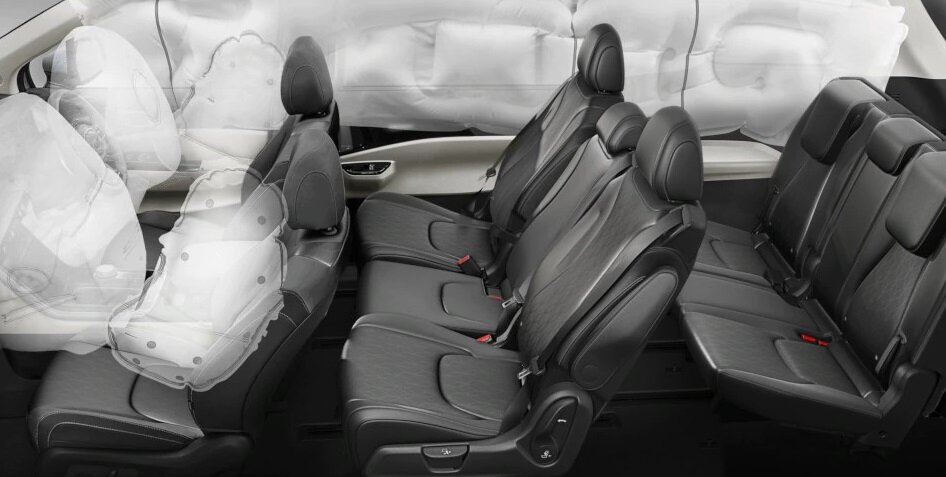

Some concessions on this: Row three in Santa Fe and Sorento is deemed an ‘occasional use only’ function - like dropping the neighbour’s kids off at school or taking Nanna and Grandpa along for the ride to beach day, yet another wedding or funeral - whatever.
Look, if you’re going to use row three full-time because you’re expecting twins on top of the two you already have (or some variation on this theme), then stop kidding around… and get a Kia Carnival. (Pun intended.)
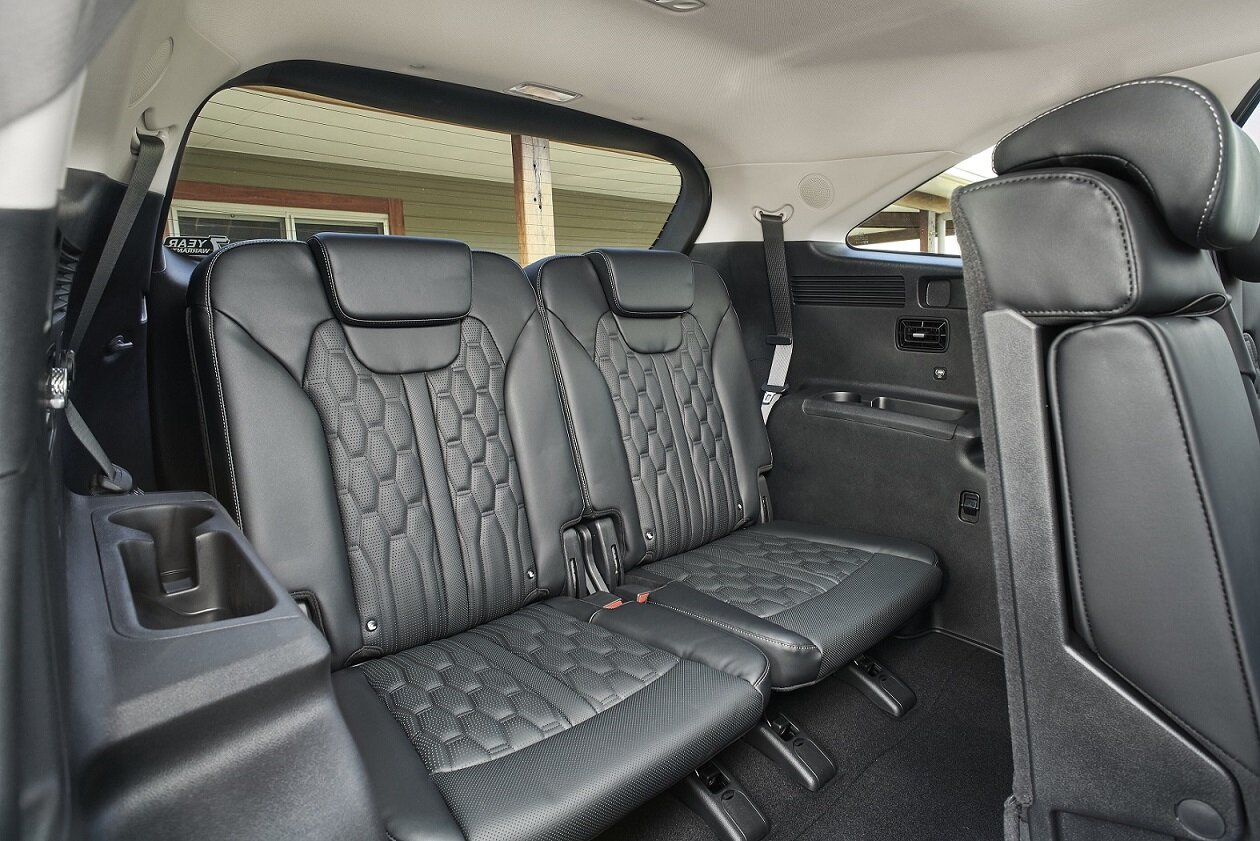
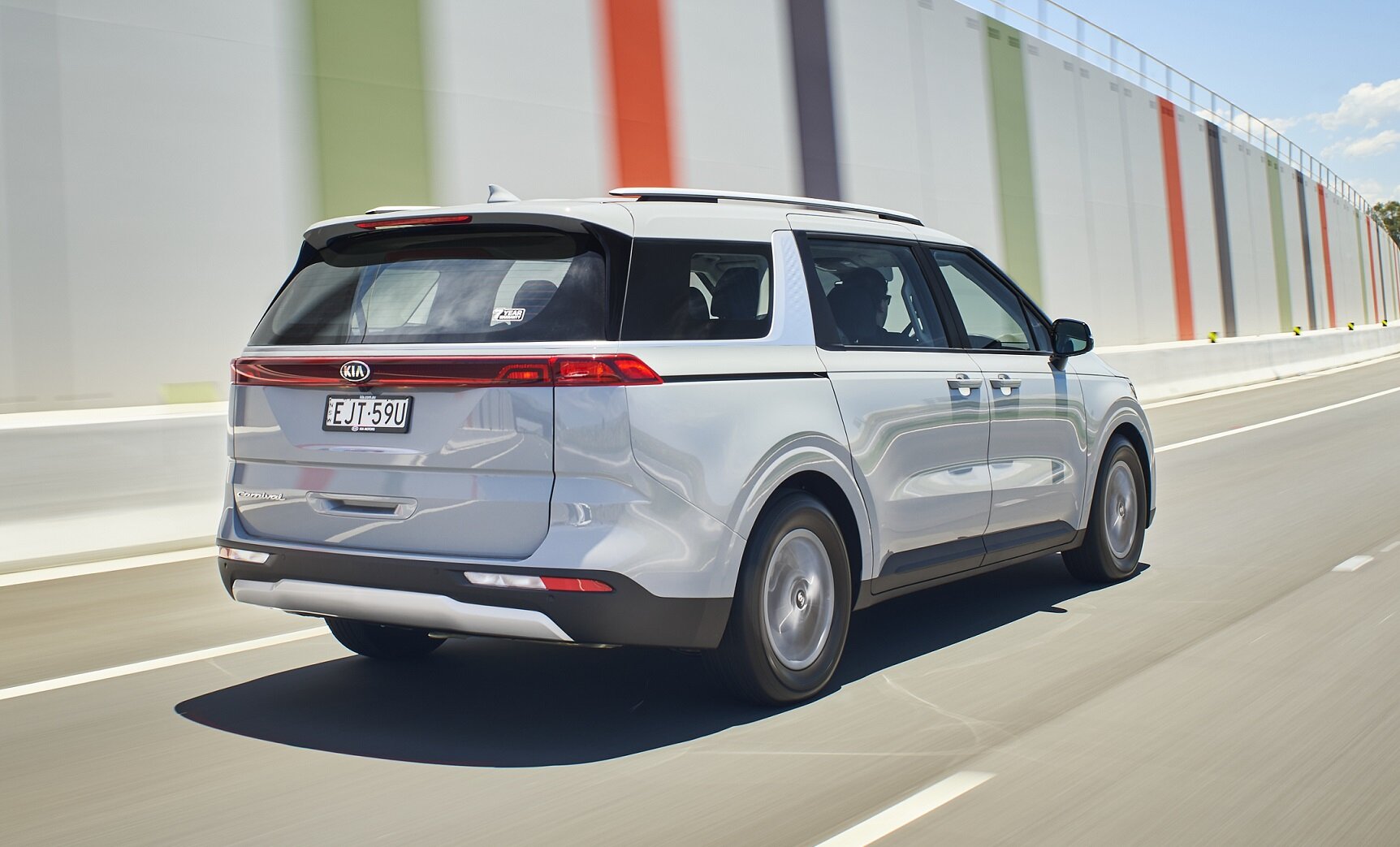
Row three gets air vents and air-con, USB charging ports for ‘shut-up factor’, and 746mm of legroom. But there are no ISOFIX or top tether anchorage points in row three, meaning only children who’ve left booster seats behind can use seats 6 and 7.
There are two ISOFIX points in the outboard row 2 seats, and three top-tethers. And you get two top-tethers and ISOFIX points in row 3, like with the Kia Carnival, albeit where you get five top tethers and five ISOFIX points in the Kia.
One last touch of added practicality on new Santa Fe is the roof rack load limit which is now 100kg where most in this segment are limits to around 70-80kg.
SAFETY
Santa Fe gets the latest safety features that are of actual benefit to you, such as adaptive cruise control, front-centre and driver’s knee airbags, and reverse emergency braking. It’s also made with all the necessary crumple zones, airbags and emergency braking equipment needed to minimise or avoid a crash, which are present on every new car by law.
This is offset by the annoying ANCAP-appeasing speed warnings, driver stalking (or “monitoring” as they say) and lane-keeping systems that are poorly implemented and have the opposite affect on drivers. These are present on pretty much all new cars these days and can’t be avoided, but they can be deactivated thanks to a 3-second button press on the steering wheel.
If you don’t know what some of the safety jargon means, here’s a basic explainer.
‘Blind-view monitor’ and ‘Blind-spot collision avoidance’: Side cameras project traffic behind the B-pillar, although not entirely necessary if people learned to adjust their door mirrors correctly. Still good to have, especially for towing, where you might actually readjust your mirrors to accommodate a large caravan or trailer and recreate that blind-spot.
Blind-spot collision avoidance will simply apply the brakes if the driver inadvertently changes lanes into said blind spots, say, with an indicator on (thereby cancelling out lane-departure & lane-keeping) and into the path of a neighbouring vehicle. Not that anybody should be firing into another lane without checking if the space is already occupied, but, there’s a reason warning labels are put on clothes not to be ironed while being worn.
Rear occupant alert: detects a door opening and closing sequence to alert the driver if a person or animal is present in the rear seat when the driver leaves the vehicle
Heads-up display: Projects critical driving information such as speed, radar cruise control, satnav, blind-spot monitoring and collision-avoidance warnings into the windscreen, at what appears to be about seven metres ahead of where you sit, for optimum clarity. Anybody with compromised eyesight may need to adjust that setting.
Rear Cross-Traffic Collision-Avoidance Assist: If you start barrelling down a driveway - which you definitely should not do because, Pro Tip: it’s really stupid - the car will hit the brakes if you’re imminently about to crash into a vehicle travelling perpendicularly across your path, or worse - a child. Which they obviously have every right to do.
Safe Exit Assist: Heaven (not actually a thing) forbid your most precious kid or dog or grandmother attempts to open the rear door in front of an approaching vehicle detected by the Santa Fe’s rearward sensor array - it’ll arm the doors and lock them shut to avoid being opened. There’s no second-chance after death, it’s binary, on or off, lights up or lights down - there’s no dimmer switch. This might be one of the next best safety innovations for in-vehicle technology, along with the centre airbag.
As for Santa Fe’s crash performance, let’s take an international snapshot of how impressively it protects occupants in the ‘moderate overlap’ crash test conducted in the US by the Insurance Institute for Highway Safety.
This test commits the vehicle to a 40 per cent overlap with a deformable barrier at 60km/h.
What’s reassuring here for you is that in this test the Santa Fe scored very well. It got a ‘good’ overall evaluation despite a few anomalous readings for the rear passengers, and so too did it perform very well in the small overlap teat.
The small overlap is considered a very severe test because it concentrates just 25 per cent of frontal overlap into the deformable barrier, which is conducted at 60km/h. Santa Fe received even better scores in this test, and performed quite well in the side impact test against a 1700kg trolley that simulates a medium-large SUV; here Santa Fe was also rated ‘good’ overall. You can check these results for yourself here at iihs.org>
MAIN COMPETITORS
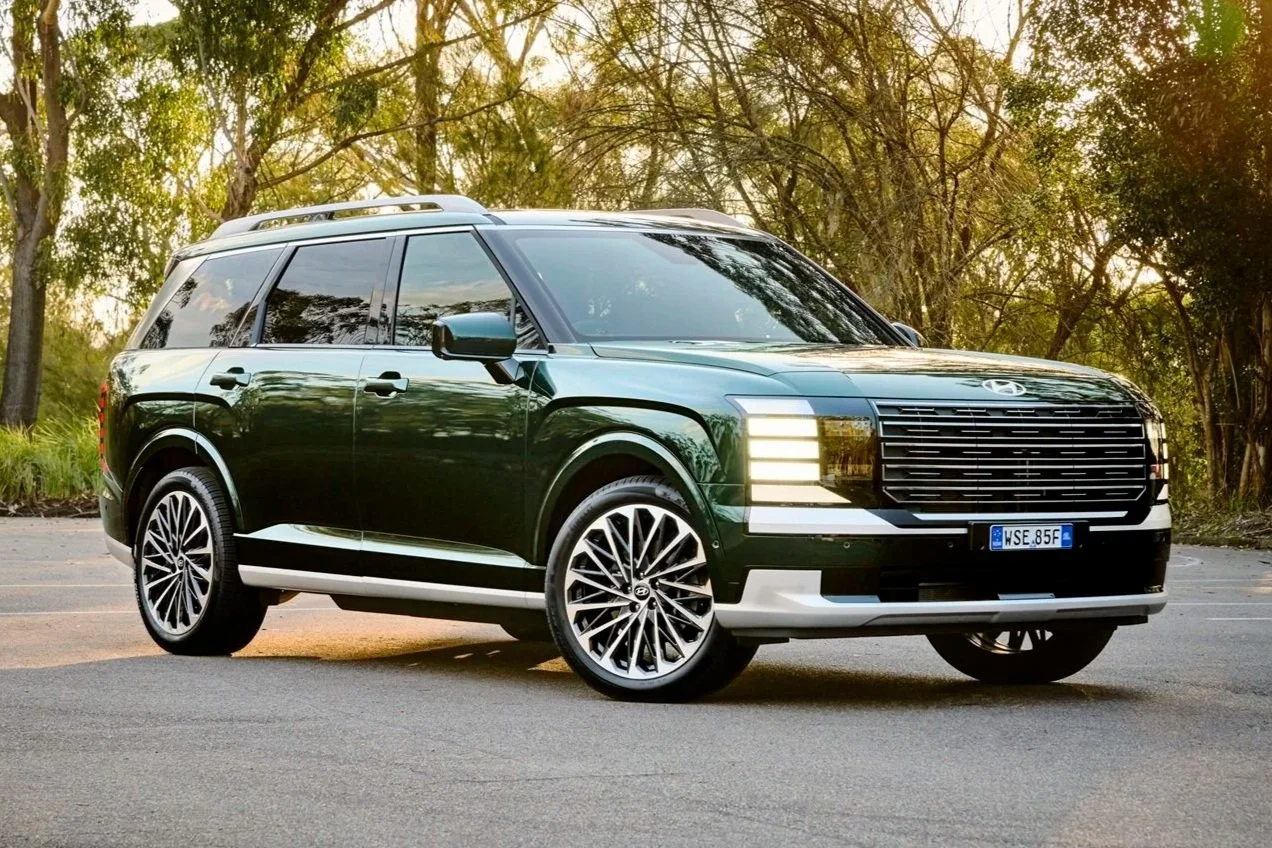
HYUNDAI PALISADE (Calligraphy, hybrid)
Good for that family where you have kids but they’re almost beyond child restraints and can dress themselves, feed themselves and so on. Especially if you don’t want to be seen in a people-mover.
You can option Palisade as a 7-seater with row-2 walk-thru access to row 3, or you can straight-up have it as an 8-seater in a 2-3-3 configuration front-to-rear.
About $40,000 cheaper than a Toyota LandCruiser 300 with about 300-400kg less of heavy duty hardcore off-road drivetrain to drag around in the suburbs or on the freeway.
Engine: 2.5L turbo-petrol 4-cyl, 1.65kWh Li-ion battery + 54kW AC motor
Power: 245kW (combined) | Power-weight ratio: 112kW/t (approx.)
Dimensions: L: 5060mm | W: 1980mm | H: 1805mm | Wheelbase: 2970mm | Ground clearance: 187mm | Kerb wt.: 2185kg
Luggage: 2081L (rows 1 up), 712L (row 2 up), 300L (Rows 1, 2 & 3 up)
CLICK HERE FOR MORE ON HYUNDAI PALISADE >

KIA SORENTO (hybrid)
Engine: 2.5L turbo-petrol 4-cyl, 1.65kWh Li-ion battery + 54kW AC motor
Power: 245kW (combined) | Power-weight ratio: 112kW/t (approx.)
Dimensions: L: 4815mm | W: 1900mm | H: 1700mm | Wheelbase: 2815mm | Ground clearance: 176mm | Kerb wt.: 2014kg
Luggage: 2011L (rows 1 up), 608L (row 2 up), 179L (Rows 1, 2 & 3 up)
CLICK HERE FOR MORE ON KIA SORENTO >

TOYOTA KLUGER (Grande hybrid AWD)
Engine: 2.5L non-turbo petrol 4-cyl, 1.65kWh Li-ion battery + 88kW AC motor
Dimensions: L: 4966mm | W: 1930mm | H: 1755mm | Wheelbase: 2850mm | Ground clearance: 208 mm | Kerb wt.: 2090kg
Luggage: 241 L (rows 1, 2 & 3 up), 552L (row 1 & 2 up), 1150L (row 1 up)
Power: 184kW (combined) | Power-weight ratio: 89 kW/t
CLICK HERE FOR MORE ON TOYOTA KLUGER >

MAZDA CX-90 (Azami diesel)
Engine: 3.3L turbo-petrol 6-cyl
Dimensions: L: 5100mm | W: 1994mm | H: 1745mm | Wheelbase: 3120mm | Ground clearance: 206mm | Kerb wt.: 2241kg
Luggage: 608L (rows 1, 2 & 3 up), 1163L (row 1 & 2 up), 2025L (row 1 up)
Power: 254kW (combined) | Power-weight ratio: 83kW/t | Torque: 550Nm from 1500-2400 RPM
CLICK HERE FOR MORE ON MAZDA CX-90 >
CONCLUSION
In the context of buying a new SUV, the Santa Fe is awesome value, and minimal compromise in the context of what others sacrifice versus their price.
Meaning, you don’t always get more when you pay more, and often when you pay less, you get a lot less. Kluger, for example costs more, but doesn’t offer more, proportionately. Mazda CX-90 costs much more, and it’s the same story.
Chery Tiggo 9 costs less, but you get less in terms of historical reliability, brand technical support and commercial viability long-term. An Outlander costs less, but you literally get less car.


Mazda CX-90 is a very good thing to drive with its powerful turbocharged petrol or turbo-diesel 3.3-litre inline 6-cylinder SkyActiv engine, it’s crammed with creature comforts and an interior worthy of the brand snobs.
The boot (which includes third row seating) is massive, but filling it with kids and stuff for a week away in the hills means you’re burdened with a maximum 80km/h crawl home in the pouring rain in the event of a tyre puncture. Have fun catching pneumonia, won’t you?
The Kia Sorento does so much right, (especially where the Mazda is limited) thanks to a full-size spare wheel, a torquey 2.2 diesel ideal for paring with its 2000kg towing capacity.
Hyundai Santa Fe, unlike its bigger brother the Palisade, doesn’t get third row ISOFIX child restraint anchor points, so you’re limited to two in row 2, and no anchorage points in row 3.
But you get so much other additional equipment at such a compelling price point, especially in the Highlander compared with other notionally ‘luxury’ German SUVs. Tyre pressure monitoring has been a standard feature on Santa Fe for years now, but it’s still a pricey extra on ze others.
If you have next-to-zero towing aspirations, Palisade might be the better option if money isn’t a barrier and your grown teenage kids prefer bling and having their white-bread crusts cut off.
Otherwise, Santa Fe is arguably the best all rounder in the field with decent off-road performance and exceptional on-road dynamics and handling, especially thanks to that super-refined diesel and dual-clutch combination. It’s so good, I put my money where my mouth was and bought one.
The wise money is on Santa Fe, but good luck using logic an reason to argue against its dizygotic twin, the Sorento. It’s that good.

MORE REPORTS



Hyundai Tucson looks futuristic and drives very nicely on Australian roads. It offers grunty, reliable engines, plenty of features and 5-seat practicality at a modest price that makes it an ideal, safe family SUV.