Choosing and Using Blowtorches in the Home Workshop
A blowtorch is one of the most versatile heat tools you can have in a home workshop. Whether you are working on vehicles, fabricating parts, repairing equipment, or simply dealing with stubborn fasteners, having a controllable flame dramatically expands what you can do.
The challenge for most people is choosing the right torch. There are several fuels, multiple torch designs, and two main oxidiser systems (air or oxygen). Understanding how these differences affect heat output and usability makes it much easier to choose equipment that actually fits your workshop needs.
This guide outlines the main types of workshop blowtorches and what they are best used for.
Get 25% OFF these Hot Devil blow torches at AUTO ONE
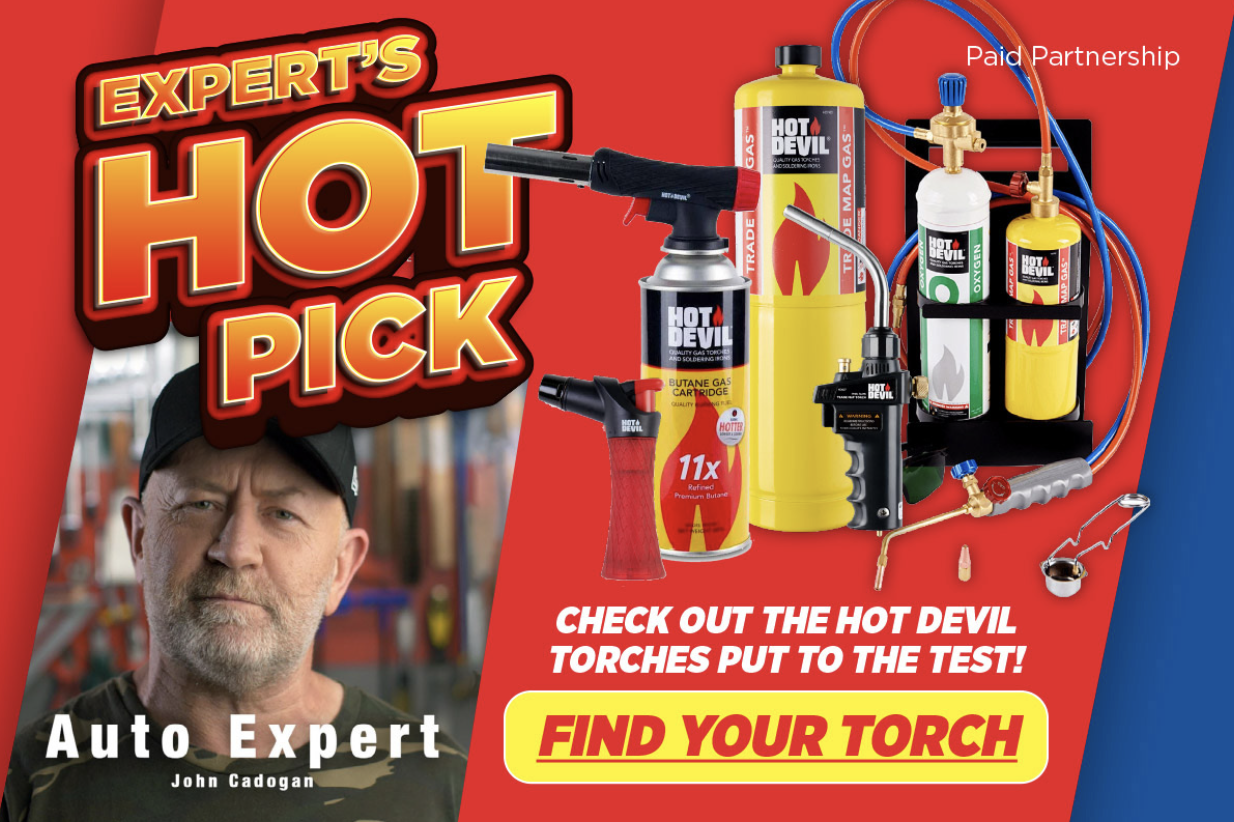
Offer ends midnight, March 8, 2026. Terms and conditions apply. Order online. In-store collection only.
Butane Gas Blow Torch: https://bit.ly/jc-hd-butane-H09B
(Most compact & portable option.)Professional Butane Blow Torch: https://bit.ly/jc-hd-pro-blowtorch-HD910 (Excellent ‘moderate heat’ option.)
Trade Map Swirl Flame Torch: https://bit.ly/jc-hd-swirl-HD027
(Hardcore DIY option - super versatile and very hot for air-fuel.)Brazing Torch Kit: https://bit.ly/jc-hd-brazing-HDBTK
(Maximum concentrated heat - without breaking out the ‘industry’ tools.)
Why a Blowtorch Is Useful in the Shed
Heat is an extremely useful workshop tool. Many processes become simpler, faster, or even possible only when heat is applied.
Typical workshop uses include:
Heat-shrink tubing and electrical work
A small torch quickly shrinks tubing for wiring repairs and cable terminations.
Soldering
Blowtorches can handle soldering tasks ranging from electronics to plumbing.
Freeing seized fasteners
Heating bolts or nuts expands the metal and softens thread-locking compounds like Loctite.
Hot forming steel
Heating steel allows it to be bent or shaped without damaging the material or the tools holding it.
Heat treatment
Medium- and high-carbon steels can be hardened and tempered using a torch.
Hot bluing
Low-carbon steel parts can be heated and quenched in oil to create a corrosion-resistant oxide finish.
Brazing and silver soldering
Many repairs — particularly on cast iron — are easier with brazing than welding.
These jobs span a wide range of heat requirements. The type of torch you choose determines how effectively you can do them.
Understanding Torch Fuels
The main fuel gases used in small workshop torches are:
Butane
Propane
MAP-Pro (modern replacement for MAPP gas)
All three burn in air by default, although some systems can also be used with pure oxygen.
Butane
Butane torches are typically small and inexpensive. They are commonly used for light-duty tasks such as:
Heat-shrink tubing
Small soldering jobs
Light heating work
A typical butane torch flame reaches roughly 1,300–1,350 °C.
However, butane has a limitation: vapour pressure drops significantly in cold conditions. Below roughly 10–15 °C, sustained output can become unreliable. This makes butane less suitable for outdoor winter work in colder climates.
For indoor or warm-climate workshops, however, small butane torches remain extremely convenient.
Propane vs MAP-Pro
Propane is widely available and works well for many heating tasks. However, MAP-Pro generally provides better performance in workshop applications.
MAP-Pro offers several advantages:
Higher flame temperature
Faster flame speed
Better heat concentration
Wider operating temperature range
In practical terms, this means work gets done faster and larger parts can be heated effectively.
For most workshop users, MAP-Pro represents a useful step up from butane without adding significant complexity.
Air-Fuel Torches
Most portable workshop torches burn fuel using atmospheric air as the oxidiser.
Air contains roughly 21 % oxygen, with the remainder mostly nitrogen. During combustion, the nitrogen does not participate in the reaction but still absorbs heat.
This limits the maximum achievable temperature. Typical flame temperatures are roughly:
FuelApprox Flame Temperature (Air)Butane~1,350 °CPropane~1,980 °CMAP-Pro~2,000 °C
Many modern torches use swirl flame burners, which spin the gas flow and concentrate heat into a tighter flame. This improves heat transfer to the workpiece.
Air-fuel torches are simple, portable, and safe enough for most home workshop applications.
Oxy-Fuel Torches
For significantly higher heat output, the oxidiser can be switched from air to pure oxygen.
Using oxygen dramatically increases flame temperature because the nitrogen present in air is removed from the combustion process.
Typical advantages include:
Much hotter flame
More concentrated heat
Better precision
Faster heating
Oxy-fuel flames can be roughly 1,000 °C hotter than air-fuel flames, depending on the fuel used.
This allows:
Heavier brazing work
Faster heating of large parts
More precise flame control
The trade-off is increased complexity and cost, since oxygen must be supplied from a cylinder.
Full industrial oxy-fuel systems (for example oxy-acetylene or oxy-propane setups) involve regulators, hoses, flashback arrestors, and large cylinders. These systems are excellent but often excessive for casual workshop use.
Small portable oxy-fuel kits using MAP-Pro provide a practical middle ground for DIY users who occasionally need higher heat output.
Need a FULL-TILT ‘propellerhead’ deep dive on blow torch fuels and oxidisers? Watch this video:
Choosing the Right Torch
For most home workshops, torch needs generally fall into three tiers.
1. Small Butane Torch
Best for:
Electrical work
Heat-shrink tubing
Light soldering
Small heating tasks
Advantages:
Compact
Inexpensive
Easy to refill
Limitations:
Limited heating power
Reduced performance in cold weather
2. Larger Butane or MAP-Pro Air Torch
Best for:
General workshop heating
Loosening fasteners (MAP-Pro)
Heat treating smaller parts (Butane)
Hot bluing (MAP-Pro)
Light brazing (MAP-Pro)
Advantages:
Much higher heat output (Esp MAP-PRO)
Still simple and portable
Suitable for most DIY workshop work (no special training required)
For many users, this type of torch provides the best balance between performance, cost, and simplicity.
3. Portable Oxy-Fuel Torch
Best for:
Heavier brazing
Larger heat-treating jobs
Fast heating of thicker parts
More precise flame control
Advantages:
Significantly higher temperatures
Smaller, more focused flame
Faster work on heavier components
Limitations:
Requires oxygen cylinders
Higher running cost
More complex equipment
A Practical Torch Operating Tip
With most torches, the best approach is to run the torch at full output and control heat by adjusting distance from the workpiece.
Throttling the torch down excessively can sometimes cause burn-back, where the flame retreats into the burner. Over time this can damage ignition components such as piezo starters.
Using full output generally produces a cleaner, more stable flame.
The Bottom Line
A blowtorch is one of the most useful heat tools in any home workshop. It enables processes that would otherwise require large industrial equipment or specialised machinery.
For most DIY users:
A small butane torch handles light tasks.
A MAP-Pro air torch covers the majority of fabrication and repair work.
A portable oxy-fuel setup adds the capability for heavier heating and brazing.
Choosing the right torch — and understanding how fuel and oxidiser affect performance — allows you to work faster, expand your fabrication options, and tackle repairs that would otherwise be difficult or impossible.