Volvo slashes EX30 electric car driving range by 30% to limit fire risk
RESOURCES
I will save you thousands on your next new car (in Australia) here
I’ll take the guesswork out of home solar with a quality system that won’t break the bank here
Volvo EX30 recall - official Australian Government recall listing
Is your car affected? Download the affected VIN list.
ChatGPT’s summary of Australian Consumer Law and refund entitlement as it relates to this recall, plus ChatGPT’s suggested drafts of correspondence to Volvo Car Australia and the dealer which sold you the vehicle. (My advice would be to do everything in writing from this point onward if you want a refund.) Download here. (This is just information - not advice.)
TRANSCRIPT
In this video: Quite possibly the most hilarious recall of 2026 (big call, I know) but only if you don’t actually own the affected vehicle.
This is emblematic of the gulf between EV ownership (the promise) and EV ownership (the reality).
It’s also 100 per cent ‘Keystone Cops’ from the perspective of regulatory framework and enforcement. They get away with it because: Net Zero, dude - nothing gets in the way of ideology as powerful as that.
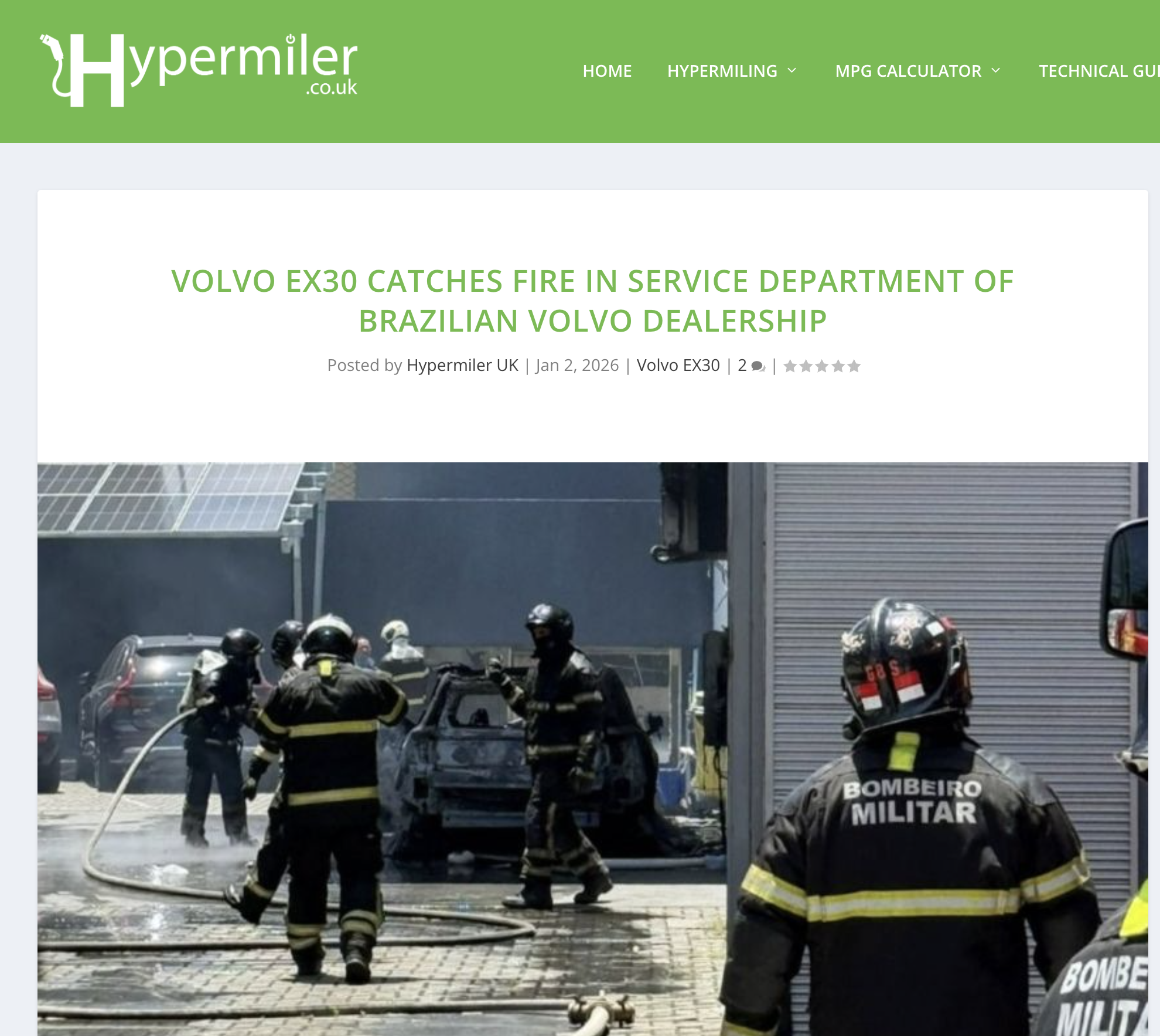
This is the aftermath of the EX30 fire in Brasil recently
Volvo is recalling EX30 compact EVs. Because they might burn to the ground without warning and kill you (or your family, the neighbours, mother-in-law - whatever). This could occur without all that much provocation from you. All you have to do is charge them fully. I’m tipping this was not in the brochure at point of sale.
2815 EX30s are being recalled. Volvo claims in official recall documentation that these are 2024 models, although official industry sales figures here reveal that only 2129 EX30s were sold in 2024.
This is just the Australian component of a much larger global EX30 recall. Apparently they’re all pooping in their duds, potentially.
The bottom line there is that if you bought one in the second half of 2023, or the first half of 2025 you might be up Faeces Creek without propulsion - so go to the recalls page linked in the description and download the VIN code list - it’s the only way of being definitively certain.
In its online Q&A, Volvo makes various ironic claims about the EX30, such as (quote): “Is the Volvo EX30 a safe car? The EX30 may be small, but it’s as safe as you’d expect from a Volvo SUV. We’ve applied our industry-leading standards of protective safety and added new features. Learn more about our safety heritage.” Source.
To me this is perverse because in the recall document it claims:
“Due to a manufacturing issue, the cell modules installed in the high voltage battery may overheat at high charge levels. If this occurs, it could lead to a vehicle fire.”
That doesn’t sound good - for you, or net zero. Presumably this could lead to potential consequences?
“A vehicle fire could increase the risk of injury or death to vehicle occupants, other road users and bystanders, and/or damage to property.”
I’m sensing a disconnect between the earlier claim (as safe as you’d expect from a Volvo SUV), and what they had to say in the recall statement. (Injury or death to you inside, the people sharing the road with you, and bystanders.) Because, you know, these batteries, when they burn, toxic, carcinogenic shit-storm.
So the EX30 seems a bit more ‘Ford Pinto’ on the heritage front, I think it’s fair to say.
(For anyone born since the 1990s the Ford Pinto is a classic. A classic piece of shit, designed hastily to burn its occupants to death in a low-speed rear-ender. Ford knew all about the defect and decided it was better to let a few people die than spend money fixing it. They were the Volkswagen of the 20th Century.) Source
The EC30 incinerating you and the kids to death while it saves the planet: The burning question (see what I did there?) is: exactly how are we rectifying the problem?
“Until a remedy is made available owners should keep the battery charge level below 70%. This can be set in the Charging setting menu in the vehicle display.”
That’s everything a girl could hope for, isn’t it? What a well thought out solution. Not exactly how we got the crew of Apollo 13 back, but ‘net zero’!
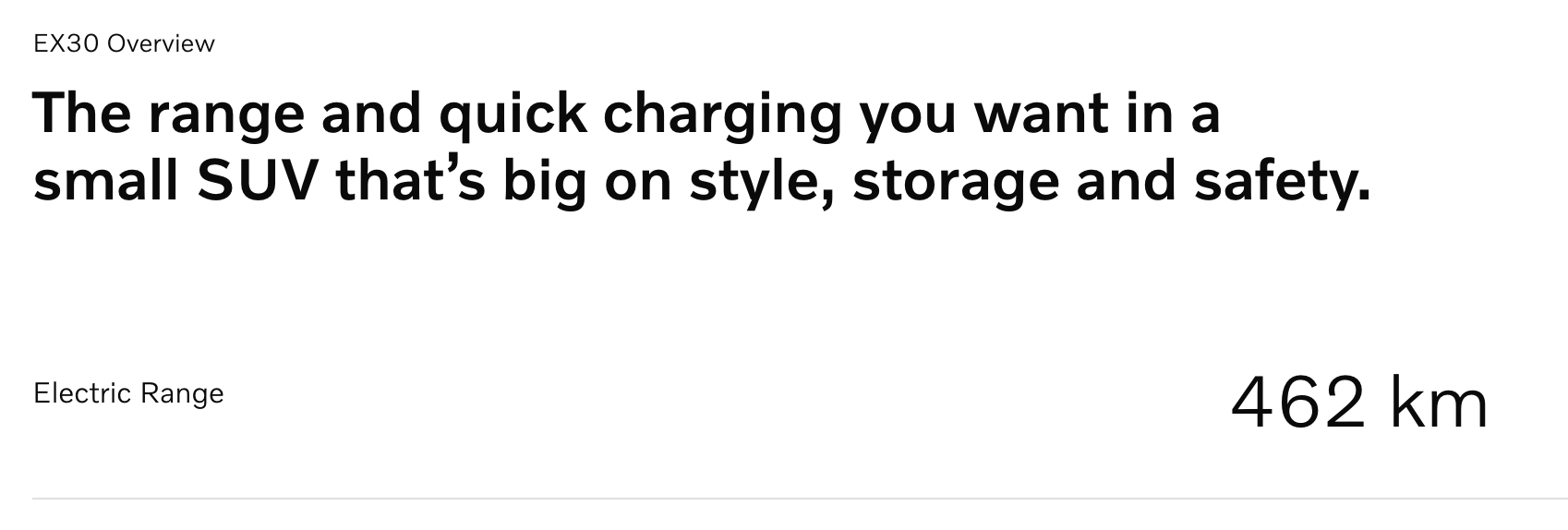
Volvo claims the range of the EX30 is a generous 462km - that’s according to the bullshit WLTP range test, so in the real world, it probably gets 350km on a good day, with the air conditioning off and not driving at more than about 85 kays an hour on the freeway.
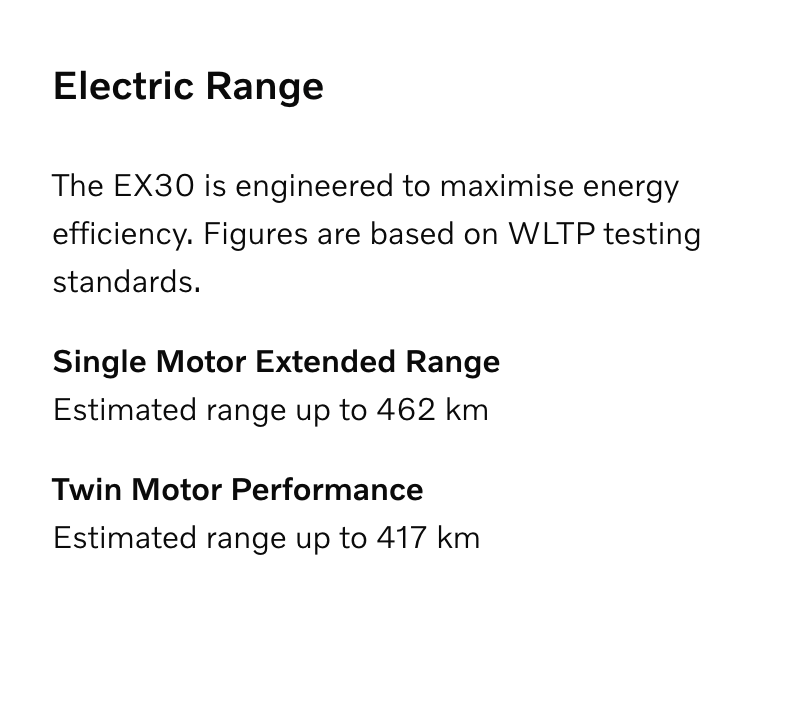
That’s with 100 per cent charge, obviously. With 70% charge: 250km. So you’re not even getting from Sydney to Canberra in that $74,000 fake-Swedish shitbox. (Volvo is Chinese-owned. Has been for more than a decade.)
Apparently there’s no fix in sight. But clearly the thing that needs to happen is - they need to replace the battery pack. Clearly.
But the problem with that is cost, plus the fact that Volvo’s owner, Geely, is suing the battery manufacturer, Sunwoda, for doing an emphatically shit job, as reported here by CarNewsChina.com.
(If you buy that purportedly Swedish EX30, it’s actually a Chinese car - like, it’s made there. The only thing you don’t get is the typically low Chinese price.)
Sunwoda is a battery manufacturer you’ve probably never heard of, which makes batteries for the EX30. And this is a $300 million (US dollar) lawsuit against Sunwoda for a similar issue, from another Geely subsidiary, Zeekr)
From CarNewsChina: “According to a public announcement released by Sunwoda on December 26, 2025, the company’s subsidiary Sunwoda Power Technology received legal documents from the Ningbo Intermediate People’s Court in Zhejiang Province on December 25, including a civil complaint (Case No: (2025) Zhejiang 02 Civil First Instance No. 1870).
“The plaintiff, Viridi E-Mobility Technology (Ningbo) Co., Ltd., alleges that battery cells delivered by Sunwoda between June 2021 and December 2023 had quality problems that resulted in substantial financial losses. Viridi is seeking compensation of 2,31billion yuan (323 million USD), plus interest calculated at the market lending rate from the date of filing until actual payment.
“Viridi E-Mobility Technology is a wholly-owned subsidiary of Geely Holdings Group, specializing in the research, development, manufacturing, and sales of power batteries, electric drive systems, charging systems, and energy storage systems for new energy vehicles. Their products are used in various premium brands, including Zeekr, Volvo, and Lotus.”
I just checked: Sunwodaq definitely makes the cells for at least some EX30s, and the fact that they’re recalling every Australian-sold one suggests strongly it’s a ‘poorly built battery pooping its pants’ problem, which is strongly suggestive of a ‘cell provider’ problem.
Again, from CarNewsChina: “In an interview with Jiupai News on January 14, (Big) Wang (the Cheese of Sunwoda) clarified that the battery packs in question were not directly supplied by Sunwoda. “The battery packs were actually provided by factories within Volvo’s own system,” (Big) Wang explained. He further noted that while the battery cells were manufactured by a joint venture between Geely and Sunwoda (Shandong Geely Sunwoda Co., Ltd.), Sunwoda holds only a minority 30% stake in this venture.”
OK - sounds like ‘that’s not us. It’s only 30% us.
Here’s more from CarNewsChina: “According to auto media Hypermiler, Volvo has confirmed that 10,440 EX30 vehicles in the UK market are affected by potential safety hazards in Sunwoda’s high-voltage batteries. This is part of a broader issue involving 33,777 EX30 vehicles produced with Sunwoda battery cells, where approximately 0.02% of cells have reportedly overheated.”
Substantially better odds than winning Lotto - just saying. But the prize sucks - always the way. The sure thing…
“The situation became more urgent after a Volvo EX30 caught fire at a dealership in Maceió, Brazil in November 2025. The vehicle was completely destroyed, requiring 11 firefighters and four fire trucks to extinguish the blaze.”
How exciting to be a firefighter in the era of net zero.
“In response, Volvo has issued urgent warnings to owners in markets including the UK, US, Australia, and South Africa, instructing them to limit charging to 70% capacity to reduce fire risk while a comprehensive recall plan is prepared.”
Bottom line: Choose the cheapest supplier, screw them right down on price. WTF do you suppose might happen? But, all good because we can charge ignorant punters as if we’re still a premium European carmaker. Which makes you a golden goose if you buy a Volvo today, I would argue.
So, Volvo sold 33,777 flamethrower edition EX30s globally, of which 2815 came here, entertainingly.
They implicitly promised you 100 per cent battery capacity (because this is how the range is determined), but now they have reduced that to 70% for an indefinite period.
Australian consumer law says - in s56 - that goods must match the description.
The description includes range - which is based on being able to achieve 100 per cent charge, and this is a core attribute of the decision-making process for many EV buyers.
Like: would you have bought that car had you known the range would be indefinitely reduced to 70 per cent? Would you have paid the same price if you did buy it?
Given that this is an exquisitely half-baked recall - it’s not hypothetical, there’s already been one self-immolate, there’s no fix, and no proposed timeline for a fix, the vehicle appears to be in breach of the legislated consumer guarantees, and it’s clearly a pretty low-quality shitbox on fundamentals (because high-quality shitboxes don’t come with free fire and brimstone).
Are you in line for a refund? Because this is the legislated remedy under Australian Consumer Law, if the defect or problem is serious.
So I asked my lawyer where you might stand on this. And by ‘My Lawyer’ I mean ‘ChatGPT’. Do I look like I’m made of lawyers?
My “lawyer” told me:
Short answer: you have a strong ACL argument, but a full refund is not automatic. Whether it crystallises into a major failure (and therefore a refund) depends on how a regulator or court characterises the 70% charge cap and Volvo’s lack of a defined remedy timeline.
And the strongest claim to get a refund over the line is:
Advertising EV range at 100% SOC is not incidental
This is the key point in your favour.
An EV’s advertised range is:
a core functional attribute, not a peripheral feature
directly tied to purchase decisions
repeatedly used in marketing, comparison tools, and spec sheets
If Volvo advertised (explicitly or implicitly):
WLTP range based on 100% usable battery
normal charging to 100% as part of standard operation
…then permanently or indefinitely limiting the vehicle to 70% SOC means: The goods no longer match their description and arguably no longer meet acceptable quality. This is not a “minor inconvenience” like a software feature being delayed.
This is not a lay-down misere, however. They’re not going to bend over and capitulate if you drive in without burning to death and demand a refund. They will certainly push back.
So if ‘full refund’ is the path you choose to pursue, you should start now doing everything in writing. I’ll put a link in the description where you can download the full consumer law analysis - ChatGPT is not a lawyer, but it’s a pretty good primer on a discussion you might have with a lawyer. It’s a PDF.
I’ll also put in the description a draft of ChatGPT’s suggested letter you should write to Volvo and the dealer who sold you that appalling shitbox, plus follow-ups when they ignore you and/or drag their heels, hoping you’ll just piss off.
I hope you don’t burn to death in your absurd ‘net zero’ chariot. Hopefully you can put this ugliness behind you. Far better to go out in a hot tup full of cheerleaders. Or chased relentlessly for several days - possibly weeks - through the forest by topless barmaids. (My preferred options.) Better to die with a smile on your face, doing something you love, dude.